Origins of Pompeii-style artefacts examined at ISIS
February 20, 2009 Origins of Pompeii-style artefacts examined at ISIS

Enlarge

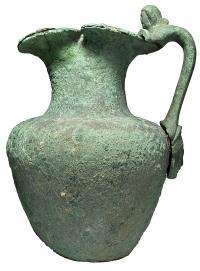
Roman jug. Courtesy: Oxford Archaeology

(PhysOrg.com) -- Roman artefacts which are nearly two thousand years old with similarities to ancient remains found at Pompeii in Italy will be examined at the Science and Technology Facilities Council’s ISIS neutron source this weekend. (21-22 February 2009). Researchers hope to learn more about our heritage by discovering whether the items were imported from southern Italy, or manufactured using similar techniques in Britain.

The bronze artefacts, which include a wine-mixing vessel, jugs and ceremonial pan-shaped objects, were discovered in Kent in two high status Roman pit-burials that are among the best examples ever seen in Britain. Previous excavation in an area close to the A2 where the items were found - by construction group Skanska Civil Engineering during a Highways Agency road improvement scheme - had predicted archaeological discoveries, but they were bigger than expected, with settlements ranging from the Bronze Age to the late medieval period.

Archaeological scientists will compare the 1st Century AD artefacts from Kent with those from Pompeii in Italy. The neutron beams at the world-leading ISIS facility allow for detailed crystal structure analysis of intact delicate objects without cutting out a sample of the material.

Dana Goodburn-Brown, a conservator and ancient metals specialist commissioned by Oxford Archaeology, is analysing the artefacts along with archaeological scientist Dr. Evelyne Godfrey at ISIS to see how they were made. It is hoped the experiments will answer many questions about how the items were made to give more insight into their origin: for example, the metals used in manufacturing, how they were cast and finished, and how metal pieces were joined together.

"Our experiments will hopefully aid us in characterising different Roman metalworking practices and perhaps recognising the distinction between imported south Italian goods and high standard copies produced by skilled local craftsman. These artefacts represent a time of great change in Britain - they appear shortly after the Romans arrived in this country, and may represent locals taking on cultural practices of these 'newcomers'," Dana Goodburn-Brown said.

Dr Andrew Taylor, ISIS Director said: "For these rare and highly-valued objects, analysis with neutrons can give fantastic insight. Neutrons are a very powerful way to look at matter at the molecular level and they give unique results that you can’t easily get with any other technique. The measurements are extremely delicate and non-destructive, so the objects are unharmed by the analysis and can be returned to the museums unscathed.

"The neutron beams we have at ISIS are a very versatile research tool and we’re always keen to help researchers answer a broad range of questions. Here we realised that we could take the same analysis methods we developed to look at parts of aircraft and power plants and use them to help archaeologists understand how ancient objects were traded and manufactured."

Provided by Science and Technology Facilities Council


print this article email this article download pdf blog this article bookmark this article     Stumble it Digg this share on Facebook retweet share on Reddit add to delicious
Rate this story - 4.3 /5 (3 votes)


February 20, 2009 all stories

Comments: 0

4.3 /5 (3 votes)
  • Stumble this up

  • Digg this

  • share this

  • hide
  • Related Stories

  • The court will now call its expert witness: the brain
    created Nov 20, 2009 | popularity not rated yet | comments 0
  • Technology brings new insights to ancient language
    created Oct 14, 2009 | popularity not rated yet | comments 0
  • Blinkx at work on search engine for online video
    created Sep 02, 2009 | popularity not rated yet | comments 0
  • Mathematicians set world record in packing puzzle
    created Aug 12, 2009 | popularity not rated yet | comments 0
  • Galaxy Zoo Hunters Help Astronomers Discover Rare 'Green Pea' Galaxies
    created Jul 27, 2009 | popularity not rated yet | comments 0


  • hide
  • Relevant PhysicsForums posts

  • Is it true that
    created 2 hours ago
  • Selenocysteine in pH=7
    created Nov 26, 2009
  • What is the formula for calculating the speed of thought?
    created Nov 26, 2009
  • What does word "absorption" mean in the intestine?
    created Nov 26, 2009
  • More from Physics Forums - Biology

Other News

Researcher: Faint writing seen on Shroud of Turin (AP)

Researcher: Faint writing seen on Shroud of Turin (Update)

Other Sciences / Archaeology & Fossils

created Nov 20, 2009 | popularity 2.4 / 5 (34) | comments 52

(AP) -- A Vatican researcher has rekindled the age-old debate over the Shroud of Turin, saying that faint writing on the linen proves it was the burial cloth of Jesus. Experts say the historian may be reading ...


Living buildings could mop up carbon dioxide

Living buildings could mop up carbon dioxide

Other Sciences / Other

created 17 hours ago | popularity 1 / 5 (2) | comments 1

(PhysOrg.com) -- Architecture could help us tackle climate change, if we start to design our buildings with 'living' materials, according to Dr Rachel Armstrong, UCL Bartlett School of Architecture.


Climate change could boost incidence of civil war in Africa

Other Sciences / Social Sciences

created Nov 23, 2009 | popularity 2.4 / 5 (16) | comments 10

Climate change could increase the likelihood of civil war in sub-Saharan Africa by over 50 percent within the next two decades, according to a new study led by a team of researchers at University of California, Berkeley, ...


Explained: The Discrete Fourier Transform

Explained: The Discrete Fourier Transform

Other Sciences / Mathematics

created Nov 25, 2009 | popularity 4.1 / 5 (27) | comments 8

(PhysOrg.com) -- In 1811, Joseph Fourier, the 43-year-old prefect of the French district of Isčre, entered a competition in heat research sponsored by the French Academy of Sciences. The paper he submitted ...


Political views may skew perception of skin tone, new study finds

Other Sciences / Social Sciences

created Nov 24, 2009 | popularity 3.6 / 5 (5) | comments 7

(PhysOrg.com) -- Political affinity could influence how some people view the skin tone of biracial political candidates, according to a new study from the University of Chicago Booth School of Business, New York University ...