'Cyber footballers' cloned
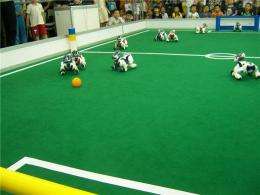
A team of IT scientists from the Carlos III University in Madrid (UC3M) has managed to programme clones that imitate the actions of humans playing football on a computer, according to the online version of the journal Expert Systems with Applications. The clones learn the players' behaviour and apply this knowledge in order to avoid their opponents and score goals.
"The objective of this research is to programme a player, currently a virtual one, by observing the actions of a person playing in the simulated RoboCup league," Ricardo Aler, one of the authors of the study and a researcher in the Computer Sciences Department of the UC3M, tells SINC.
RoboCup is an international football championship held to promote the development of artificial and robotic intelligence. The competition's promoters are trying to develop a team of totally autonomous robots able to beat the best team of human footballers by 2050. "It's like what happened with the Deep Blue computer when it managed to beat Kasparov at chess in 1997," says Aler.
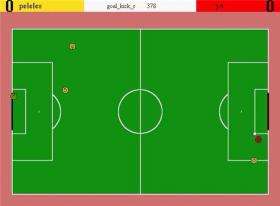
The researcher explains that there are various leagues within RoboCup, including a league of real robots, but that his team participates in the simulation league, using a software model called Robossocer. "The human player plays Robosoccer as if it were a video game, and the system observes both the stimuli that the person is receiving from the screen as well as the actions he or she is carrying out on the keyboard in order to shoot or pass the ball," he adds.
Later, the researchers use automatic learning techniques in order to construct this person's model of play, and this model is used to create the "clone agent", which imitates the human player. The results of the study, published in the online version of the journal Expert Systems with Applications, show that the cloned player is able to tackle opponents and score goals in the opposing goal, in a similar way to human players.
Both the real and virtual robots in the Robocup league are normally programmed by hand by researchers, but the Spanish scientists are aiming to do this automatically. Although they have so far managed to get the clones to a point where they can carry out "low level" actions, such as moving forward, turning and shooting, their objective is to ensure they can learn "high level" actions, such as tackling or passing the ball to the most appropriate team member. In addition, they want to give the models human cognitive capacities such as being able to remember or predict the position of the ball or an opponent.
One of the fundamental ideas behind this study was that it is more interesting for a human player to challenge an opponent with the same level of skills and disadvantages, rather than playing against an adversary with robotic behaviour.
This type of study falls within a field of computer science called behavioural cloning. The objective of this discipline is to construct a model for a clone agent that can learn from the behaviour of the other agent (which may be human) by observing the stimuli this agent receives and the actions it takes in response to them.
The first studies on this subject showed that a system of neuronal networks can learn to drive a vehicle by observing a driver (ALVINN project), or to control a flight simulator by analysing the behaviour of a pilot. Today, the use of behavioural cloning is also being researched in Internet-based videogames, as well as in competitions such as RoboCup.
The last international robotic football championship event was held in Suzhou, China, and the next one will be held this summer in Graz, Austria, alongside RoboCup Rescue, a simultaneous competition based developing robots designed to help rescue people in natural disasters.
On the web: www.plataformasinc.es
Provided by Plataforma SINC, Spain


