Safer nanoparticles spotlight tumors, deliver drugs
February 22, 2009 Silicon Nanoparticles

Enlarge

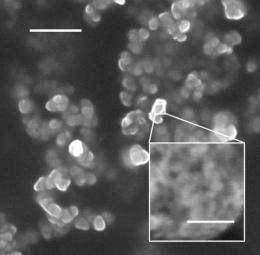
This is a microscopic view of silicon flakes designed to deliver drugs, then dissolve away. Credit: Luo Gu

(PhysOrg.com) -- Small is promising when it comes to illuminating tiny tumors or precisely delivering drugs, but many worry about the safety of nano-scale materials. Now a team of scientists has created miniscule flakes of silicon that glow brightly, last long enough to slowly release cancer drugs, then break down into harmless by-products.

"It is the first luminescent nanoparticle that was purposely designed to minimize toxic side effects," said Michael Sailor, a chemistry professor at the University of California, San Diego who led the study.

Many nanoparticles tested in research labs are too poisonous for use in humans.

"This new design meets a growing need for non-toxic alternatives that have a chance to make it into the clinic to treat human patients," Sailor said.

The particles inherently glow, a useful property that is most commonly achieved by including toxic organic chemicals or tiny structures called quantum dots, which can leave potentially harmful heavy metals in their wake.

When the researchers tested their safer nanoparticles in mice, they saw tumors glow for several hours, then dim as the particles broke down. Levels dropped noticeably in a week and were undetectable after four weeks, they report in Nature Materials February 22.

This is the first sudy to image tumors and organs using biodegradable silicon nanoparticles in live animals, the authors say.

The particles begin as thin wafers made porous with an electrical current then smashed to bits with ultrasound. Additional treatment alters the physical structure of the flakes to make them glow red when illuminated with ultraviolet light.

Luminescent particles can reveal tumors too tiny to detect by other means or allow a surgeon to be sure all of a cancerous growth has been removed.

These nanoparticles could also help deliver drugs safely, the researchers report. The cancer drug doxorubicin will stick to the pores and slowly escape as the silicon dissolves.

"The goal is to use the nanoparticles to chaperone the drug directly to the tumor, to release it into the tumor rather than other parts of the body," Sailor said.

Targeted delivery would allow doctors to use smaller doses of the drug. At doses high enough to be effective, when delivered to the whole body, doxorubicin often has toxic side effects.

At about 100 nanometers, these particles are bigger than many designed to deliver drugs, which can be just a few nanometers across - a thousand times smaller than the diameter of a human hair.

Their larger size contributes to both their effectiveness and their safety. Large particles can hold more of a drug. Yet they self-destruct, and the remnants can be filtered away by the kidneys.

Close examination of vulnerable organs like liver, spleen and kidney, which help to remove toxins, revealed no lasting changes in mice treated with the new nanoparticles.

Video available: http://ucsdnews.ucsd.edu/video/safenano.html

Source: University of California - San Diego


print this article email this article download pdf blog this article bookmark this article     Stumble it Digg this share on Facebook retweet share on Reddit add to delicious
Rate this story - 4.8 /5 (6 votes)

Rank Filter

Move the slider to adjust rank threshold, so that you can hide some of the comments.


Display comments: newest first

  • Arikin - Feb 22, 2009
    • Rank: 3 / 5 (1)
    Nice design. Thank you for thinking responsibly.

February 22, 2009 all stories

Comments: 1

4.8 /5 (6 votes)
  • Stumble this up

  • Digg this

  • share this

  • hide
  • Related Stories

  • Nanotechnology: A risky frontier?
    created Nov 05, 2009 | popularity not rated yet | comments 0
  • Discovery offers potential new pancreatic cancer treatment
    created Nov 02, 2009 | popularity not rated yet | comments 0
  • 'Micro shuttle' drug delivery could mean an end to regular dosing
    created Oct 02, 2009 | popularity not rated yet | comments 0
  • Nanodiamonds deliver insulin for wound healing
    created Jul 27, 2009 | popularity not rated yet | comments 0
  • Chasing tiny vehicles -- Microscope shows how nanoferries invade cells
    created Jul 20, 2009 | popularity not rated yet | comments 0


  • hide
  • Relevant PhysicsForums posts

Other News

Engineers image nanostructure of a solid acid catalyst and boost its catalytic activity

Nanotechnology / Nanomaterials

created 7 hours ago | popularity 5 / 5 (1) | comments 2

The catalytic processes that facilitate the production of many chemicals and fuels could become much more environmentally friendly thanks to a breakthrough achieved by researchers from Lehigh and Rice Universities.


New transparent insulating film could enable energy-efficient displays

New transparent insulating film could enable energy-efficient displays

Nanotechnology / Nanomaterials

created 11 hours ago | popularity 4.9 / 5 (7) | comments 0

Johns Hopkins materials scientists have found a new use for a chemical compound that has traditionally been viewed as an electrical conductor, a substance that allows electricity to flow through it. By orienting ...


Ideal nanoparticle cancer therapies surf the bloodstream

Nanotechnology / Bio & Medicine

created 12 hours ago | popularity 5 / 5 (1) | comments 0

Eric Shaqfeh studies blood at Stanford University, using computer models that simulate how the fluid and the cells it contains move around. On November 11 at a meeting of the scientific society AVS, he will present his latest ...


New Digital 'Electronics' Concept May Continue Moore's Law

New Digital 'Electronics' Concept May Continue Moore's Law

Nanotechnology / Nanophysics

created Nov 05, 2009 | popularity 4.6 / 5 (57) | comments 9

(PhysOrg.com) -- Computers of the future could be operating not on electrons, but on tiny waves traveling through an electron "fluid," if a new proposal is successful. The new circuit design, recently introduced ...


Nanoparticles for gene therapy improve

Nanoparticles for gene therapy improve

Nanotechnology / Bio & Medicine

created Nov 06, 2009 | popularity 5 / 5 (5) | comments 3

(PhysOrg.com) -- About five years ago, Professor Janet Sawicki at the Lankenau Institute in Pennsylvania read an article about nanoparticles developed by MIT's Robert Langer for gene therapy, the insertion ...