Using wireless sensors to monitor bridge safety
February 23, 2009 Using wireless sensors to monitor bridge safety

Enlarge

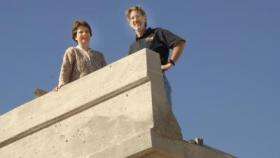
This is principal investigator and chair of the University of Texas Department of Civil, Architectural and Environmental Engineering, Sharon Wood, and University of Texas Department of Electrical & Computer Engineering professor Dean Neikirk. Credit: Erin McCarley

University of Texas (UT) professor, Dean Neikirk, will be field-testing a new bridge monitoring system within the year. The project is a collaboration between industry, government, and academia that will provide real-time monitoring of dangerous bridges and reduce inspection costs for all bridges.

According to the American Society of Civil Engineers, deferred maintenance has left one-quarter of the nation's bridges deficient. Congress mandated 2-year inspections in 1971, but at least 17,000 bridges did not meet the requirement in 2008, including 3 out of every 100 freeway bridges. More alarming, the average age of America's bridges is 43 years out of an average 50-year life span.

"Most bridges have already been built," says Neikirk. "Our project will develop simple, low-cost equipment that can be used to retrofit existing construction as well as in new construction, but we are primarily concerned with ensuring that bridges do not fail without warning. Most aging bridges do not necessarily require replacement, they just need to be monitored for signs of corrosion and wear."

Neikirk and principal investigator and UT Civil, Architectural, and Environmental Engineering Chair Sharon L. Wood are developing a network of low-power wireless sensors capable of capturing and transmitting data to a central location. They already have working sensors, a data collection methodology, and specifications for sensor placement. Researchers are working on (1) powering sensors with solar, wind, or traffic vibrations instead of batteries, (2) ensuring the sensor output is compatible with National Instruments (NI) equipment that will be collecting the data and that NI equipment is rugged enough for outdoor use, and (3) preventing the steel structures from interfering with the radio signals used to transmit data.

"We are resolving the last few technical issues before our field-testing begins—probably within the year and probably in Texas," says Neikirk. "We hope that the immediate effect will be ensuring Texas bridges are inspected more frequently and for much less money. We also hope to partner with a commercial developer who can take this technology and help make it commercially available."

Source: University of Texas at Austin


print this article email this article download pdf blog this article bookmark this article     Stumble it Digg this share on Facebook retweet share on Reddit add to delicious
Rate this story - not rated yet


February 23, 2009 all stories

Comments: 0

not rated yet
  • Stumble this up

  • Digg this

  • share this

  • hide
  • Related Stories

  • Earthquake early-warning system soon to enter testing
    created Oct 20, 2009 | popularity not rated yet | comments 0
  • Implementing sustainable technology to monitor the integrity of the nation's bridges
    created Apr 16, 2009 | popularity not rated yet | comments 0
  • New method for detecting explosives
    created Mar 13, 2009 | popularity not rated yet | comments 0
  • K-State engineers helping develop energy-harvesting radios
    created Dec 16, 2008 | popularity not rated yet | comments 0
  • Researchers make new electronics -- with a twist
    created Nov 19, 2008 | popularity not rated yet | comments 0


  • hide
  • Relevant PhysicsForums posts

  • I wanna build a robot!
    created 7 hours ago
  • Finding Max Moment for triangular load
    created 23 hours ago
  • Dehumidifier from a walk-in freezer unit?
    created Nov 10, 2009
  • Cloak of invisiblity , what kind of applications can it be usefull for
    created Nov 09, 2009
  • More from Physics Forums - General Engineering

Other News

Creating 3D models with a simple webcam

Creating 3D models with a simple webcam (w/ Video)

Technology / Computer Sciences

created 5 hours ago | popularity 5 / 5 (6) | comments 1

(PhysOrg.com) -- Constructing virtual 3D models usually requires heavy and expensive equipment, or takes lengthy amounts of time. A group of researchers at the University of Cambridge, Qi Pan, Dr Gerhard Reitmayr ...


Google Go

Google Go gets going (w/ Video)

Technology / Software

created 14 hours ago | popularity 4.8 / 5 (4) | comments 4

(PhysOrg.com) -- Google has introduced its new experimental programming language Go, which aims to combine speedy application development through simplified coding with high-speed program execution.


Google Wave Client

Many computer users hesitate to ride the Wave

Technology / Internet

created 3 hours ago | popularity not rated yet | comments 2

Google's latest brainchild, Google Wave, is all the rage among bleeding-edge technology enthusiasts. But corporate information technology executives say that while they're intrigued by Wave -- a replacement ...


Bing logo

Microsoft brings more Web data to Bing results; teams up with WolframAlpha

Technology / Internet

created 3 hours ago | popularity not rated yet | comments 0

(AP) -- Microsoft's Bing search service will pull more information and tools from other Web sites as the company tries to distinguish itself as part of its challenge to market leader Google.


Iowa State engineers develop 3-D software to give doctors, students a view inside the body

Iowa State engineers develop 3-D software to give doctors, students a view inside the body

Technology / Software

created 5 hours ago | popularity not rated yet | comments 0

James Oliver picked up an Xbox game controller, looked up to a video screen and used the device's buttons and joystick to fly through a patient's chest cavity for an up-close look at the bottom of the heart.