New light shed on marine luminescence
February 23, 2009 New light shed on marine luminescence

Enlarge

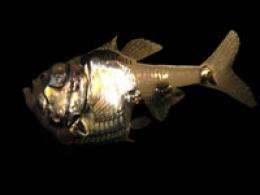
This is the silver hatchetfish (Argyropelecus olfersii). Credit: Jenny Kronstrom, University of Gothenburg

The phenomenon of light emission by living organisms, bioluminescence, is quite common, especially in marine species. It is known that light is generated by chemical reactions in which oxygen molecules play an important part. In the animal world, these chemical reactions take place in special luminescent cells called photocytes. These are aggregated into complex light organs, in which the intensity of light is regulated by nerve impulses, and in which light can be modulated with the help of reflectors, lenses and filters. By these means, organisms can adjust the wavelength, diffusion and intensity of light according to need. But the exact mechanisms behind these processes remain shrouded in mystery.

Jenny Krönström, a researcher at the Department of Zoology of the University of Gothenburg has put another piece of the jigsaw puzzle in place by investigating the light organs of marine jellyfish, crustaceans and fish. In her thesis she reveals that krill, the luminescent crustacean, is equipped with special muscles that regulate light intensity through contraction and relaxation.

Nitric oxide is also thought to play an important role in the bioluminescence of krill. It is produced in the small capillary vessels that keep the krill's photocytes supplied with oxygen, as well as in special closure muscles, sphincters, that are located at the point where these capillaries distribute blood to the photocytes. Experiments with agents that make the sphincters contract or relax show that when the sphincters relax, the krill begins to luminesce, presumably because of the increased flow of oxygenated blood to the photocytes.

As bioluminescence has developed independently at several different points in evolution, different species have developed different methods of regulating and emitting light. Jenny Krönström's research demonstrates that nitric oxide also has different effects in different species. In the remarkable deep sea Silver Hatchetfish (Argyropelecus olfersii) nitric oxide inhibits the light reaction, whilst in the Plain Midshipman fish (Porichthys notatus) it has an opposite, stimulating effect.

Biological light is not only useful to the organism itself as a biological torch, camouflage or as a means of communication; the substances that are involved in the chemical luminescent reaction have also shown themselves to be useful in modern molecular biology, in which the discovery of green fluorescent protein, which produces green light in jellyfish, led to the Nobel Prize in Chemistry as recently as 2008.

Source: University of Gothenburg


print this article email this article download pdf blog this article bookmark this article     Stumble it Digg this share on Facebook retweet share on Reddit add to delicious
Rate this story - 5 /5 (1 vote)


February 23, 2009 all stories

Comments: 0

5 /5 (1 vote)
  • Stumble this up

  • Digg this

  • share this

  • hide
  • Related Stories

  • Imaging a catalyst one atom at a time
    created Nov 09, 2009 | popularity not rated yet | comments 0
  • 3-D system based on optical fiber could provide new options for photovoltaics
    created Nov 02, 2009 | popularity not rated yet | comments 0
  • Nanoparticles Detect and Purge Metastases in Lymph Nodes
    created Oct 30, 2009 | popularity not rated yet | comments 0
  • Interactions with Aerosols Boost Warming Potential of Some Gases
    created Oct 29, 2009 | popularity not rated yet | comments 0
  • First hyperlens for sound waves created
    created Oct 25, 2009 | popularity not rated yet | comments 0


Other News

Indonesia rejects Bali plan for turtle sacrifices (AP)

Indonesia rejects Bali plan for turtle sacrifices

Biology / Ecology

created 2 hours ago | popularity not rated yet | comments 0

(AP) -- Indonesia has rejected a push by the resort island of Bali for rare turtles to be legally slain in Hindu ceremonies, siding with conservationists of the protected reptiles against religious advocates, ...


Hammerhead shark

Wide heads give hammerheads exceptional stereo view

Biology / Plants & Animals

created 4 hours ago | popularity 4 / 5 (3) | comments 2

Hammerhead sharks are some of the Ocean's most distinctive residents. 'Everyone wants to understand why they have this strange head shape,' says Michelle McComb from Florida Atlantic University. One possible ...


Tough yet stiff deer antler is materials scientist's dream

Biology / Plants & Animals

created 4 hours ago | popularity not rated yet | comments 1

Prized for their impressive antlers, red deer have been caught in the hunters' sights for generations. But a deer's antlers are much more than decorative. They are lethal weapons that stags crash together when duelling. John ...


The six elephants in Sierra Leone were shot and "crudely butchered"

S.Leone elephants 'wiped out' by poachers: official

Biology / Ecology

created 22 hours ago | popularity 5 / 5 (5) | comments 6

Poachers "wiped out" the entire elephant herd in Sierra Leone's only wildlife park, wildlife managers said Thursday after police said they had arrested a gang of 10 poachers.


First-ever blueprint of a minimal cell is more complex than expected

First-ever blueprint of a minimal cell is more complex than expected

Biology / Cell & Microbiology

created 20 hours ago | popularity 5 / 5 (15) | comments 4

What are the bare essentials of life, the indispensable ingredients required to produce a cell that can survive on its own? Can we describe the molecular anatomy of a cell, and understand how an entire organism ...