New barrier coating offers savings for aluminium smelters
February 23, 2009
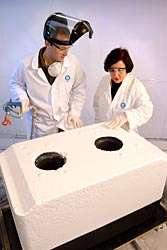
CSIRO project officer Enzo Gulizia and Dr Mahnaz Jahedi inspect the surface of a freshly coated carbon anode, intended for use in a trial at an aluminium smelter.
(PhysOrg.com) -- A barrier coating developed through CSIRO’s Light Metals Flagship offers aluminium smelters significant annual savings in reduced consumption of petroleum coke alone.
Smelter trials indicate that the low-cost coating prevents air burn oxidation and extends the operational life of carbon anodes used in high-temperature electrolytic cells.
Use of the coating was shown to produce a net reduction in carbon usage of 0.02 Kg carbon/Kg aluminium produced.
“Our coating can provide considerable savings for the companies operating the more than one hundred smelters that produce aluminium at present,” said Dr Mahnaz Jahedi of CSIRO Materials Science and Engineering.
Dr Jahedi presented the results of the project at a recent meeting of The Minerals, Metals and Materials Society in San Francisco.
Carbon anodes are made from petroleum coke, and in the extreme heat of aluminium electrolysis cells, the exposed top and sides of the anodes can oxidise spontaneously due to air burn.
Air burn can spread rapidly between anodes, and necessitates more frequent interruptions to the smelting process to replace anodes.
The CSIRO coating performed significantly better than conventional aluminium spray coating.
“The trials demonstrated that the coated anodes don’t develop air burn, and last longer in the smelter cells as a result,” said Dr Jahedi.
The trials were designed to test the efficacy of the coating by placing coated anodes in positions in the electrolytic cells found to be particularly prone to air burn.
“None of the coated anodes had to be removed due to air burn during the trials,” Dr Jahedi said.
Uncoated anodes placed in similar positions needed to be replaced more frequently due to severe air burn.
The cost-effective coating also proved durable during trials, remaining undamaged during transport of anodes to the smelter and during in-plant handling.
“The coating did not melt or crack while the anodes were in use. The trials showed no safety issues with application or use of the coating in smelters.”
The coating is simple to apply, and adheres well to the carbon anode.
The next stage of in-plant trials will use several hundred coated anodes and is expected to provide a complete assessment of the productivity improvements offered by the coating.
CSIRO plans to license the coating technology to smelters, and invites expressions of interest in the technology.
Provided by CSIRO
-
Battery electrode's 40,000 charge cycles look promising for grid storage
Nov 22, 2011 |
4.4 / 5 (12) |
12
-
Sulfur in hollow nanofibers overcomes challenges of lithium-ion battery design
Oct 05, 2011 |
5 / 5 (14) |
8
-
Powered by seaweed: Polymer from algae may improve battery performance
Sep 08, 2011 |
4.8 / 5 (4) |
1
-
Copying geckos’ toes
Sep 05, 2011 |
5 / 5 (4) |
2
-
Designing diamond circuits for extreme environments
Aug 04, 2011 |
5 / 5 (8) |
1
-
Engineers build first sub-10-nm carbon nanotube transistor
Feb 01, 2012 |
4.9 / 5 (33) |
30
-
Something old, something new: Evolution and the structural divergence of duplicate genes
Jan 31, 2012 |
4.6 / 5 (7) |
1
-
The hidden nanoworld of ice crystals: Revealing the dynamic behavior of quasi-liquid layers
Jan 30, 2012 |
5 / 5 (4) |
1
-
Stock market network reveals investor clustering
Jan 27, 2012 |
3.9 / 5 (23) |
8
-
Of microchemistry and molecules: Electronic microfluidic device synthesizes biocompatible probes
Jan 26, 2012 |
5 / 5 (2) |
0
-
How to calculate total compressibility in liquid porous solid system
5 hours ago
-
Need help reading 3-D
Feb 11, 2012
-
A way to send and receive wireless data
Feb 11, 2012
-
Calling function with no input argument
Feb 10, 2012
-
Force free body diagram problem on gym equipment
Feb 10, 2012
-
Empirical data regarding shower heads and water
Feb 10, 2012
- More from Physics Forums - General Engineering
More news stories
Google might launch Drive for cloud storage soon
(PhysOrg.com) -- Google's next big move, according to the Wall Street Journal, is a cloud storage service called Drive. Hardly first to the plate, Google is simply catching up to introducing its cloud reposi ...
Iran blocks email, restricts net access: reports
Iran has further restricted access to the Internet and blocked popular email services for the past few days, in a move a top lawmaker said could "cost the regime dearly," media reports said on Sunday.
7 hours ago |
5 / 5 (2) |
3
Love a click away in Indonesia's Twitter Republic
He was a geeky kid from Yogyakarta, she a glamorous city girl in Jakarta. In a country with one of the world's most vibrant social networking scenes they fell in love on Twitter.
15 hours ago |
4 / 5 (1) |
0
Walney offshore wind farm is world's biggest (for now)
(PhysOrg.com) -- The Walney wind farm on the Irish Sea--characterized by high tides, waves and windy weather--officially opened this week. The farm is treated in the press as a very big deal as the Walney ...
Navy to begin tests on electromagnetic railgun prototype launcher
The Office of Naval Research (ONR)'s Electromagnetic (EM) Railgun program will take an important step forward in the coming weeks when the first industry railgun prototype launcher is tested at a facility ...
Feb 06, 2012 |
4.5 / 5 (19) |
94
|
Scientists discover molecular secrets of 2,000-year-old Chinese herbal remedy
For roughly two thousand years, Chinese herbalists have treated Malaria using a root extract, commonly known as Chang Shan, from a type of hydrangea that grows in Tibet and Nepal. More recent studies suggest that halofuginone, ...
New method to examine batteries -- MRI from the inside
There is an ever-increasing need for advanced batteries for portable electronics, such as phones, cameras, and music players, but also to power electric vehicles and to facilitate the distribution and storage of energy derived ...
A mitosis mystery solved: How chromosomes align perfectly in a dividing cell
Although the process of mitotic cell division has been studied intensely for more than 50 years, Whitehead Institute researchers have only now solved the mystery of how cells correctly align their chromosomes during symmetric ...
Overeating may double risk of memory loss
New research suggests that consuming between 2,100 and 6,000 calories per day may double the risk of memory loss, or mild cognitive impairment (MCI), among people age 70 and older. The study was released today and will be ...
Lab study raises questions over nano-particle impact
Tests involving chickens have raised questions about the impact on health from engineered nano-particles, the ultra-fine grains commonly used in drugs and processed foods, scientists said on Sunday.
Starve a virus, feed a cure? Findings show how some cells protect themselves against HIV
A protein that protects some of our immune cells from the most common and virulent form of HIV works by starving the virus of the molecular building blocks that it needs to replicate, according to research published online ...