Brainwaves could help understanding of mental health disorders
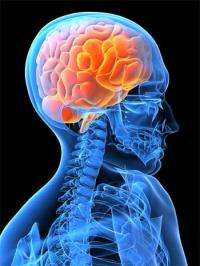
February 23, 2009 Brainwaves could help understanding of mental health disorders

Enlarge

(PhysOrg.com) -- Researchers at the University of Aberdeen have unlocked the details of a communication process that helps to generate the brainwaves that allow us to think and learn.

Ultimately their findings, published this week in the Proceedings of the National Academy of Sciences, could lead to new insights into psychiatric disorders like schizophrenia and help guide future development of new anti-psychotic drugs.

The University of Aberdeen led team studied two types of brainwaves - theta and gamma waves - in the part of the brain responsible for learning and memory.

They have discovered that connections between rare types of nerve cells in the brain orchestrate the generation and interaction of these brain rhythms.

Brainwaves arise from synchronised activity of large groups of nerve cells and are required for efficient mental processing.

Rare cells in the brain - parvalbumin-expressing interneurons - are key to the whole process.

These cells send out inhibitory signals to thousands of other cells and therefore generate the brainwaves.

The team of biologists and mathematicians from Aberdeen, Boston and Heidelberg Universities reveal the actual link between these cells that helps trigger the brain activity.

The scientists also discovered that this link plays a part in how different brain waves interact with each other.

Dr Peer Wulff, who led the research in Aberdeen together with Dr Marlene Bartos and Professor Bill Wisden at the University's Institute of Medical Sciences, said: "We have discovered a cellular mechanism that controls brain rhythms. This is an area that scientists have hypothesised about over the past decade.

"Patients suffering from schizophrenia are known to have a loss of the type of cells that play a key role in this process.

"If we can understand more about the cellular mechanics of brainwaves then what we learn may one day lead to the development of better drugs for the treatment of psychiatric disorders."

Provided by University of Aberdeen


print this article email this article download pdf blog this article bookmark this article     Stumble it Digg this share on Facebook retweet share on Reddit add to delicious
Rate this story - 4.7 /5 (3 votes)


February 23, 2009 all stories

Comments: 0

4.7 /5 (3 votes)
  • Stumble this up

  • Digg this

  • share this

  • hide
  • Related Stories

  • New mathematical method provides better way to analyze noise
    created Jun 08, 2006 | popularity not rated yet | comments 0
  • New stem cell lines approved for tax-paid research
    created 1hour ago | popularity not rated yet | comments 0
  • Discovery makes brain tumor cells more responsive to radiation
    created 2 hours ago | popularity not rated yet | comments 0
  • 3 Questions: Suzanne Corkin on the world's most famous amnesic
    created 20 hours ago | popularity not rated yet | comments 0
  • Bone Marrow Stem Cells May Prevent Chronic Lung Disease
    created 21 hours ago | popularity not rated yet | comments 0


  • hide
  • Relevant PhysicsForums posts

  • Nanomaterials destroy cancer!
    created Nov 30, 2009
  • Nuclear Medicine
    created Nov 30, 2009
  • Silver nitrate, cold sore, stain
    created Nov 29, 2009
  • Chest x-ray???
    created Nov 27, 2009
  • More from Physics Forums - Medical Sciences

Other News

Combining nanotubes and antibodies for breast cancer 'search and destroy' missions

Combining nanotubes and antibodies for breast cancer 'search and destroy' missions

Medicine & Health / Cancer

created 29 minutes ago | popularity not rated yet | comments 0

cylinders of carbon about a nanometer in diameter -- have been highly touted for potential applications such as ultrastrong fibers, electrical wires in molecular devices, or hydrogen storage components for ...


Apathy common in dementia patients with brain changes

Medicine & Health / Psychology & Psychiatry

created 56 minutes ago | popularity not rated yet | comments 0

Dementia patients with a certain type of changes in their brain's white matter are more likely to be apathetic than those who do not have these changes, reveals a patient study carried out by the Sahlgrenska Academy and Sahlgrenska ...


Study simulated car crashes involving pregnant women

Study simulated car crashes involving pregnant women

Medicine & Health / Health

created 43 minutes ago | popularity not rated yet | comments 0

Although states are not required to report fetal deaths in accident data, between 300 and 1,000 unborn babies die in car accidents each year. This accident fatality rate is about four times the rate for victims ...


Balancing protein intake, not cutting calories, may be key to long life

Balancing protein intake, not cutting calories, may be key to long life

Medicine & Health / Research

created 1hour ago | popularity 4.5 / 5 (2) | comments 0

Getting the correct balance of proteins in our diet may be more important for healthy ageing than reducing calories, new research funded by the Wellcome Trust and Research into Ageing suggests.


Why a short run is better than a long walk

Why a short run is better than a long walk

Medicine & Health / Research

created 4 hours ago | popularity 4.4 / 5 (5) | comments 1

(PhysOrg.com) -- Using the latest technology, researchers are uncovering evidence of exactly how major a role activity plays in the battle to keep obesity at bay. In new report published in the British Me ...