2008 Was Earth's Coolest Year Since 2000
February 23, 2009 by Leslie McCarthy 2008 Was Earth's Coolest Year Since 2000

Enlarge

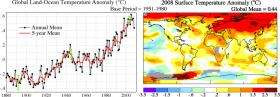
Left: Annual-mean global-mean anomalies. Right: Global map of surface temperature anomalies for 2008. Credit: NASA GISS

(PhysOrg.com) -- Climatologists at the NASA Goddard Institute for Space Studies (GISS) in New York City have found that 2008 was the coolest year since 2000. The GISS analysis also showed that 2008 is the ninth warmest year since continuous instrumental records were started in 1880. The ten warmest years on record have all occurred between 1997 and 2008.

The GISS analysis found that the global average surface air temperature was 0.44°C (0.79°F) above the global mean for 1951 to 1980, the baseline period for the study. Most of the world was either near normal or warmer in 2008 than the norm. Eurasia, the Arctic, and the Antarctic Peninsula were exceptionally warm (see figures), while much of the Pacific Ocean was cooler than the long-term average.

The relatively low temperature in the tropical Pacific was due to a strong La Niña that existed in the first half of the year, the research team noted. La Niña and El Niño are opposite phases of a natural oscillation of equatorial Pacific Ocean temperatures over several years. La Niña is the cool phase. The warmer El Niño phase typically follows within a year or two of La Niña.
2008 Was Earth's Coolest Year Since 2000
Enlarge

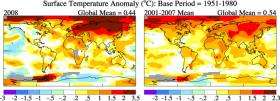
Comparison of 2008 temperature anomalies with the mean 2001-2007 anomalies. Note that this figure uses a slightly different color bar than that of the figure above in order to show more structure in the right-hand map. Credit: NASA GISS

The temperature in the United States in 2008 was not much different than the 1951-1980 mean, which makes it cooler than all the previous years this decade.

“Given our expectation that the next El Niño will begin this year or in 2010, it still seems likely that a new global surface air temperature record will be set within the next one to two years, despite the moderate cooling effect of reduced solar irradiance,” said James Hansen, director of GISS. The Sun is just passing through solar minimum, the low point in its 10- to 12-year cycle of electromagnetic activity, when it transmits its lowest amount of radiant energy toward Earth.

The GISS analysis of global surface temperature incorporates data from the Global Historical Climatology Network of the National Oceanic and Atmospheric Administration’s National Climate Data Center; the satellite analysis of global sea surface temperature of Richard Reynolds and Thomas Smith of NOAA; and Antarctic records of the international Scientific Committee on Antarctic Research.

"GISS provides the ranking of global temperature for individual years because there is a high demand for it from journalists and the public," said Hansen. "The rank has scientific significance in some cases, such as when a new record is established. But rank can also be misleading because the difference in temperature between one year and another is often less than the uncertainty in the global average."

Provided by Goddard Institute for Space Studies


print this article email this article download pdf blog this article bookmark this article     Stumble it Digg this share on Facebook retweet share on Reddit add to delicious
Rate this story - 4 /5 (22 votes)

Rank Filter

Move the slider to adjust rank threshold, so that you can hide some of the comments.


Display comments: newest first

  • Sean_W - Feb 23, 2009
    • Rank: 3.8 / 5 (16)
    Since we are told that solar activity has nothing to do with climate we must assume that the recent turn around is due to reductions in greenhouse gasses over the last 8 years. Good work Bush.
  • joefarah - Feb 23, 2009
    • Rank: 3.8 / 5 (9)
    There's a huge problem with the graphs. They make it appear as if the measurements used to compute the mean temperature were the same across time, when in fact there were very substantial differences in which stations were used to contribute readings. And there happens to be some strong correlations between such changes and the changes in the graph. If anyone has details on what measurements were used to produce these graphs, that would be useful.
  • axemaster - Feb 23, 2009
    • Rank: 3 / 5 (11)
    "Since we are told that solar activity has nothing to do with climate we must assume that the recent turn around is due to reductions in greenhouse gasses over the last 8 years. Good work Bush."

    Actually there is no turn around - things like this are merely statistical variations around the mean. This fact is fairly obvious if you simply look at the graph and note that it makes a random walk, albeit in a certain general direction.
  • JohnGalt - Feb 23, 2009
    • Rank: 3.9 / 5 (14)
    It might be worth looking at other sources of global temperature data than GISS. I think that RSS and UAH are more reliable.

    As far as the comment, "there is no turnaroud" I think that's unsupported. If all of the warming in the 90's was due to CO2 (no natural variability) then the cooling in this century can't be attributed to natual variability. You can't have it both ways. Anyone with basic common sense knows there is natural variability, and that the GCM's over estimate the CO2 effect. This subject would be a lot easier to discuss if all of the parties would admit to what that they know is true, rather than some belief system they wish were true.
  • Arkaleus - Feb 23, 2009
    • Rank: 3.7 / 5 (12)
    It seems the point of this sort of climate research isn't to gain any true understanding of climate, but rather to catalyst a sophisticated social engineering coup on the developed world.

    Many climatologists have expressed anti-human fantasies where most of the human population is removed and a new global government is erected to completely dominate human destiny, somehow creating a utopia of "sustainability."

    Their aims, no matter how anti-social or psychotic, are shared by a large number of climate quacks, and they see an opportunity in creating an international emergency - or at least the perception of one.

    After the Bush years the world should be very wary of groups trying to convince us there is a dire emergency requiring us to "act now" or face "dire consequences", especially when the solutions they offer require us to hand over money and sovereignity to their interests.
  • barkster - Feb 23, 2009
    • Rank: 3.5 / 5 (8)
    albeit in a certain general direction
    ... albeit in a certain general direction since the conveniently "conclusive" starting point in the 1880's.
  • robbycoats - Feb 24, 2009
    • Rank: 3.7 / 5 (9)
    People go to school for 4 years so they can make bad weather predictions a week away.
  • Sirussinder - Feb 24, 2009
    • Rank: 3.7 / 5 (9)
    I agree, since everyone disregards the sun (the bright yellow ball that can hold over 1 million earths) which has nothing to do with warming or cooling the earth, it had to have been Bush.

    Thanks Bush for all your hard work!
  • Modernmystic - Feb 24, 2009
    • Rank: 4 / 5 (8)
    Yep it really does boil down to not being able to have your cake and eat it too...

    Either thee is natural variability which has a significant effect on temperature and this is part of it, or there simply is none and this latest downward trend totally disproves AGW. Either way the AGW camp is screwed to one level or another...
  • GrayMouser - Feb 26, 2009
    • Rank: 3.9 / 5 (7)
    "But rank can also be misleading because the difference in temperature between one year and another is often less than the uncertainty in the global average."
    Boy! Hansen can dance!
  • MikeB - Mar 02, 2009
    • Rank: 4.2 / 5 (5)
    "But rank can also be misleading because the difference in temperature between one year and another is often less than the uncertainty in the global average."

    So, the .44C anomoly over the average is within the uncertainty level? That means that we are just as likely to be below the 1951-1980 Mean. What is the big deal then? Whew, the danger has passed!
  • MikeB - Mar 02, 2009
    • Rank: 4.2 / 5 (5)
    2008... Coolest year of the millenium!!!
  • Roach - Mar 02, 2009
    • Rank: 4.3 / 5 (6)
    It's funny how several degrees cooler is a natural variation, but the drought one year prior was a hearald of the pending apocalypse, except that the lack of a brutal huricane season was a natural variance, but the more intense season in 2005 was again, conclusive proof? I feel bad for even trying to read these articles anymore.
  • dachpyarvile - Mar 02, 2009
    • Rank: 4.2 / 5 (5)
    Since we are told that solar activity has nothing to do with climate we must assume that the recent turn around is due to reductions in greenhouse gasses over the last 8 years...


    Looking at the numbers...nope. CO2 and CH4 levels ppm have increased since 2000. Yet, temps have gone down in spite of the rises in levels of these two greenhouse gasses. Maybe if Al Gore gets up and starts blowing air from his mouth the temps will go back up again before he loses money on his investments into Hydrogen tech and Carbon offsets.

February 23, 2009 all stories

Comments: 14

4 /5 (22 votes)
  • Stumble this up

  • Digg this

  • share this

  • hide
  • Related Stories

  • New insight into predicting cholera epidemics in the Bengal Delta
    created Nov 04, 2009 | popularity not rated yet | comments 0
  • Climate variability impacts the deep sea
    created Nov 02, 2009 | popularity not rated yet | comments 0
  • Soil moisture and ocean salinity satellite ready for launch
    created Oct 29, 2009 | popularity not rated yet | comments 0
  • Computer Modeling Can Contribute to Thai Soybean Production
    created Oct 27, 2009 | popularity not rated yet | comments 0
  • FASTSAT instruments shipped for tests and launch preparation
    created Oct 26, 2009 | popularity not rated yet | comments 0


  • hide
  • Relevant PhysicsForums posts

  • cycles
    created 13 hours ago
  • The Origin of the term 'fossil' fuels
    created Nov 05, 2009
  • co2
    created Nov 03, 2009
  • Early Earths Sulfidic Ocean Conditions
    created Oct 30, 2009
  • More from Physics Forums - Earth

Other News

Deep creep means milder, more frequent earthquakes along Southern California's San Jacinto fault

Deep creep means milder, more frequent earthquakes along Southern California's San Jacinto fault

Space & Earth / Earth Sciences

created 12 hours ago | popularity 4.7 / 5 (3) | comments 0

With an average of four mini-earthquakes per day, Southern California's San Jacinto fault constantly adjusts to make it a less likely candidate for a major earthquake than its quiet neighbor to the east, the ...


Success in 'space elevator' competition (AP)

Success in 'space elevator' competition (Update 3)

Space & Earth / Space Exploration

created Nov 05, 2009 | popularity 4.3 / 5 (33) | comments 50

(AP) -- A robot powered by a ground-based laser beam climbed a long cable dangling from a helicopter on Wednesday to qualify for prize money in a $2 million competition to test the potential reality of the ...


In a Galaxy Far, Far Away...

In a Galaxy Far, Far Away...

Space & Earth / Astronomy

created Nov 06, 2009 | popularity 4.8 / 5 (5) | comments 16

(PhysOrg.com) -- Astronomers have published the discovery of the farthest known object in the cosmos: a star that exploded when the universe was only 630 million years old -- only 4.6% of its current age. ...


'Dropouts' pinpoint earliest galaxies

'Dropouts' pinpoint earliest galaxies

Space & Earth / Astronomy

created Nov 06, 2009 | popularity 4.2 / 5 (10) | comments 13

Astronomers, conducting the broadest survey to date of galaxies from about 800 million years after the Big Bang, have found 22 early galaxies and confirmed the age of one by its characteristic hydrogen signature ...


Space hotel taking bookings for 2012 opening

Space hotel taking bookings for 2012 opening

Space & Earth / Space Exploration

created Nov 05, 2009 | popularity 4.4 / 5 (21) | comments 11

(PhysOrg.com) -- The first orbiting space hotel is on track to open for its first customers in 2012, but hurry, as bookings are filling fast.