The pluses and (mostly) minuses of biofuels
February 23, 2009 By Robert Sanders
The pluses and (mostly) minuses of biofuels

Enlarge

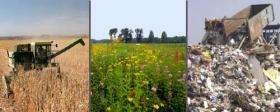
Cornfield waste, or stover; perennials grown on marginal land; or municipal waste, ranging from kitchen scraps to cardboard, could be used as feedstocks to produce ethanol using cellulosic technology.

Speakers at last week’s AAAS meeting presented abundant evidence that tropical rainforest destruction has accelerated in recent years, at least in part because of the worldwide push to produce more biofuels.

As Europe and America rush to supplant polluting fossil fuels with plant-derived fuels like ethanol, soy and palm oil, farmers in the tropics are accelerating forest clearing to plant more sugarcane, soybeans and palm trees to meet the demand. What should be carbon-neutral biofuels - the carbon dioxide these plants take in while growing is returned to the atmosphere when they're burned, resulting in zero net carbon release - end up spewing more CO2 into the atmosphere as forests are slashed and burned.

Carbon dioxide is such a potent greenhouse gas that one recent study estimated it will take hundreds of years to recoup the greenhouse gas damage of clearing rainforests to grow and harvest plants for biofuels.

In one session, Michael Coe of Woods Hole Research Center in Massachusetts illustrated one ripple effect from the stampede to create more ethanol from corn in the United States. As corn prices skyrocketed several years ago, soybean fields were converted to corn, and the price of soy rose. As a result, farmers in Brazil, one of the main countries with the soil, climate and infrastructure to make up the difference, began to bulldoze rainforest to grow more soybeans.

"If reduced U.S. soybean production results in a parallel increase in Brazilian soybean production, a potential net release of 1,800 to 9,100 Tg (trillion grams) of CO2-equivalents of greenhouse gas emissions due to land-use change is possible," Coe wrote in a summary of his talk. That is equivalent to more than 9 billion metric tons of carbon dioxide.

Bulldozing Indonesian rainforests to plant oil palms

In the same session, Holly Gibbs of Stanford University reported that, despite assurances by biofuel producers that biofuel crops are being grown on degraded or already cleared lands, forest clearing throughout the tropics has increased. In Indonesia and Malaysia, especially, deforestation has accelerated as farmers scramble to plant oil palms to supply Europe with biodiesel fuel.

While growing crops on degraded land "would be restoring the land to a higher potential to provide environmental services for people," she said, "if biofuels are grown in place of forests, we're actually going to end up emitting a huge amount of carbon."

In the face of these reports that biofuels are worsening global warming, Dan Kammen, a UC Berkeley professor of energy and resources and director of the Renewable and Alternative Energy Laboratory, tried in a Feb. 14 session to put biofuels into perspective.

"No matter what people say about the good or bad aspects of a given fuel, whether it's oil, tar sands, biofuels, solar or wind, the fact is, a large number of these will be used for economic reasons, based on subsidies, momentum, vested interests, whatever," he said in his talk, "A Hunger for Power: The Global Nexus of Energy and Food." The key, he said, is to design global models that will guide policy makers in making the right choices.

The country has to develop models that allow us to assess "biofuel demand from a global perspective. You can't just look at it in terms of what happens on a hectare of land in Iowa, but also in terms of the conflicts between food, fiber, fuel and nature," Kammen said.

With regard to biofuels, Kammen was in agreement with the scientists reporting the negative aspects of biofuels in use today.

From a global perspective, he said, it’s clear that “if we pursue the path we are on, it is an environmental and food security loser.” Based on a soon-to-be-published study by Kammen and colleagues at Purdue University, no matter how sustainably the United States grows corn for ethanol, it will have a negative impact on greenhouse gases because of the growth of soy in tropics.

Leading the way to cellulosic

Research programs like UC Berkeley and LBNL's Energy Biosciences Institute, funded last year by oil giant BP to the tune of $500 million over 10 years, are developing such models at the same time as they are pursuing next-generation biofuels. Cellulosic biofuels, made by more complete fermentation of biofuel feedstocks, won’t be commercially viable for 5-10 years, but they and other technologies, including algae, are attractive options that together may combine to produce as much as 10 percent of the nation’s energy needs, he said.

“None is a home run individually, but if together they could be done sustainably, they are big enough opportunities that there will be strong economic forces to develop a range of them,” said Kammen.

He held up California as an example of what the nation and the world can do to reduce greenhouse gas emissions using biofuels as one part of a broad “energy portfolio.” The state's AB 32, passed in 2006, presents a framework for reducing carbon emissions, with the 2020 goal of returning California emissions to what they were in 1990, which would amount to slightly more than a 25 percent reduction from current emissions.

More importantly, a 2005 executive order by Gov. Arnold Schwarzenegger established the goal of reducing carbon emissions 80 percent by 2050, which is the number that "those of us who work with the IPCC (Intergovernmental Panel on Climate Change) have effectively endorsed, not as a solution to global warming, but as the best soft landing; the beginning of what we want to get to," Kammen said.

Combined with California's low carbon fuel standard, which addresses carbon emissions from vehicles, and the state's developing renewable energy portfolio, which mandates that 33 percent of the state’s electricity come from zero-carbon sources by 2020, California has created a model for the nation. In fact, he said, “a version of California's plan, scaled up to the size of the nation, is Obama's evolving federal plan - the endpoint numbers are about the same, though the paths are not yet set."

While Kammen admitted that he expects biofuels to be replaced by better and sustainable sources of energy within 50 years, for now they will remain part of a portfolio that will include solar and wind as well as coal, oil and nuclear power.

“We, as a nation, need to use what is happening in the U.S. West and in California as an example of the context in which biofuels are being explored,” said Kammen.

Provided by UC Berkeley

Filter


Move the slider to adjust rank threshold, so that you can hide some of the comments.


Display comments: newest first

NOM
Feb 23, 2009

Rank: not rated yet
What is needed is economic incentives for countries to preserve their rainforests, backed by penalties for allowing destruction by any means, including illegal logging.
redapes
Feb 23, 2009

Rank: not rated yet
The palm oil industry is guilty of some truly heinous ecological atrocities, including the systematic genocide of orangutans. The forests of Borneo and Sumatra are the only place where these gentle, intelligent creatures live, and the cultivation of palm oil has directly led to the brutal deaths of thousands of individuals as the industry has expanded into undisturbed areas of rainforest.

When the forest is cleared, adult orangutans are typically shot on sight. These peaceful, sentient beings are beaten, burned, mutilated, tortured and often eaten. Babies are torn off their dying mothers so they can be sold on the black market as illegal pets to wealthy families who see them as status symbols of their own power and prestige. I am not trying to be overly dramatic. This actually happens. It has been documented time and again.

Some of the luckier orangutans are confiscated and brought to sanctuaries such as the Nyaru Menteng Orangutan Rescue Center, which is now home to nearly 700 orphaned and displaced orangutans in Central Kalimantan (Indonesian Borneo). Many of these orangutans are only several weeks old when they arrive, and all of them are psychologically traumatized and desperate for their mothers-- who are no longer alive.

Nyaru Menteng is managed by a remarkable woman named Lone Droscher Nielsen and is featured on Animal Planet's series 'Orangutan Island'.

To learn more about the crisis facing wild orangutans and see how you can help protect them, please visit the Orangutan Outreach website: http://redapes.org

Thank you for taking the time to read my long comment!

Best wishes,

Richard Zimmerman
Director, Orangutan Outreach
http://redapes.org
Reach out and save the orangutans!
Join our Facebook Cause: http://causes.com/redapes
DozerIAm
Feb 24, 2009

Rank: not rated yet
Kammen's flaw is that he wants to plan out glogal agriculture from the top down. Central planning rarely works well on a large scale - its neither quick enough to respond to changes nor flexible enough to meet the needs of the growers.
lengould100
Feb 24, 2009

Rank: not rated yet
Central planning rarely works well on a large scale...
Depends on what you mean by "Central Planning". If detailed five-year plans at the individual field level, then agreed. HOWEVER, in a market economy, SOME centrally issued rules must exist, else neither a market or an economy can exist.

Trick is finding a near-ideal balance.
DozerIAm
Feb 25, 2009

Rank: not rated yet
I was thinking of the diverging interests of the farmer who wants to maximize his short and long term yields vs the "macro planner" who's interests are guided by some long term goal that is in the planner's interest but not necessarily in the farmer's interest. Its assumed that the individual farmer best understands what is most efficient and effective for his unique situation. Individuals, groups, businesses, governments - all act in their own perceived best interest, and the interests of one isn't necessarily the interests of all. Thus I don't see central planning as having the individual growers' interests in mind. Given that, failure seems likely on either end of that dynamic.
superhuman
Feb 28, 2009

Rank: 1 / 5 (1)
I have one idea how deforestation could perhaps be slowed down somewhat.

The solution I am thinking about is to establish a program of ownership of rain forests. The areas which are most at risk of deforestation should be divided into plots and auctioned to international community. The titles to the land would not grant the right to modify the land but the owner would gain the title of protector of the land he bought. A tax should also be associated with such ownership with the money going to the local people, this tax should be high enough to give them incentive to protect the land and a feeling that they also benefit from the deal.

The owner would of course be allowed to sell or abandon his right if he would choose to.

The whole purpose of this program is to give wealthy and environmentally conscious individuals or organizations a way in which they can help protect the forests. Right now they can donate the money to some cause but the effect is much less direct and in most cases they have no real knowledge what the money will be spent on. Here on the other hand they would know precisely what plot of land they help protect, they would have the title to this land, would be able to come visit it, they would also know they help local population, etc. They could really see that they are making the difference.

On the other hand money from auctions and taxes would help local community and give it an incentive to protect the forest, it would give the forest a monetary value and an owner who could care for it.
DozerIAm
Mar 09, 2009

Rank: not rated yet
Superhuman, that is an awful, awful idea. Its almost like buying a time share you aren't allowed to use at all, except worse.

It has all the negatives of land ownership (taxes, liability for what happens on it) without any of the benefits (use of the land and its resources as you see fit).

Why not follow the existing models for land protection already in use:

Government level: state forests, state parks, wilderness conservation areas, wildlife management areas.

corporate level: land trusts

Private level: what I call the Robert Redford model (a private citizen buys up a couple thousand acres of land and doesn't develop it).

Any of these models would be preferable to what you suggest, as these all respect property rights.
Rank 4 /5 (1 vote)
Relevant PhysicsForums posts
  • Empirical data regarding shower heads and water
    created5 hours ago
  • feed hold button on CNC lathe
    createdFeb 09, 2012
  • RFAC in Fortran
    createdFeb 09, 2012
  • dynamics 2/32
    createdFeb 08, 2012
  • dynamics
    createdFeb 08, 2012
  • Vibration Absorbtion Problem
    createdFeb 08, 2012
  • More from Physics Forums - General Engineering

More news stories

US video game sales fall 34 percent in January

(AP) -- U.S. retail sales of video game hardware, software and accessories fell 34 percent in January from a year earlier to $751 million due to the lack of new game titles, according to market researcher NPD Group.

Technology / Business

created 2 hours ago | popularity not rated yet | comments 0

Zynga partners with toy maker Hasbro

Old school toy maker Hasbro and online social game star Zynga on Thursday announced a partnership to mesh the Internet firm's hits with real-world products.

Technology / Business

created 1 hour ago | popularity not rated yet | comments 0

Samsung can continue selling Galaxy tabs in Germany: court

South Korea's Samsung Electronics can continue to sell its Galaxy Tab 10.1N tablet computer in Germany, a German court ruled Thursday, rejecting a bid by arch-rival Apple to have them banned.

Technology / Business

created 23 hours ago | popularity 4 / 5 (4) | comments 3

Digital photos could put kids at risk

A study published in the International Journal of Electronic Security and Digital Forensics this month suggests that parents and carers could be putting children at risk if they upload digital photos that are automatically "geota ...

Technology / Internet

created 19 hours ago | popularity 5 / 5 (1) | comments 3

Google launches Chrome browser for Android smartphones

With more and more people connecting to the Internet through a phone or a tablet instead of a PC, Google Inc. is bringing its fast-growing browser, Chrome, to the newest Android-powered mobile devices.

Technology / Software

created 22 hours ago | popularity 5 / 5 (5) | comments 0


Protein libraries in a snap

(PhysOrg.com) -- A Rice University undergraduate will depart with not only a degree but also a possible patent for his invention of an efficient way to create protein libraries, an important component of biomolecular ...

Breastfeeding protects against asthma up to six years of age

(Medical Xpress) -- Research by the University of Otago in Christchurch and Wellington has shown that breastfeeding of infants has a clear protective effect against children developing asthma or wheezing up to six years of ...

Study finds stress hormones fluctuate with mood during pregnancy

(Medical Xpress) -- While pregnant, women pay particular attention to factors such as diet and exercise to ensure their babies are born healthy and develop normally. New research from the University of Calgary’s Faculty ...

Humans may have helped the decline of African rainforests 3000 years ago

(PhysOrg.com) -- Large areas of rainforests in Central Africa mysteriously disappeared over three thousand years ago, to be replaced by savannas. The prevailing theory has been that the cause was a change ...

Japan scientist makes 'Avatar' robot

A Japanese-developed robot that mimics the movements of its human controller is bringing the Hollywood blockbuster "Avatar" one step closer to reality.

Miami battling invasion of giant African snails

No one knows how they got there. But an invasion of African giant snails has southern Florida in a panic over potential crop damage, disease and general yuckiness surrounding the slimy gastropods.