A Newtonian system that mimics the baldness of rotating black holes
February 23, 2009 Black hole

Enlarge

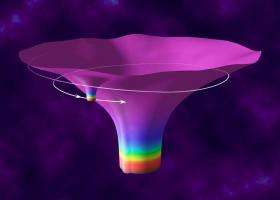
Clifford Will hopes to learn more about how small black holes orbit around rotating massive black holes in general relativity, where the relativistic Carter constant plays a key role. Illustration by Don Davis

(PhysOrg.com) -- The rotating black hole has been described as one of nature's most perfect objects. As described by the Kerr solution of Einstein's gravitational field equations, its spacetime geometry is completely characterized by only two numbers — mass and spin — and is sometimes described by the aphorism "black holes have no hair.''

A particle orbiting a rotating black hole always conserves its energy and angular momentum, but otherwise traces a complicated twisting rosette pattern with no discernible regularity.

But in 1968, theoretical physicist and cosmologist Brandon Carter showed that the particle's wild gyrations nevertheless hold another variable fixed, which was named the "Carter constant.'' The true meaning of Carter's constant still remains somewhat mysterious 40 years after its discovery.

Now Clifford M. Will, Ph.D., the James S. McDonnell Professor of Physics in Arts & Sciences at Washington University in St. Louis, has shown that, even in Newton's theory of gravitation, arrangements of masses exist whose gravitational field also admits a Carter-like constant of motion, in addition to energy and angular momentum.

What's more, the deviation of the field's shape from being spherical is determined by a set of equations that are identical to those for Kerr black holes.

In his article "Carter-like Constants of the Motion in Newtonian Gravity and Electrodynamics" in the Feb. 12 issue of Physical Review Letters, Will points out that one Newtonian system that exhibits this property is surprisingly simple: two equal point masses at rest separated by a fixed distance.

"I was completely stunned when I saw that the Newtonian condition for a Carter constant was identical to the condition imposed by the black hole no-hair theorems," said Will. "Do I know why this happens? So far, not a clue.

"But what I really hope is that insights gained about this strange constant in the simpler Newtonian context will teach us something about how small black holes orbit around rotating massive black holes in general relativity, where the relativistic Carter constant plays a key role."

This will have implications for gravitational-wave astronomy, he says, because the signal from such events may be detectable by the advanced LIGO-VIRGO-GEO network of ground-based laser interferometric detectors or by the proposed space-based LISA (Laser Interferometer Space Antenna).

Will, who is also a visiting associate at the Institute of Astrophysics in Paris, is a theoretical physicist whose research interests encompass the observational and astrophysical implications of Einstein's general theory of relativity, including gravitational radiation, black holes, cosmology, the physics of curved spacetime and the interpretation of experimental tests of general relativity.

Will's "Was Einstein Right?" (1986) won the American Institute of Physics Science Writing Award. His "Theory and Experiment in Gravitational Physics" (1981) is considered the bible of the field.

Provided by Washington University in St. Louis


print this article email this article download pdf blog this article bookmark this article     Stumble it Digg this share on Facebook retweet share on Reddit add to delicious
Rate this story - 4.3 /5 (18 votes)

Rank Filter

Move the slider to adjust rank threshold, so that you can hide some of the comments.


Display comments: newest first

  • Alexa - Feb 23, 2009
    • Rank: 1.8 / 5 (5)
    At conceptual level the geometry of particle arrangement consist of layers, which are alternating the classical and non-classical behavior. If we compress dense particle system, the particle fluctuations behave like particle fluctuation in gas driven by Newtonian mechanics, then in fluid, then in foam gradually. At the end the resulting system of particles will become so dense and chaotic, the observable reality would consist from subtle and sparse density fluctuations only.

    After then just these subtle density fluctuations would become significant with respect of observable reality and whole process can repeat again. Therefore it's not so strange, highly relativistic system, like the black hole exhibits a traces of quantum physics or even Newtonian physics. The highly condensed surface of black hole exhibits some common properties with Newtonian fluids, for example.

    http://physics.ap...es/v1/38

    Math itself doesn't help us in sorting of pile of equations, which the formal solution provides. A higher level of insight is required to organize results of many modern theories. Such level of understanding can be mediated by pure intuition, only. By my opinion, high level of thinking, as proposed by AWT is necessary to understand the complex emergent phenomena of high degree of complexity.
  • Alexa - Feb 23, 2009
    • Rank: 1.8 / 5 (5)
    I can give you a following example of high level thinking, which we can apply for explanation of black hole phenomena, for example. In Hubble depth field the Universe appears like being composed of less or more randomly spreaded swirling galaxies, infinitely. Here's no evidence of limit, coming from Big Bang theory or something similar. The Universe appears infinite.

    http://imgsrc.hub...rint.jpg

    What the heck all this means?

    Well, by AWT spacetime is formed by many tightly condensed/collapsed particles, we can call them gravitons, if you like - it doesn't matter. These particles are moving randomly so their lateral forces will compensate gradually in less or more distant perspective. After then just the surface motion of particles becomes significant, because it cannot compensate so easily.

    Under deeper analysis every particle can be approximated by spherical density gradient, which is characterized by its surface vorticity, so called the spin. At the case of water droplet here is many vortex zones at the surface, but if we decrease the size of droplet, only pair of surface vortices can remain by hairy ball theorem. We can say, every tiny droplet is formed by Cooper pair of quantum vortices on background, a pretty well like the vortices inside of boson condensates. We are saying, the spin of every fermion particle is 1/2.

    http://en.wikiped..._theorem

    Now we can simply say, if we collect sufficiently large system of particles, then the all forces will compensate mutually, just the surface vorticity/spin will remain. Being cumulative, it creates a wildly swirling places randomly spreaded through space.

    From this perspective the existence of black holes in our Universe is undeniable: every large space is formed by particles, the surface vorticity of this will cumulate less or more lately under formation of less or more large perturbations, where space-time is swirling wildly. From more general perspective Universe is formed less or more irregular, but infinite lattice of black holes, surrounded by galaxies. These galaxies are behaving like new generation of particles, so from even more general perspective we can expect the formation of black holes lattices composed of black holes and so on.

    By my opinion, this can be one from ways, by which we can understand, what we can really see around us. I'm afraid, abstract math won't help us in such imagination. Just at the moment, when we realize, what we want to describe, we can develop a math model safely.

    For example, until we realize, the density fluctuations of space-time particles should appear like foamy density fluctuations inside of gas, we can start to believe in strings of string theory, but not before. Without such insight the whole string theory remains ad hoced - no matter, how good experimental predictions it can provide occasionally. It doesn't, and this is just a consequence of fact, scientists have proposed it without deeper understanding of underlying reality. So they've combined a mutually inconsistent postulates.

    http://aetherwave...ory.html

    Frankly, the dumb formal approach is not, how the science can be made for future. The understanding at predicate logics level should always come first, the formal math later. Without it it's just a blind piling of equations under (futile) hope, someone more clever will find a hidden sense in them.

    Contemporary situation in physics is the consequence of "shut-up and calculate" paradigm, as it was proposed by formal science before years.
  • yep - Feb 23, 2009
    • Rank: 3 / 5 (2)
    But scientists, who ought to know
    Assure us that it must be so.
    Oh, let us never, never doubt
    What nobody is sure about.
    %u2014Hilaire Belloc
    http://www.holosc...6bcdajsb&keywords=black holes#dest


February 23, 2009 all stories

Comments: 3

4.3 /5 (18 votes)
  • Stumble this up

  • Digg this

  • share this

  • hide
  • Related Stories

  • Black Holes Go 'Mano a Mano'
    created Oct 06, 2009 | popularity not rated yet | comments 0
  • Cosmic entropy could be 100 times greater than previously thought
    created Oct 06, 2009 | popularity not rated yet | comments 0
  • Living fossils hold record of 'supermassive' kick
    created Jul 09, 2009 | popularity not rated yet | comments 0
  • Astronomers reveal a 'blue whale of space'
    created Jul 07, 2009 | popularity not rated yet | comments 0
  • Computer Finds Massive Black Hole in Nearby Galaxy
    created Jun 09, 2009 | popularity not rated yet | comments 0


  • hide
  • Relevant PhysicsForums posts

  • Enthalpy and it's use in Gibb's Free Energy
    created 2 hours ago
  • Newton Question #2 (centripetal motion)
    created 5 hours ago
  • Microwave vs metallic objects
    created 5 hours ago
  • Newtons law questions (rocket)
    created 7 hours ago
  • More from Physics Forums - General Physics

Other News

Scientists react as they stand in front of a screen at CERN

First atoms reported smashed in Large Hadron Collider (Update)

Physics / General Physics

created Nov 23, 2009 | popularity 4.5 / 5 (30) | comments 21

Two circulating beams on Monday produced the first particle collisions in the world's biggest atom smasher, the Large Hadron Collider (LHC), three days after its restart, scientists announced.


Restored machine to explore mysteries of Big Bang (AP)

Restored machine to explore mysteries of Big Bang

Physics / General Physics

created Nov 21, 2009 | popularity 4.6 / 5 (18) | comments 26

(AP) -- Scientists are preparing the world's largest atom smasher to explore the depths of matter after successfully restarting the $10 billion machine following more than a year of repairs.


nuclear power plant

Doubts raised on nuclear industry viability

Physics / General Physics

created Nov 19, 2009 | popularity 3.1 / 5 (21) | comments 19

(PhysOrg.com) -- The investment in nuclear power has been growing around the world over the last few years, being viewed as a means for countries to control their energy security, avoid the price fluctuations ...


In the Brain, Seven Is A Magic Number

In the Brain, Seven Is A Magic Number

Physics / General Physics

created Nov 23, 2009 | popularity 4.5 / 5 (33) | comments 9

Having a tough time recalling a phone number someone spoke a few minutes ago or forgetting items from a mental grocery list is not a sign of mental decline; in fact, it's natural.


Proton's party pals may alter its internal structure

Proton's party pals may alter its internal structure

Physics / General Physics

created Nov 18, 2009 | popularity 4.6 / 5 (20) | comments 9

A recent experiment at the DOE's Thomas Jefferson National Accelerator Facility has found that a proton's nearest neighbors in the nucleus of the atom may modify the proton's internal structure.