Researchers studying spiny dogfish, Gulf of Maine's mini shark
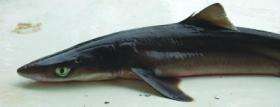
For such a small shark species, there seems to be super-sized confusion about its population status. But for researchers at the University of New Hampshire, one thing is clear - definite changes have occurred to spiny dogfish shark populations in the past two decades.
Commercial fishermen haul up nets loaded with so many of the three-foot-long sharks that the yellow-eyed creatures are often considered a nuisance. However, fishery management plans have set quotas to limit the harvest of dogfish to 3,000 pounds per trip in state waters due to concerns by scientists that the species could easily be overfished. The market for dogfish meat is located primarily in England and Germany, so dogfish caught in the Gulf of Maine are shipped overseas.
Confusion over their population status is compounded by the fact that there are relatively few recent studies to document dogfish ages, growth rates and maturity. In fact, it has been more than 20 years since the last life history study was conducted for dogfish in the Gulf.
"In order for management to be effective, we need updated and accurate biological information, we need to accurately age these fish and determine their age at maturity," says Paul Tsang, UNH professor of molecular, cellular and biomedical sciences. "To really understand what's going on with their populations, we need to understand their basic life history."
Tsang is collaborating with University of New England professors David Koester and James Sulikowski to establish basic biological information about dogfish populations in the Gulf of Maine. Spiny dogfish sharks are part of the Elasmobranch family, which includes sharks, skates and rays. With funding from N.H. Sea Grant, UNH Ph.D. candidate Walter Bubley is working with Tsang to determine the average and maximum age, growth rate and age at maturity for this species.
Bubley worked closely with New Hampshire commercial fishermen to collect dogfish on their routine fishing trips. Biological information including fish length and weight were recorded, blood samples were taken and dorsal fin spines, vertebrae and reproductive organs were brought back to the lab for further analyses.
Similar to how the age of a tree is determined by the rings in the trunk, certain bony structures on a fish can be cross-sectioned and examined for bands, or annuli, that are laid down each year. The ages of fish are often determined by the annuli on otoliths (inner ear bones), dorsal or pectoral fin spines.
The second dorsal fin spine was previously used to identify the ages of dogfish, but often with imprecise results due to normal calcification and damage to the structure. So instead, Bubley is using vertebrae to determine their age, a technique typically used on other Elasmobranchs. Two individuals examine vertebrae cross-sections that have been processed to reduce the calcification and stained to bring out the annuli more clearly.
"The chance of the two readers getting the same age estimate is vastly improved with the vertebrae than from the dorsal spines," Bubley says.
The preliminary results show that the dogfish age at maturity — typically between 10-15 years — has not changed dramatically over the last couple decades. However, the growth rate may be slowing down, so that smaller sized fish are reaching maturity at around the same age as is typical for that species in the Atlantic.
"I think this trend was initially set into motion by the fishing pressure on them in the 1990s," Bubley says. "The largest sized dogfish were harvested by fishermen, and so the smaller ones remained behind to reproduce. They passed their genes on to the next generation, causing size selection to occur where smaller fish are able to reproduce."
The average number of offspring produced by a female dogfish has decreased from 10 two decades ago to four today, according to Tsang. Changes in the environment may be impacting their fertility.
In addition, Bubley adds that the maximum age of dogfish in his research is typically 25 years — down from 35 or 40 in previous studies. "That doesn't mean there is a shift in maximum age of dogfish," he cautions, "it just indicates that the discrepancies in ageing techniques between previous studies and this one may have resulted in different outcomes."
"This gives us a new starting point because a lot can happen in the span of 20 years," he adds.
Source: University of New Hampshire


