Camera trap survey snaps cheetahs in Algeria
February 24, 2009
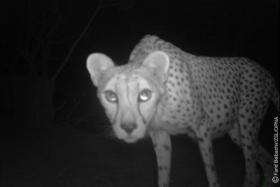
Researchers working in Africa's central Sahara have captured images of the elusive Saharan cheetah using camera traps. They are the first camera trap photos of cheetahs in Algeria. Credit: Farid Belbachir/ZSL/OPNA
A Wildlife Conservation Society-supported survey of the Sahara has captured the first camera-trap photographs of the critically endangered Saharan cheetah in Algeria. The survey was conducted by researchers from the Zoological Society of London (ZSL), the Office du Parc National de l'Ahaggar (OPNA), and the Université de Béjaďa, with support from WCS and Panthera.
The photographs were taken as part of the first systematic camera trap survey across the central Sahara, covering an area of 2,800 square kilometres (1,081 square miles).
Overall, the survey identified four different Saharan cheetahs—a subspecies of cheetah (Acinonyx jubatus hecki)—using spot patterns unique to each individual.
"The Saharan cheetah is critically endangered, yet virtually nothing is known about the population, so this new evidence, and the ongoing research work, is hugely significant," said Dr Sarah Durant, Zoological Society of London Senior Research Fellow.
"This first camera-trap confirmation of cheetahs in Algeria is a landmark success toward our efforts to save these big cats," said Dr. James Deutsch, Director of WCS-Africa. "Findings like these help us refine our conservation strategies for the cheetah across its entire range."
Farid Belbachir, who is implementing the field survey, said that "This is an incredibly rare and elusive subspecies of cheetah and current population estimates, which stand at less than 250 mature individuals, are based on guesswork. This study is helping us to turn a corner in our understanding, providing us with information about population numbers, movement and ecology."
The Northwest African cheetah is found over the Sahara desert and savannas of North and West Africa, respectively, including Algeria, Niger, Mali, Benin, Burkina-Faso and Togo. The populations are very fragmented and small, with the biggest thought to be found in Algeria. The ongoing surveys in the region will also work with the local Tuareg pastoralist community to find out more about the ecology of the cheetah and identify threats to it.
Dr Luke Hunter, Panthera's Executive Director, said "This is very exciting news. The photos are the first new data on this endangered sub-species, which also represent months of hard work by a very talented Algerian scientist and his team. Panthera is delighted to support Farid as part of our Kaplan Graduate Awards Program"
The species as a whole has just been put on Appendix I on the Convention of Migratory Species, at the request of Algeria with support from other parties. This affords protection of the species from all signatory countries.
Source: Wildlife Conservation Society
-
Manatee subspecies genetically confirmed, but diversity challenge looms
Sep 13, 2010 |
5 / 5 (1) |
0
-
Afghanistan protects newly rediscovered rare bird
Feb 28, 2010 |
4.5 / 5 (2) |
0
-
Climate change: South Africa has much to lose
Nov 24, 2011 |
5 / 5 (1) |
1
-
New discovery positions Smithsonian to bolster genetic diversity among cheetahs
Aug 12, 2011 |
4 / 5 (1) |
2
-
Significant litter of cheetah cubs born at Smithsonian Conservation Biology Institute
Jun 11, 2011 |
not rated yet |
0
-
Engineers build first sub-10-nm carbon nanotube transistor
Feb 01, 2012 |
4.9 / 5 (33) |
30
-
Something old, something new: Evolution and the structural divergence of duplicate genes
Jan 31, 2012 |
4.6 / 5 (7) |
1
-
The hidden nanoworld of ice crystals: Revealing the dynamic behavior of quasi-liquid layers
Jan 30, 2012 |
5 / 5 (4) |
1
-
Stock market network reveals investor clustering
Jan 27, 2012 |
3.9 / 5 (23) |
8
-
Of microchemistry and molecules: Electronic microfluidic device synthesizes biocompatible probes
Jan 26, 2012 |
5 / 5 (2) |
0
More news stories
A mitosis mystery solved: How chromosomes align perfectly in a dividing cell
Although the process of mitotic cell division has been studied intensely for more than 50 years, Whitehead Institute researchers have only now solved the mystery of how cells correctly align their chromosomes during symmetric ...
3 hours ago |
5 / 5 (4) |
0
|
The proteins ensuring genome protection
Researchers from the University of Geneva (UNIGE), Switzerland, have discovered the crucial role of two proteins in developing a cell 'anti-enzyme shield'. This protection system, which operates at the level of molecular ...
3 hours ago |
5 / 5 (2) |
0
|
Researchers find extensive RNA editing in human transcriptome
In a new study published online in Nature Biotechnology, researchers from BGI, the world's largest genomics organization, reported the evidence of extensive RNA editing in a human cell line by analysis of RNA-seq data, demons ...
3 hours ago |
5 / 5 (3) |
0
|
Entire genome of extinct human decoded from fossil
(PhysOrg.com) -- In 2010, Svante Pääbo and his colleagues presented a draft version of the genome from a small fragment of a human finger bone discovered in Denisova Cave in southern Siberia. The ...
Feb 07, 2012 |
4.7 / 5 (59) |
48
|
Why are there so few fish in the Earth's oceans?
(PhysOrg.com) -- A Stony Brook University researcher has found that, contrary to popular belief, there are not plenty of fish in the sea.
Feb 08, 2012 |
4.3 / 5 (17) |
27
|
Google might launch Drive for cloud storage soon
(PhysOrg.com) -- Google's next big move, according to the Wall Street Journal, is a cloud storage service called Drive. Hardly first to the plate, Google is simply catching up to introducing its cloud reposi ...
Scientists discover molecular secrets of 2,000-year-old Chinese herbal remedy
For roughly two thousand years, Chinese herbalists have treated Malaria using a root extract, commonly known as Chang Shan, from a type of hydrangea that grows in Tibet and Nepal. More recent studies suggest that halofuginone, ...
New method to examine batteries -- MRI from the inside
There is an ever-increasing need for advanced batteries for portable electronics, such as phones, cameras, and music players, but also to power electric vehicles and to facilitate the distribution and storage of energy derived ...
Lab study raises questions over nano-particle impact
Tests involving chickens have raised questions about the impact on health from engineered nano-particles, the ultra-fine grains commonly used in drugs and processed foods, scientists said on Sunday.
Injured boomers beware: Know when to see doctor
(AP) -- It happened to nurse Jane Byron years after an in-line skating fall, business owner Haralee Weintraub while doing "men's" push-ups, and avid cyclist Gene Wilberg while lifting a heavy box.
Starve a virus, feed a cure? Findings show how some cells protect themselves against HIV
A protein that protects some of our immune cells from the most common and virulent form of HIV works by starving the virus of the molecular building blocks that it needs to replicate, according to research published online ...
Feb 24, 2009
Rank: not rated yet