Determining risk for pancreatic cancer
February 24, 2009 Determining risk for pancreatic cancer

Enlarge

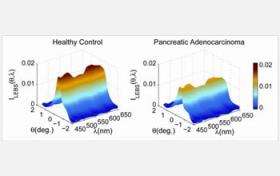
Measurements of light scattering off of benign tissue look different from similar measurements taken from cancerous tissue using the four-dimensional elastic light scattering fingerprinting (4D-ELF) and low-coherence enhanced backscattering spectroscopy (LEBS) techniques developed by researchers from Northwestern University and Evanston Northwestern Healthcare. The results are from the most recent clinical trial of the light-scattering analytical techniques, a trial that has shown the minimally invasive method for detecting pancreatic cancer is also able to differentiate other types of dangerous and benign pancreatic lesions without actually sampling pancreatic tissue. Credit: Northwestern University

In the latest clinical trial for a technique to detect pancreatic cancer, researchers found they could differentiate cells that are cancerous from those that are benign, pre-cancerous, or even early stage indicators called mucinous cystic lesions.

Pancreatic cancer is dangerous to screen for, yet deadly if ignored. The pancreas is extremely sensitive--biopsies can lead to potentially fatal complications--but with few symptoms, the cancer is usually detected too late.

The disease is the fourth largest cause of cancer-related deaths in the United States, with a five-year survival rate of less than 5 percent. If doctors can find ways to identify early precursor lesions, the disease can be prevented in most individuals.
Determining risk for pancreatic cancer
Enlarge

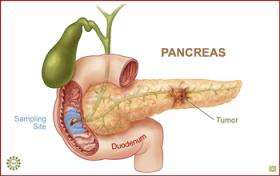
Pancreatic cancer, unseen at its earliest stages by any other method, can be detected by examining tissue from inside the duodenum, the uppermost section of the small intestine. The pancreatic duct communicates with the duodenum via the Ampulla of Vater. Researchers have shown that cells in a roughly 3 cm radius from this feature can show signs of the presence of cancer. Credit: Zina Deretsky, National Science Foundation

Reporting online Feb. 10, 2009, in the journal Disease Markers, researchers from Northwestern University and Evanston Northwestern Healthcare report convincing results with their minimally invasive methods for detecting pancreatic cancer.

"This technique allows us to detect changes in cells that look normal using microscopy," says co-author Vadim Backman of Northwestern University. "This level of detail allows us to detect cancer in its earliest stages."

Their techniques, called four-dimensional elastic light scattering fingerprinting (4D-ELF) and low-coherence enhanced backscattering spectroscopy (LEBS), identify the cancer and its precursors by analyzing light reflected off cells in the duodenum, a section of the small intestine adjacent to the pancreas.

"I'm excited about this work," said Leon Esterowitz, the National Science Foundation (NSF) biophotonics program director who helped fund this study and the development of the 4D-ELF and LEBS technologies. "I believe these results are very promising, and the techniques have a high probability of success for not just detecting early pancreatic cancer, but pre-cancer, so doctors can go ahead and treat the patient while there's still a chance to defeat the disease." Esterowitz added. "For pancreatic cancer, this could lead to not only an excellent prognosis, but perhaps even a cure."

While earlier success had shown that the techniques could tell cancerous from non-cancerous tissue without resorting to a biopsy, the new study of 203 individuals was the first to show the method can identify various disease stages and risk factors, including a possible signature related to "family history."

The researchers' approach had a sensitivity of 95 percent for determining healthy tissue from cancerous tissue and appears to be the most successful yet developed for detecting pancreatic diseases at curable stages and for identifying high-risk individuals.

"These optical techniques have shown promise for detecting both colon and pancreatic cancer," says Backman. "Our hope is to continue to test the ability to detect other forms of cancer, which would greatly expand the impact of the technology." In ongoing work, the researchers will continue to refine their instrumentation and hope to validate the recent findings with further clinical trials.

Source: National Science Foundation


print this article email this article download pdf blog this article bookmark this article     Stumble it Digg this share on Facebook retweet share on Reddit add to delicious
Rate this story - not rated yet


February 24, 2009 all stories

Comments: 0

not rated yet
  • Stumble this up

  • Digg this

  • share this

  • hide
  • Related Stories

  • The tall and short of diseases
    created Nov 25, 2009 | popularity not rated yet | comments 0
  • Tissue tension regulates tumor progression
    created Nov 23, 2009 | popularity not rated yet | comments 0
  • Sponges against cancer
    created Nov 20, 2009 | popularity not rated yet | comments 0
  • Rare pancreatic cancer patients may live longer when treated with radiation therapy
    created Nov 20, 2009 | popularity not rated yet | comments 0
  • Is type 2 diabetes mellitus a risk factor for gallbladder, biliary and pancreatic cancer?
    created Nov 19, 2009 | popularity not rated yet | comments 0


  • hide
  • Relevant PhysicsForums posts

  • Chest x-ray???
    created 4 hours ago
  • Multiple Sclerosis & CCSVI
    created Nov 26, 2009
  • 23 Years in a Vegetative State....or not?
    created Nov 25, 2009
  • Has the H1N1 vaccine been scientifically proven to work?
    created Nov 24, 2009
  • More from Physics Forums - Medical Sciences

Other News

What a grind: Bruxism at night likely a sign of stress by day

Medicine & Health / Health

created 4 hours ago | popularity 5 / 5 (1) | comments 0

You can practically track Steve Barkley's stress by the level of activity in his temporomandibular joint, or TMJ, the hinge joint that connects the lower jaw to the temporal bone of the skull and helps one chew, talk and ...


eye

Over-the-counter eye drops raise concern over antibiotic resistance

Medicine & Health / Medications

created 16 hours ago | popularity 3.5 / 5 (2) | comments 1

(PhysOrg.com) -- The use of antibiotic eye drops for conjunctivitis has increased by almost half since they became available over the counter at chemists in 2005, data obtained by Oxford University researchers ...


Overeating can set stage for obesity, researchers say

Medicine & Health / Health

created 10 hours ago | popularity not rated yet | comments 1

It doesn't seem like a fair fight. In one corner loomed the Thanksgiving table, groaning with poultry, pie and mashed potatoes.


New tools for prediction of disease progression in acute childhood leukemia

Medicine & Health / Cancer

created 11 hours ago | popularity not rated yet | comments 0

(PhysOrg.com) -- Researchers at Uppsala University and University Children’s Hospital in Uppsala have devised powerful new tools for typing cells from children with acute lymphatic leukemia and for prediction of how children ...


Nuclear science to fight sleeping sickness

Medicine & Health / Diseases

created 13 hours ago | popularity not rated yet | comments 0

The International Atomic Energy Agency on Friday announced an agreement to help African nations battle the tsetse fly, the main carrier of parasites that causes sleeping sickness with its bites.