A mathematical method helps to select human embryos
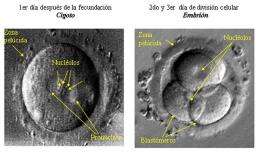
A team of researchers from the University of the Basque Country (UPV-EHU) have developed a mathematical classification which makes it possible to select human embryos for use in assisted reproduction treatments. Scientists have used the morphology of embryos to select the best candidates for implantation in the woman's uterus.
"Up to now experts working in in vitro fertilisation have selected the best embryos subjectively, based on their training and experience", so SINC was informed by Dinora A. Morales, from the Intelligent Systems Group at the UPV-EHU. However, in two studies carried out by researchers from this team the use of mathematical classifiers to help embryologists with that task was looked at.
In the first work, published in the journal Computer Methods and Programs in Biomedicine, the scientists presented an "intelligent system" of support for infertility treatments. For this they used information from 63 cases from the infertility programme at Clínica del Pilar in San Sebastian (Guipúzcoa), and analysed the evolution of trios of embryos (Spanish law allows for the transfer of up to three embryos to a woman's uterus).
To prepare the study, the researchers focused on the case history of infertile couples (age, type of infertility, quality of sperm, etc), as well as the morphological characteristics of the zygote (the resulting cell from the fusion of two gametes) and the embryos.
From the images taken with the microscope, the scientists were able to measure and classify the zygotes and embryos, as well as the blastomeres (undifferentiated animal cells produced by the division of the zygote), their degree of fragmentation and the thickness of the ‘zona pellucida', a membrane that surrounds them.
All this information was processed with Bayesian classifiers, so-called due to the application of Bayes rules, which make it possible to calculate the probability of implanting an embryo in a woman's uterus if transferred there. "What's more, these types of mathematical classifiers provide experts with evidence on what embryo characteristics enable the identification of the most ideal embryos, through the selection of variables", explained Morales.
The results of this study indicate that the size and degree of fragmentation of the blastomeres, thickness of the zona pellucida and the fact that they might have various nuclei are some of the aspects embryologists should concentrate on.
The Basque research group also carried out a second study, published in the journal Computers in Biology and Medicine to check the effectiveness of different Bayesian classifiers as a tool for choosing the best embryo.
The researchers analysed 249 photographs of embryos from the database at the Genesis Centre in Rome (Italy) and discovered that the "wrapper-TAN" classifier had a success rate of over 90%.
The team's next lines of work will concentrate on perfecting these techniques for selecting the best embryo in infertility treatments and in predicting multiple pregnancies, due to the risk they pose to women. The scientists will try to collaborate with other hospitals in this task.
More information:
Dinora Araceli Morales, Endika Bengoetxea, Pedro Larrañaga. “Selection of human embryos for transfer by Bayesian classifiers”. Computers in Biology and Medicine 38 (11-12): 1177-1186, 2008.
Dinora Araceli Morales, Endika Bengoetxea, Pedro Larrañaga, Miguel García, Yosu Franco, Mónica Fresnada, Marisa Merino. “Bayesian classification for the selection of in vitro human embryos using morphological and clinical data”. Computer Methods and Programs in Biomedicine 90 (2): 104-116, 2008.
Provided by SINC


