Scientists Identify Stem-Cell Genes That Help Form Plant Organs
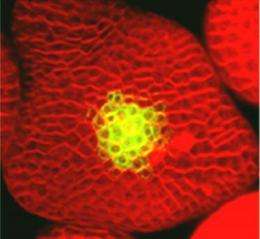
(PhysOrg.com) -- Plant stem-cells are master cells located at the tip of the stem and are part of a structure called the shoot apical meristem (SAM). Here, the stem cells—all clumped together—divide throughout the life of the plant to give rise to other cells, resulting in the formation of above-ground organs such as leaves, flowers, branches and stem.
But despite the important role the stem cells play in plant development, their molecular composition has eluded researchers for long.
Now, working on Arabidopsis, a mustard-like plant that is a model for studying plant biology, a team of researchers at UC Riverside has identified all the genes expressed in the plant's stem cells.
The researchers also identified all the genes expressed in two other SAM cells: niche cells (which are located just beneath the stem cells and which provide signals that regulate the stem cells), and differentiating cells (which are generated by, and surround, the stem cells).
The final product of the researchers' work is a genome-scale, expression map of SAM—an achievement that paves the way to developing better varieties of crops and plants.
Besides revealing the molecular pathways that stem cells employ, the discovery also can help scientists better understand why stem cells—in both plants and animals—give rise to specialized cells at all.
Study results appear online this week in the early edition of the Proceedings of the National Academy of Sciences.
"Our study is the first to reveal the stem-cell signatures for any plant and the first to provide a global view of which genes are expressed, and where, within the SAM," said G. Venugopala Reddy, the lead author of the study and an assistant professor of plant cell biology in the Department of Botany and Plant Sciences. "Since SAM stem-cells are responsible for forming plant organs and determining plant architecture, further analysis of their genes may provide a handle in altering growth rates and growth patterns in economically important crop-species in order to maximize yield."
Reddy stressed that understanding the function and regulation of stem-cell-specific genes is critical to gaining insights into basic questions such as what constitutes stem-cell identity (the ability of cells to remain unspecialized) and what makes them differentiate into specialized cells.
"A comparative analysis of stem-cell-specific genes between plant and animal systems may also lead to a better understanding of stem-cell identity, a concept common to both the systems," he said.
The study breaks ground also in the way Reddy's research team pinned down the stem-cell genes in Arabidopsis.
His lab initially labeled the three different SAM cell types—stem cells, niche cells and differentiating cells—by using different fluorescent proteins. Next, the researchers isolated the three discrete cell populations by first stripping the cell walls to release the cells as free populations. Then, using an instrument called Fluorescence Activated Cell Sorter, they separated each set of cells from the rest of the cell populations.
"Plant biologists have found it difficult to isolate the approximately 35 stem cells in the Arabidopsis shoot system for two main reasons: this is an extremely low number of stem cells and this clump of cells is tightly packed with a waxy coating covering its outer layer," Reddy said. "To meet this challenge, we used specific mutants of Arabidopsis that make more SAMs per plant. In the lab, we also formulated specific combinations of enzymes that efficiently digest away the cell walls."
Reddy explained that the gene expression map his team generated can help researchers track how genes give rise to complex tissues. It also will allow researchers to determine the expression patterns of SAM genes by a mere click of a button on a computer.
"Development of an organ such as SAM is a complex process in which cells constantly exchange information through regulated gene activities," he said. "What we have done so far is to find out which genes are expressed and where. One of the future challenges is to represent the gene expression on actual templates of plant cells, which would generate a dynamic atlas of stem-cell development. Such an atlas can be used to explore how genes function as a network to bring about stem-cell function."
Reddy acknowledged that developing the atlas is a difficult venture, requiring a synthesis of multiple disciplines such as genomics, live-imaging and informatics sciences.
"But our work breaks ground to make this a reality and we have already initiated some work in this direction," he said.
Source: University of California - Riverside


