Nanotechnologists Gain Powerful New Materials Probe
February 25, 2009 Nanotechnologists Gain Powerful New Materials Probe

Enlarge

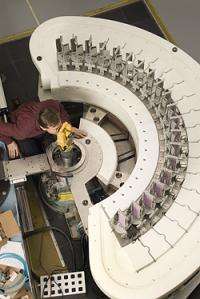
Top view of the MACS multiaxis detector system (seen before being enclosed in shielding material). With more neutrons striking the sample and more detectors surrounding it, MACS will greatly extend the capabilities of neutron inelastic scattering as a materials probe technique in nanotechnology and basic science. Principal investigator Collin Broholm of the Johns Hopkins University is seen examining the alignment of one of the 20 detection channels. Copyright: Robert Rathe

(PhysOrg.com) -- Researchers at the National Institute of Standards and Technology and The Johns Hopkins University have constructed a unique tool for exploring the properties of promising new materials with unprecedented sensitivity and speed—potentially allowing them to identify quickly those most useful for nanotechnology and industrial applications.

This novel instrument, called the Multi-Axis Crystal Spectrometer (MACS), is a variation on several other spectrometers at the NIST Center for Neutron Research (NCNR), where MACS is located. Like them, MACS bombards a sample of material with low-energy neutrons, which then bounce off the sample’s constituent atoms in specific directions and with specific velocities that reflect the arrangement of atoms within the material. Analyzing how neutrons scatter from a sample can tell scientists a great deal about the material’s physical properties, but older spectrometers are limited to relatively large samples and offer less range in the conditions under which they can be tested.

“These limitations are problematic in nanotechnology,” says Professor Collin Broholm of the Johns Hopkins University, “because oftentimes you grow a new material as a tiny crystal weighing only four or five milligrams, and then you want to see how it behaves under, say, an intense magnetic field.”

Not only can MACS overcome these limitations, but its unique construction allow has additional advantages. Many spectrometers provide just a single “channel” for detection, whereas MACS offers 20, forming a semicircle behind the sample—an arrangement that leads Broholm to compare MACS to a wide-angle, high-resolution lens. These improvements mean that MACS could become a favorite tool for scientists who must choose—and choose quickly—what material to grow next.

“With previous instruments for inelastic scattering from magnetic materials, 80 milligrams is about the smallest sample you can work with,” Broholm says. “But with MACS, we might be able to get detailed information about magnetic interactions even from a nano-structured thin film sample. These are the sort of interactions that nanotechnologists are trying to take advantage of when they design and shape things at the nanoscale.”

Broholm’s team is still fine-tuning MACS and expects to issue a full call for proposals to use the new spectrometer in about six months. Additional information on the NIST Center for Neutron Research http://www.ncnr.nist.gov/, a national user facility, is available on the facility’s Web site, including a list of available instruments at http://www.ncnr.nist.gov/instruments/. MACS is supported by the National Science Foundation.

Provided by NIST


print this article email this article download pdf blog this article bookmark this article     Stumble it Digg this share on Facebook retweet share on Reddit add to delicious
Rate this story - 3 /5 (2 votes)

Rank Filter

Move the slider to adjust rank threshold, so that you can hide some of the comments.


Display comments: newest first

  • holoman - Feb 27, 2009
    • Rank: not rated yet
    Neutrons' lack of total electric charge prevents engineers or experimentalists from being able to steer or accelerate them. Charged particles can be accelerated, decelerated, or deflected by electric or magnetic fields. However, these methods have no effect on neutrons except for a small effect of an inhomogeneous magnetic field because of the neutron's magnetic moment.

February 25, 2009 all stories

Comments: 1

3 /5 (2 votes)
  • Stumble this up

  • Digg this

  • share this

  • hide
  • Related Stories

  • Web browser enters a golden age
    created Jul 01, 2009 | popularity not rated yet | comments 0
  • Apple to open 24/7 store on Fifth Avenue
    created May 18, 2006 | popularity not rated yet | comments 0
  • Industry’s First Broadband Passive Optical Networking System-On-Chip
    created Jun 21, 2004 | popularity not rated yet | comments 0
  • With Windows 7 and new designs, PCs looking better
    created Oct 21, 2009 | popularity not rated yet | comments 0
  • RIM Introduces the New BlackBerry Bold 9700 Smartphone
    created Oct 21, 2009 | popularity not rated yet | comments 0


  • hide
  • Relevant PhysicsForums posts

  • Spin Polarization
    created 2 hours ago
  • Entropy
    created 2 hours ago
  • Bicycle wheel size question.
    created 3 hours ago
  • Shouldn't railgun gave any recoil?
    created 5 hours ago
  • More from Physics Forums - General Physics

Other News

Fast, easy, and highly sensitive arsenic detection with gold nanoparticles

Nanotechnology / Nanomaterials

created 13 hours ago | popularity 5 / 5 (1) | comments 0

(PhysOrg.com) -- Mention of arsenic poisoning usually brings to mind underhanded murder. However, the danger of arsenic poisoning from contaminated drinking water is far greater. Low concentrations of arsenic are found in ...


Water droplets direct self-assembly process in thin-film materials

Nanotechnology / Nanomaterials

created Nov 23, 2009 | popularity 5 / 5 (4) | comments 2

You can think of it as origami - very high-tech origami. Researchers at the University of Illinois have developed a technique for fabricating three-dimensional, single-crystalline silicon structures from thin films by coupling ...


Nanotube defects equal better energy and storage systems

Nanotube defects equal better energy and storage systems

Nanotechnology / Nanomaterials

created Nov 19, 2009 | popularity 4.4 / 5 (10) | comments 2

(PhysOrg.com) -- Most people would like to be able to charge their cell phones and other personal electronics quickly and not too often. A recent discovery made by UC San Diego engineers could lead to carbon ...


Nanotech in Space: Experiment To Weather the Trials of Orbit

Nanotech in Space: Experiment To Weather the Trials of Orbit

Nanotechnology / Nanomaterials

created Nov 24, 2009 | popularity 4 / 5 (2) | comments 0

Novel nanomaterials developed at Rensselaer were sent into orbit on Nov. 16 aboard Space Shuttle Atlantis.


Peptides control crystal growth with 'switches, throttles and brakes'

Peptides control crystal growth with 'switches, throttles and brakes'

Nanotechnology / Bio & Medicine

created Nov 23, 2009 | popularity 5 / 5 (3) | comments 0

(PhysOrg.com) -- By producing some of the highest resolution images of peptides attaching to mineral surfaces, scientists have a deeper understanding how biomolecules manipulate the growth crystals. This research ...