Probing and Controlling 'Molecular Rattling' May Mean Better Preservatives
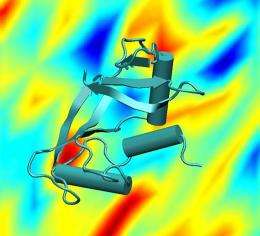
(PhysOrg.com) -- For centuries, people have preserved fruit by mixing it with sugar, making thick jams that last for months without spoiling. Now scientists at the National Institute of Standards and Technology have discovered* a fundamental property of mixture behavior that might help extend the life of many things including vaccines, food and library books—and save money while doing it.
In addition to jams, sugars are often used to preserve pharmaceuticals and similar biological materials. There are a number of mechanisms involved, but recently the local stiffening of the preservative was identified as a factor that can increase shelf life. Basically, stiffening the preservative decreases the ‘rattling’ of the fluid’s molecules and stabilizes the product, presumably because these rattling motions are intimately involved in spoiling—for instance, in the protein degradation processes that lead to the loss of biological function. Several years ago, the NIST team discovered the practical importance of high-frequency molecular rattling for protein preservation.**
But while sugars and other preservatives such as salts have been used for centuries, the prediction of how well a preservative works for a specific material has remained more an art than a science. Now, however, the NIST team has developed a relatively accessible measurement method for precisely quantifying the slowing down (or enhancement) of the local rattling motions in preservative formulations and have introduced a general mathematical framework for describing these changes. “This should remove much of the guesswork in determining the best way to protect a particular commodity,” says Jack Douglas of Polymers Division of NIST.
In the new paper, the team reveals a general pattern of behavior in the change in the rattling motions in mixtures that appears to apply to a variety of materials; these findings promise to be very helpful in the future development of preservatives. The paper also focuses on understanding the fundamental origin of high-frequency rattling’s effects, and it addresses enhancements in measurement and analysis that should allow researchers to optimize the preservation process.
“There’s a real regularity with which these changes occur, and we found a simple mathematical model that encapsulates these changes,” Douglas says. “The value here is that this mathematical framework allows you to consider this problem for many different materials.”
Douglas speculates that the discovery could help to extend the shelf life of vaccines significantly and also could be applied to preserving other biological materials such as seeds and prepared foods. The insight gained could even help to preserve library books. “These measurements can help determine the rate at which the changes occur, and that would help you predict how using more or less preservative might affect things, or how one substance stacks up against another,” Douglas says. “It could hasten discovery of the optimal additive for achieving a given end.”
More information:
* T. Psurek, C.L. Soles, K.A. Page, M.T. Cicerone and J.F. Douglas. Quantifying changes in the high-frequency dynamics of mixtures by dielectric spectroscopy. Journal of Physical Chemistry B, 2008, 112, 15980-15990.
** M.T. Cicerone and C.L. Soles. Fast dynamics and stabilization of proteins: Binary glasses of trehalose and glycerol. Biophysical Journal 2004, 86, 3836-3845.
Provided by NIST


