Big-Hearted Fish Reveals Genetic Underpinnings of Enigmatic Cardiovascular Condition
(PhysOrg.com) -- Researchers at the University of Pennsylvania School of Medicine have unlocked the mystery of a puzzling human disease and gained insight into cardiovascular development, all thanks to a big-hearted fish.
Mark Kahn, MD, Associate Professor of Medicine, graduate student Benjamin Kleaveland, and colleagues report in the February issue of Nature Medicine that a human vascular condition called Cerebral Cavernous Malformation (CCM) is caused by leaky junctions between cells in the lining of blood vessels. By combining studies with zebrafish and mice, the researchers found that the aberrant junctions are the result of mutated or missing proteins in a novel biochemical process, the so-called Heart-of-glass (HEG)-CCM pathway.
The HEG-CCM pathway "is essential to regulate endothelial cell-cell interaction, both during the time that vertebrates make the cardiovascular system and later in life," says Kahn. "Its loss later in life confers this previously unexplained disease, cerebral cavernous malformation."
CCM proteins, along with the receptor HEG, are responsible for building properly formed blood and lymphatic vessels during embryonic development by sealing the cell-cell junctions in the walls of vessels; loss of any of these proteins disrupts those seals, causing leaky vasculature.
Cerebral Cavernous Malformations are abnormal clusters of leaky blood vessels, typically in the brain, which can cause both seizures and strokes. The condition affects about 1 in 1,000 people, about 20% of whom carry a genetic predisposition for the condition. Researchers had already identified the genes responsible for the disease- indeed they were named CCM1, CCM2, and CCM3, in recognition of that fact - but not what those genes did.
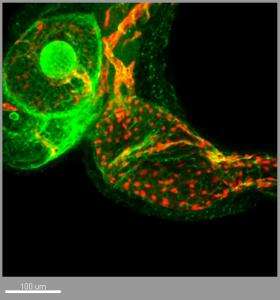
That's where the big-hearted fish come in. Several years ago, another research team discovered that mutations in CCM1, CCM2, or HEG (which had not previously been linked to CCM) caused zebrafish to develop enlarged hearts. Sensing that this observation could help unlock the mystery of what CCM proteins do, Kleaveland decided to see if these results could be extended to mice.
"Our notion was to take the zebrafish developmental studies and use the mouse as a way of bridging between what appeared to be a role in heart development in fish and blood vessel disease in people," says Kahn.
Kleaveland genetically engineered mice that both completely lack the HEG protein and produce diminished amounts of CCM2. This combination of genetic defects is fatal for the mice; they die during embryonic development. But, examination of their cardiovascular system and that of genetically altered fish, as well revealed several key findings, Kleaveland says.
First, loss of HEG produces cardiovascular defects—mainly leakiness—in the heart, in blood vessels in the lung, and in the lymphatic system. Second, loss of HEG with partial loss of CCM2 produces a worse cardiovascular defect—failure to even form critical blood vessels. Third, all of these defects are characterized by malformed cell-cell junctions in the endothelial cells that line these organs. And finally, HEG actually physically interacts with CCM proteins.
"It looks like the disease is a reflection of a disruption in endothelial cell-cell junctions, and this pathway is required to regulate them," Kahn says.
These data underscore the evolutionary significance of the biochemical process underlying CCM. "With millions of years of evolution between fish and mammals, genes typically acquire new roles and lose old roles," Kahn explains. "When things are that conserved, it just tends to mean that it's a highly important and central process, and it probably also tells us that whatever it's doing is fundamental to blood vessels and the whole cardiovascular system."
The study, Kahn adds, addresses a debate in the field as to whether CCM is the result of defects that cause the disease present in the affected endothelial cells themselves, or in the cells that surround them, such as neurons in the brain?
"We think the developmental model has shown us that the requirement is in the endothelial cell," he says.
Now Kahn, Kleaveland, and their colleagues are working to determine just what it is that HEG is doing in endothelial cell-cell junctions - what proteins it "talks" to on adjacent endothelial cells - and also, to build a true mouse model of the CCM disease.
The mice in this study died in utero, but CCM disease tends to affect humans in their 30s and older. With a good model, however, "you could watch the progression of it, and you could try to change that progression, essentially to treat a mouse," Kleaveland says.
Source: University of Pennsylvania School of Medicine


