Scientists pinpoint mechanism to increase magnetic response of ferromagnetic semiconductor
February 25, 2009 Scientists pinpoint mechanism to increase magnetic response of ferromagnetic semiconductor

Enlarge

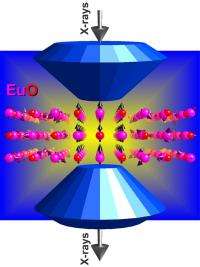
A ferromagnetic-semiconductor Europium oxide sample is subjected to high pressures in a diamond anvil cell. The electronic structure is simultaneously probed with circularly-polarized x-rays at the Advanced Photon Source, revealing the mechanism responsible for the strengthening of magnetic interactions under pressure.

(PhysOrg.com) -- When squeezed, electrons increase their ability to move around. In compounds such as semiconductors and electrical insulators, such squeezing can dramatically change the electrical- and magnetic- properties.

Under ambient pressure, Europium oxide becomes ferromagnetic only below 69 Kelvin, limiting its applications. However, its magnetic ordering temperature is known to increase with pressure, reaching 200 Kelvin when squeezed by 150,000 atmospheres. The relevant changes in electronic structure responsible for such dramatic changes, however, remained elusive.

Now scientists at the U.S. Department of Energy's Argonne National Laboratory have manipulated electron mobility and pinpointed the mechanism controlling the strength of magnetic interactions- and hence the material's magnetic ordering temperature.

"EuO is a ferromagnetic semiconductor and is a material that can carry spin polarized currents, which is an integral element of future devices aimed at manipulating both the spin and the charge of electrons in new generation microelectronics," Argonne's Postdoctoral researcher Narcizo Souza-Neto said.

Using powerful X-rays from the Advanced Photon Source to probe the material's electronic structure under pressure, Souza-Neto and Argonne Physicist Daniel Haskel report in the February 6 issue of Physical Review Letters that localized, 100 percent polarized Eu 4f electrons become mobile under pressure by hybridizing with neighboring, extended electronic states. The increased mobility enhances the indirect magnetic coupling between Eu spins resulting in a three-fold increase in the ordering temperature.

While the need for large applied pressures may seem a burden for applications, large compressive strains can be generated at interfacial regions in EuO films by varying the mismatch in lattice parameter with selected substrates. By pinpointing the mechanism the research provides a road map for manipulating the ordering temperatures in this and related materials, e.g., through strain or chemical substitutions with the ultimate goal of reaching 300 Kelvin (room temperature).

"Manipulation of strain adds a new dimension to the design of novel devices based on injection, transport, and detection of high spin-polarized currents in magnetic/semiconductor hybrid structures", Haskel said.

More information: The paper, "Pressure-induced electronic mixing and enhancement of ferromagnetic ordering in EuX (X=O,S,Se,Te) magnetic semiconductors," is available online.

Source: Argonne National Laboratory


print this article email this article download pdf blog this article bookmark this article     Stumble it Digg this share on Facebook retweet share on Reddit add to delicious
Rate this story - 4.3 /5 (3 votes)


February 25, 2009 all stories

Comments: 0

4.3 /5 (3 votes)
  • Stumble this up

  • Digg this

  • share this

  • hide
  • Related Stories

  • In Brief: Exploring the limits of antiferromagnetism in nanostructured materials
    created Oct 09, 2009 | popularity not rated yet | comments 0
  • 'Colossal' Magnetic Effect Under Pressure
    created Jun 05, 2009 | popularity not rated yet | comments 0
  • Researchers Explore Magnetic Properties of Iron-Based Superconductors
    created Apr 13, 2009 | popularity not rated yet | comments 0
  • Researchers explore magnetic properties of iron-based superconductors
    created Mar 16, 2009 | popularity not rated yet | comments 0
  • Compressor-free refrigerator may loom in the future
    created Aug 07, 2008 | popularity not rated yet | comments 0


  • hide
  • Relevant PhysicsForums posts

Other News

Restored machine to explore mysteries of Big Bang (AP)

Restored machine to explore mysteries of Big Bang

Physics / General Physics

created 12 hours ago | popularity 4.4 / 5 (12) | comments 9

(AP) -- Scientists are preparing the world's largest atom smasher to explore the depths of matter after successfully restarting the $10 billion machine following more than a year of repairs.


nuclear power plant

Doubts raised on nuclear industry viability

Physics / General Physics

created Nov 19, 2009 | popularity 3.2 / 5 (19) | comments 18

(PhysOrg.com) -- The investment in nuclear power has been growing around the world over the last few years, being viewed as a means for countries to control their energy security, avoid the price fluctuations ...


Researchers Find Innate Correlations Among Different Power Law Phenomena

Researchers Find Innate Correlations Among Different Power Law Phenomena

Physics / General Physics

created Nov 17, 2009 | popularity 4.3 / 5 (15) | comments 12

(PhysOrg.com) -- Studying the patterns that emerge in natural and social phenomena is a popular area of research, although usually individual phenomena are studied separately from each other. In a recent study, ...


Scientists demonstrate 'universal' programmable quantum processor

Scientists demonstrate 'universal' programmable quantum processor

Physics / Quantum Physics

created Nov 15, 2009 | popularity 4.6 / 5 (21) | comments 11

Physicists at the National Institute of Standards and Technology have demonstrated the first "universal" programmable quantum information processor able to run any program allowed by quantum mechanics -- th ...


Proton's party pals may alter its internal structure

Proton's party pals may alter its internal structure

Physics / General Physics

created Nov 18, 2009 | popularity 4.5 / 5 (19) | comments 9

A recent experiment at the DOE's Thomas Jefferson National Accelerator Facility has found that a proton's nearest neighbors in the nucleus of the atom may modify the proton's internal structure.