Models present new view of nanoscale friction
February 25, 2009 by Liz Ahlberg Models present new view of nanoscale friction

Enlarge

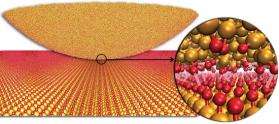
This graphic recreates an atom-level view of the nanoscale interface between carbon and diamond. At such a small scale, the surfaces are rough, although researchers have been treating them as smooth. Image: Izabela Szlufarska

(PhysOrg.com) -- To understand friction on a very small scale, a team of University of Wisconsin-Madison engineers had to think big.

Friction is a force that affects any application where moving parts come into contact; the more surface contact there is, the stronger the force. At the nanoscale — mere billionths of a meter — friction can wreak havoc on tiny devices made from only a small number of atoms or molecules. With their high surface-to-volume ratio, nanomaterials are especially susceptible to the forces of friction.

But researchers have trouble describing friction at such small scales because existing theories are not consistent with how nanomaterials actually behave. Through computer simulations, the group demonstrated that friction at the atomic level behaves similarly to friction generated between large objects. Five hundred years after Leonardo da Vinci discovered the basic friction laws for large objects, the UW-Madison team has shown that similar laws apply at the nanoscale.

The team, which was led by Izabela Szlufarska, an assistant professor of materials science and engineering, and included materials science and engineering graduate student Yifei Mo and mechanical engineering assistant professor Kevin Turner, published its findings in the Feb. 26 issue of the journal Nature.

Current nanoscale friction theories are based on the idea that nanoscale surfaces are smooth, but, in reality, the surfaces resemble a mountain range, where each peak corresponds to an atom or a molecule.

The UW-Madison team performed computer simulations that looked at nanoscale materials as a collection of atoms, monitoring their positions and interactions throughout the entire sliding process. "For the first time, we modeled friction at length scales very similar to experiments, while maintaining atomic resolution and realistic interactions between atoms," say Szlufarska.

The team discovered simple laws of nanoscale friction. They found that friction is proportional to the number of atoms that interact between two nanoscale surfaces. The researchers' simulations showed that, at the nanoscale, materials in contact behave more like large rough objects rubbing against each other, rather than as two perfectly smooth surfaces, as was previously imagined. "When you look at it closely, the surface is made of atoms, so the contact is actually rough," says Szlufarska.

The team's simulation data correlates very well with recorded experimental data — something that previous models have failed to accomplish. Szlufarska hopes to use the simulations as a tool to understand what mechanisms contribute to friction on both the nano- and macroscale.

"Nobody is able to predict friction or design materials with desired friction properties — we measure a lot of friction coefficients for different materials, but it's not really clear how to relate them to the properties of the material," she explains. "The origin of friction is really an open and growing research
field."

Provided by University of Wisconsin-Madison


print this article email this article download pdf blog this article bookmark this article     Stumble it Digg this share on Facebook retweet share on Reddit add to delicious
Rate this story - 4.8 /5 (8 votes)

Rank Filter

Move the slider to adjust rank threshold, so that you can hide some of the comments.


Display comments: newest first

  • superhuman - Feb 26, 2009
    • Rank: not rated yet
    The researchers simulations showed that, at the nanoscale, materials in contact behave more like large rough objects rubbing against each other, rather than as two perfectly smooth surfaces, as was previously imagined


    This is typical for the pathetic science reporting here. To make the discoveries more exciting the articles purposefully misrepresent the state of prior knowledge.

    No one, expect perhaps for science illiterates, imagined object surfaces are smooth at nano scale!

February 25, 2009 all stories

Comments: 1

4.8 /5 (8 votes)
  • Stumble this up

  • Digg this

  • share this

  • hide
  • Related Stories


  • hide
  • Relevant PhysicsForums posts

  • Shouldn't railgun gave any recoil?
    created 2 hours ago
  • wavelengths for ionization
    created 2 hours ago
  • atomic isolation
    created 2 hours ago
  • LED Headlights do not work
    created 4 hours ago
  • More from Physics Forums - General Physics

Other News

Fast, easy, and highly sensitive arsenic detection with gold nanoparticles

Nanotechnology / Nanomaterials

created 9 hours ago | popularity 5 / 5 (1) | comments 0

(PhysOrg.com) -- Mention of arsenic poisoning usually brings to mind underhanded murder. However, the danger of arsenic poisoning from contaminated drinking water is far greater. Low concentrations of arsenic are found in ...


Nanotech in Space: Experiment To Weather the Trials of Orbit

Nanotech in Space: Experiment To Weather the Trials of Orbit

Nanotechnology / Nanomaterials

created 21 hours ago | popularity 4 / 5 (2) | comments 0

Novel nanomaterials developed at Rensselaer were sent into orbit on Nov. 16 aboard Space Shuttle Atlantis.


Water droplets direct self-assembly process in thin-film materials

Nanotechnology / Nanomaterials

created Nov 23, 2009 | popularity 5 / 5 (4) | comments 2

You can think of it as origami - very high-tech origami. Researchers at the University of Illinois have developed a technique for fabricating three-dimensional, single-crystalline silicon structures from thin films by coupling ...


Nanotube defects equal better energy and storage systems

Nanotube defects equal better energy and storage systems

Nanotechnology / Nanomaterials

created Nov 19, 2009 | popularity 4.4 / 5 (10) | comments 2

(PhysOrg.com) -- Most people would like to be able to charge their cell phones and other personal electronics quickly and not too often. A recent discovery made by UC San Diego engineers could lead to carbon ...


Peptides control crystal growth with 'switches, throttles and brakes'

Peptides control crystal growth with 'switches, throttles and brakes'

Nanotechnology / Bio & Medicine

created Nov 23, 2009 | popularity 5 / 5 (3) | comments 0

(PhysOrg.com) -- By producing some of the highest resolution images of peptides attaching to mineral surfaces, scientists have a deeper understanding how biomolecules manipulate the growth crystals. This research ...