IceCube building goals exceeded at South Pole
February 25, 2009 IceCube building goals exceeded at South Pole

Enlarge

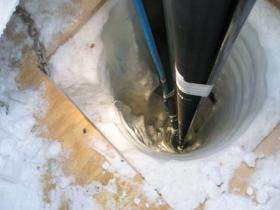
The hot water hose and support cables disappear down one of the dozens of boreholes drilled into the Antarctic ice to construct the IceCube Neutrino Observatory. This enormous telescope is using high-energy neutrinos and cosmic rays to learn about distant cosmological events like supernovas and gamma-ray bursts. Photo: Jim Haugen

(PhysOrg.com) -- As the 2008-09 Antarctic drilling season concludes, the IceCube Neutrino Observatory is on track to be finished as planned in 2011.

The observatory is an enormous telescope designed to capture evidence of elusive subatomic particles called neutrinos released by distant cosmic events like exploding stars. Built directly into the ice covering Antarctica, IceCube uses the Earth to filter out lower-energy particles and focus instead on the highest energy neutrinos that carry information about supernovas, dark matter, gamma-ray bursts and other exotic cosmological mysteries.

IceCube is constructed using a hot-water drill to bore holes one and a half miles deep into the ice. Strings of optical sensors are lowered in and frozen into place.
IceCube building goals exceeded at South Pole
Enlarge

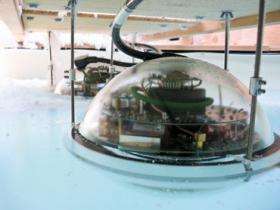
Two digital optical modules (DOMs) freeze into place in an IceTop tank on the surface of Antarctica. The IceTop array is a part of the IceCube Neutrino Observatory, an enormous telescope that is using high-energy neutrinos and cosmic rays to learn about distant cosmological events like supernovas and gamma-ray bursts. Photo: Tom Gaisser

By optimizing their drilling procedures, the IceCube team installed 19 strings of optical sensors this season, surpassing the original goal by three, and still finished a week ahead of schedule.

“Drilling a one-and-a-half-mile hole in the ice in about two days is a testing task no matter how often you have done it,” says Francis Halzen, principal investigator of IceCube and UW-Madison physics professor. “Thanks to an incredibly talented and experienced crew, drilling and moving from hole to hole has become as coordinated and precise as a marching band. We had an incredibly smooth season.”

A total of 59 strings containing 3,540 basketball-sized digital optical modules (DOMs) are now embedded in the ice near the South Pole. When completed, the detector will consist of more than 5,000 DOMs spanning a cubic kilometer of deep Antarctic ice.

In addition to the 80 regular strings, the team plans to install six “deep-core” strings that will enhance neutrino detection in the deepest, clearest ice. These strings, funded largely by the Swedish collaborators on the project, will use very high-efficiency detectors that will improve the observatory’s ability to detect a larger range of neutrinos. The first deep string was installed this season.

The deep strings will also help replace an aging experiment at the pole named AMANDA, for the Antarctic Muon and Neutrino Detector Array. AMANDA was built more than 10 years ago as a smaller-scale experiment to “break the ice” for IceCube and has been integrated into the IceCube design. To make room for newer technology, AMANDA will be decommissioned later this year.

With two-thirds of IceCube’s DOMs already in place, the scientists are already collecting and analyzing data. A small percentage of the data collected at the pole is transmitted via satellite, but the vast majority is stored on magnetic tapes and shipped to Madison at the end of the work season. Events collected during the past year are now being sorted and prepped for analysis.

Initial data are being used to test and calibrate the instrument, but the scientists are keeping their eyes open for particularly noteworthy neutrinos that might signify interesting cosmic events.

“A great advantage of IceCube is that it takes data as the telescope grows,” Halzen says. “In 2009, the accumulated volume of data will allow us to reach the sensitivity where we enter the promised land — decades of predictions waiting to be confirmed, or not. That is science.”

IceCube is an international collaboration supported by the National Science Foundation, with significant contributions from the Wisconsin Alumni Research Foundation, Germany, Sweden, Belgium, Japan, New Zealand and the Netherlands.

More information: http://icecube.wisc.edu/

Provided by University of Wisconsin


print this article email this article download pdf blog this article bookmark this article     Stumble it Digg this share on Facebook retweet share on Reddit add to delicious
Rate this story - 4.5 /5 (4 votes)

Rank Filter

Move the slider to adjust rank threshold, so that you can hide some of the comments.


Display comments: newest first

  • Adriab - Feb 26, 2009
    • Rank: not rated yet
    This is really cool (sorry about the pun). Seriously though, even though these sensors are in a bit of a harsh environment, I'd argue they are easier to install and monitor than the neutrino detectors that were put into the ocean.

    Let's just hope there are no massive ice-faults that break these things before they report good data.

February 25, 2009 all stories

Comments: 1

4.5 /5 (4 votes)
  • Stumble this up

  • Digg this

  • share this

  • hide
  • Related Stories


  • hide
  • Relevant PhysicsForums posts

  • moment of inertia and friction
    created 4 hours ago
  • two-dimensional collision
    created 7 hours ago
  • I Need Help Selecting a Good Text Book to Learn the Basics
    created 9 hours ago
  • The acceleration of mass using light
    created 9 hours ago
  • Badminton
    created 10 hours ago
  • Galileos law of free fall
    created 12 hours ago
  • More from Physics Forums - General Physics

Other News

New tool for helping pediatric heart surgery

Physics / General Physics

created 53 minutes ago | popularity not rated yet | comments 0

A team of researchers at the University of California, San Diego and Stanford University has developed a way to simulate blood flow on the computer to optimize surgical designs. It is the basis of a new tool that may help ...


In the Brain, Seven Is A Magic Number

In the Brain, Seven Is A Magic Number

Physics / General Physics

created 13 hours ago | popularity 4.3 / 5 (18) | comments 5

Having a tough time recalling a phone number someone spoke a few minutes ago or forgetting items from a mental grocery list is not a sign of mental decline; in fact, it's natural.


Scientists react as they stand in front of a screen at CERN

First atoms reported smashed in Large Hadron Collider (Update)

Physics / General Physics

created 15 hours ago | popularity 4.9 / 5 (22) | comments 10

Two circulating beams on Monday produced the first particle collisions in the world's biggest atom smasher, the Large Hadron Collider (LHC), three days after its restart, scientists announced.


Straightening messy correlations with a quantum comb

Straightening messy correlations with a quantum comb

Physics / Quantum Physics

created 15 hours ago | popularity 4.7 / 5 (7) | comments 0

Quantum computing promises ultra-fast communication, computation and more powerful ways to encrypt sensitive information. But trying to use quantum states as carriers of information is an extremely delicate ...


Visual assistance for cosmic blind spots

Visual assistance for cosmic blind spots

Physics / General Physics

created 16 hours ago | popularity 4.3 / 5 (3) | comments 0

A bit of imagination on the part of a measuring instrument wouldn't be a bad thing. It could help to add data from areas where the instrument is unable to measure. However, it must do so constructively. In ...