Fossil fish shows oldest live birth
February 25, 2009 Fossil fish shows oldest live birth

Enlarge

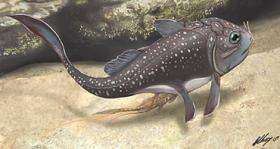
Illustration of how this ancient fish, a placoderm, gave birth to live young © Museum Victoria

(PhysOrg.com) -- A 380-million-year-old fossil fish that shows an unborn embryo and umbilical cord has been discovered, scientists report in the journal Nature.

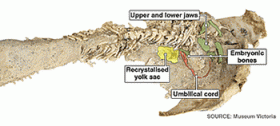
The extremely rare specimen shows incredible detail. The umbilical cord is attached to an area of small bones, corresponding to the embryo. This means the fish would have given birth to live young, known as viviparity and is the oldest record of this kind known.

'The find is important because it provides concrete evidence for vivparity,' says Zerina Johanson, fossil fish curator (expert) at the Natural History Museum.

'It is extremely rare to find preservation like this in the fossil record. This new discovery extends the record of viviparity further back almost 200 million years'.
Fossil fish shows oldest live birth
Enlarge

Fossil specimen found in Australia showing the umbilical cord and embryo parts. © Museum Victoria

Advanced reproduction

Viviparity, where a mother gives birth to live young, is an advanced form of reproduction and it is most often found in mammals.

This specimen belongs to an ancient species of fish that was previously thought to have had a more primitive form of reproduction where fertilisation happens externally.

However, the specimen shows evidence of viviparity and a reproductive biology that is comparable to that of some modern sharks and rays.

Careful unearthing

The well-preserved specimen is from the Gogo Formation in western Australia where many other fossil fishes have been discovered.

These fossils are unearthed using an acid solution to break down the limestone around the fossil. John Long (Museum Victoria, Melbourne, Australia) and colleagues were able to reveal even finer details because they used a lower concentration of acid.

'Long and his colleagues observed small placoderm bones within the body cavity of an adult placoderm,' says Johanson.

'One could say that this indicates that the adult simply ate the smaller specimen, but the concrete evidence comes in the form of a fine, curled cord in association with the small bones. Long and his colleagues suggest this is an umbilical cord, indicating a placental connection between adult and embryo.'

New species

The fossil fish belonged to an extinct diverse group of fish called placoderms. The fish is a new species, named Materpiscis attenboroughi after David Attenborough, who first drew attention to the Gogo fish sites in the Life on Earth TV series in 1979.

'Placoderms as a group represent the most primitive group of jawed vertebrates, so the work of Long and colleagues shows that viviparity evolved very early during vertebrate history,' Johanson concludes.

Provided by Natural History Museum


print this article email this article download pdf blog this article bookmark this article     Stumble it Digg this share on Facebook retweet share on Reddit add to delicious
Rate this story - 4 /5 (5 votes)


February 25, 2009 all stories

Comments: 0

4 /5 (5 votes)
  • Stumble this up

  • Digg this

  • share this

  • hide
  • Related Stories

  • Airborne nitrogen shifts aquatic nutrient limitation in pristine lakes
    created Nov 05, 2009 | popularity not rated yet | comments 0
  • Climate variability impacts the deep sea
    created Nov 02, 2009 | popularity not rated yet | comments 0
  • Like a hungry teen, life on Earth had big growth spurts
    created Oct 27, 2009 | popularity not rated yet | comments 0
  • Algae may be secret weapon in climate change war
    created Oct 22, 2009 | popularity not rated yet | comments 0
  • Killer algae a key player in mass extinctions
    created Oct 19, 2009 | popularity not rated yet | comments 0


Other News

Scientists successfully reprogram blood cells

Biology / Cell & Microbiology

created 19 minutes ago | popularity not rated yet | comments 0

Researchers have transplanted genetically modified hematopoietic stem cells into mice so that their developing red blood cells produce a critical lysosomal enzyme -preventing or reducing organ and central nervous system damage ...


Nano bubble gum for enhancing drug delivery in gut

Biology / Biotechnology

created 1hour ago | popularity not rated yet | comments 0

Of the many characteristic traits a drug can have, one of the most desirable is the ability for a drug to be swallowed and absorbed into the bloodstream through the gut. Some drugs, like over-the-counter aspirin, lend themselves ...


Study shows that some malignant tumors can be shut down after all

Biology / Cell & Microbiology

created 3 hours ago | popularity 5 / 5 (1) | comments 0

Oncologists have had their hands tied because more than half of all human cancers have mutations that disable a protein called p53. As a critical anti-cancer watchdog, p53 masterminds several cancer-fighting operations within ...


What is the meaning of 'one'? Evolutionary biologists argue for new meaning of 'organismality'

Biology / Evolution

created 4 hours ago | popularity 5 / 5 (1) | comments 1

Rice University evolutionary biologists David Queller and Joan Strassmann argue in a new paper that high cooperation and low conflict between components, from the genetic level on up, give a living thing its "organismality," ...


Researchers show how to divide and conquer 'social network' of cells

Researchers show how to divide and conquer 'social network' of cells

Biology / Biotechnology

created 5 hours ago | popularity not rated yet | comments 0

On Noah's Ark animals came in twos: male and female. In human bodies trillions of cells are coupled, too, and so are the molecules from which they are composed. Yet these don't come in twos, they are regrouped ...