Reverse Chemical Switching of a Ferroelectric Film
February 25, 2009
(PhysOrg.com) -- Ferroelectric materials display a spontaneous electric polarization below the Curie temperature that can be reoriented, typically by applying an electric field. In this study, researchers from Argonne, Northern Illinois University, and The University of Pennsylvania have demonstrated that the chemical environment can control the polarization orientation in an ultrathin ferroelectric film.
This is complementary to recent predictions that polarization can affect surface chemistry and illuminates potential applications in sublithographic patterning and electrically tunable catalysts.
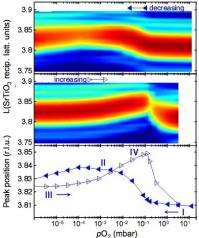
In situ synchrotron X-ray scattering measurements showed that high or low oxygen partial pressure induces outward or inward polarization, respectively, in an ultrathin PbTiO3 film. While X-ray scattering is not sensitive to interfacial charge from polarization, it is very sensitive to the atomic positions in the crystal structure of a ferroelectric film that determine its polarization.
The image shows hysteresis in the ferroelectric film structure as a function of oxygen partial pressure indicating polarization switching. The most intense (red) feature is the PbTiO3 Bragg peak. By following the behavior in situ, one sees that chemical potential affects ferroelectric film polarization in the same way as electric potential. In combination with ab initio based modeling, these experiments show that the chemical environment can play a dominant role in the behavior of nanoscale ferroelectrics.
More information:
• Wang et al., "Reversible Chemical Switching of a Ferroelectric Film," Phys. Rev. Lett., 102, 047601 (2009),
• J. Hinka, "A Viewpoint on Reversible Chemical Switching of a Ferroelectric Film," Physics. 2, 8 (2009) (online)
Provided by Argonne National Laboratory
-
Experiments prove nanoscale metallic conductivity in ferroelectrics
Jan 09, 2012 |
5 / 5 (3) |
0
-
Zinc oxide microwires improve the performance of light-emitting diodes
Oct 31, 2011 |
4.6 / 5 (11) |
0
-
Shocking: Environmental chemistry affects ferroelectric film polarity the same way electric voltage does
Feb 02, 2009 |
4.2 / 5 (9) |
2
-
Nano World: Water for denser nano-memory
May 02, 2006 |
4 / 5 (18) |
0
-
New 'Pure Light' Technology Makes Computer Screens, Cell Phone Displays More Power Efficient
Jan 05, 2005 |
2 / 5 (2) |
0
-
Fast photon control brings quantum photonic technologies closer
31 minutes ago |
5 / 5 (2) |
0
-
Engineers build first sub-10-nm carbon nanotube transistor
Feb 01, 2012 |
4.9 / 5 (33) |
30
-
Something old, something new: Evolution and the structural divergence of duplicate genes
Jan 31, 2012 |
4.6 / 5 (7) |
1
-
The hidden nanoworld of ice crystals: Revealing the dynamic behavior of quasi-liquid layers
Jan 30, 2012 |
5 / 5 (5) |
1
-
Stock market network reveals investor clustering
Jan 27, 2012 |
3.9 / 5 (23) |
8
-
Help with snow Crystals
11 hours ago
-
Doubts about surface plasmons
Feb 11, 2012
-
excited U-236 decay time in the U235 fission chain
Feb 09, 2012
-
Polar catastrophe?
Feb 09, 2012
-
Large scale field sonication
Feb 09, 2012
-
states and energy of paired electrons in BCS
Feb 08, 2012
- More from Physics Forums - Atomic, Solid State, Comp. Physics
More news stories
Fast photon control brings quantum photonic technologies closer
(PhysOrg.com) -- Using photons instead of electrons to transmit information could lead to faster and more secure ways to communicate, among other advantages. Now a team of physicists has taken another step toward realizing ...
Rapunzel, Leonardo and the physics of the ponytail
(PhysOrg.com) -- New research provides the first mathematical understanding of the shape of a ponytail and could have implications for the textile industry, computer animation and personal care products.
5 hours ago |
4.7 / 5 (3) |
0
|
Researchers make better heat sensor based on butterfly wings
(PhysOrg.com) -- Scientists have long known that butterfly wings produce their iridescent colors by bouncing light around and between tiny ridges in structures made of chitin. More recently they’ve discovered ...
Explained: Sigma
It's a question that arises with virtually every major new finding in science or medicine: What makes a result reliable enough to be taken seriously? The answer has to do with statistical significance -- but ...
Feb 09, 2012 |
5 / 5 (21) |
87
Quantum physicist explains $100K offer for proof scaled-up quantum computing is impossible
(PhysOrg.com) -- MIT researcher Scott Aaronson has certainly riled the physics community with his offer this past Friday, of $100,000 to anyone who can prove that scaled-up quantum computing is impossible. ...
Planck mission steps closer to the cosmic blueprint
(PhysOrg.com) -- ESA's Planck mission has revealed that our Galaxy contains previously undiscovered islands of cold gas and a mysterious haze of microwaves. These results give scientists new treasure to mine ...
New ability to regrow blood vessels holds promise for treatment of heart disease
(Medical Xpress) -- University of Texas at Austin researchers have demonstrated a new and more effective method for regrowing blood vessels in the heart and limbs a research advancement that could have ...
A lost world? How zooarchaeology can inform biodiversity conservation
A new study of tropical forests will provide a 50,000-year perspective on how animal biodiversity has changed, explored through an archaeological investigation of animal bones.
Myths and shame keep many from seeking bankruptcy protection
(PhysOrg.com) -- Two interesting facts that may counter modern ideas about bankruptcy: The overwhelming majority of U.S. filings belong to individuals rather than corporations or entities, and most of these ...
Big Society could threaten biodiversity conservation
A study of the Moray Firth Seal Management Plan (MFSMP), in north-east Scotland, identified four key conditions for long-term success, three of which pointed to the importance of direct government involvement.
Motivation to exercise affects behavior
(Medical Xpress) -- For many people, the motivation to exercise fluctuates from week to week, and these fluctuations predict whether they will be physically active, according to researchers at Penn State. In an effort to ...