Brain protein may be a target for fast-acting antidepressants
February 25, 2009(PhysOrg.com) -- It takes weeks or months for the effect of most antidepressants to kick in, time that can feel like an eternity to those who need the drugs the most. But new research suggests that a protein called p11, previously shown to play a role in a person’s susceptibility to depression, activates a serotonin receptor in the brain known for producing a rapid antidepressant response. If scientists could develop drugs to target this receptor, they might produce an effect in as little as two days.
The finding, reported this month in The Journal of Neuroscience by Rockefeller University’s Paul Greengard, Jennifer L. Warner-Schmidt and colleagues in Sweden, solidifies p11 as a key determinant of vulnerability to depression and may lead investigators to new treatments.
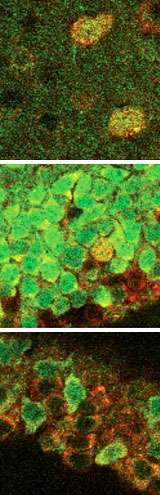
Pinpointing depression. Using transgenic mice that express a green fluorescent protein when the serotonin 4 receptor is switched on, Rockefeller University researchers show that a protein called p11 (red) and the serotonin 4 receptor (green) are expressed together in regions of the brain that are associated with depression.
Previous research by Greengard, who is Vincent Astor Professor and head of the Laboratory of Molecular and Cellular Neuroscience, and coauthor Per Svenningsson established p11 as a key signaling molecule for a neurotransmitter known as serotonin, which has long been linked to mood. They also showed that the interaction between p11 and serotonin influences an individual’s susceptibility to depression and his or her response to antidepressant treatments. (They later showed that p11 and serotonin also play a role in the symptoms of advanced Parkinson’s disease.)These earlier studies focused on the serotonin 1B receptor. For the new study, Greengard, Svenningsson and their colleagues looked at p11’s interaction with another receptor known as serotonin 4, which has been shown to produce a rapid antidepressant response in rodent models of depression. Because serotonin 4 is expressed outside the brain, particularly in the gastrointestinal system, scientists have had difficulty homing in on it to evaluate its potential as an effective therapeutic target.
Using transgenic mice that express a green fluorescent protein when the serotonin 4 receptor is switched on, the researchers showed that p11 and serotonin 4 are expressed together in regions of the brain that are associated with depression.
Previous studies by Greengard’s team showed that p11 is required for the antidepressant actions of a molecule called an agonist, which activates the serotonin 1B receptor. To determine whether p11 is required for the action of a serotonin 4 agonist, the researchers injected two groups of mice with a compound called RS67333, which has been shown to produce antidepressant-like effects. They found that the antidepressant activity of RS67333 was normal in normal mice but absent in mice that were lacking p11.
“Together, these findings confirm the essential role played by p11 in modulating signaling through the serotonin 4 receptor and support the concept that this protein may be a key determinant of vulnerability to depression,” says Greengard.
Currently available antidepressants require weeks or months to produce therapeutic effects in patients. Studies in rodents have shown that behavioral responses that typically require two to three weeks of antidepressant treatment will occur after only one or two days of treatment with the serotonin 4 receptor agonist RS67333. The interaction of p11 with serotonin 4, says Greengard, represents a promising avenue of investigation for improved antidepressants.
“There is a pressing clinical need for faster-acting antidepressants,” says Greengard. “An understanding of the cellular mechanisms underlying the therapeutic actions of these drugs may lead to better treatments with fewer side effects.”
More information: The Journal of Neuroscience 29(6): 1937-1946 (February 11, 2009), Role of p11 in Cellular and Behavioral Effects of 5-HT4 Receptor Stimulation, Jennifer L. Warner-Schmidt, Marc Flajolet, Abigail Maller, Emily Y. Chen, Hongshi Qi, Per Svenningsson and Paul Greengard
Provided by Rockefeller University
-
New model for treatment of obsessive-compulsive disorder created
Sep 15, 2011 |
5 / 5 (1) |
0
-
Melatonin analogue agomelatine could have role in treating major depression
May 17, 2011 |
5 / 5 (1) |
0
-
Neurological protein may hold the key to new treatments for depression
Nov 29, 2010 |
4.5 / 5 (2) |
0
-
Scientists shed light on how serotonin works
Oct 05, 2010 |
5 / 5 (12) |
0
-
Depressed mice could aid research on drug-resistant depression in humans
Jun 29, 2010 |
4.8 / 5 (4) |
0
-
Fast photon control brings quantum photonic technologies closer
9 hours ago |
5 / 5 (4) |
0
-
Engineers build first sub-10-nm carbon nanotube transistor
Feb 01, 2012 |
4.9 / 5 (33) |
30
-
Something old, something new: Evolution and the structural divergence of duplicate genes
Jan 31, 2012 |
4.6 / 5 (7) |
1
-
The hidden nanoworld of ice crystals: Revealing the dynamic behavior of quasi-liquid layers
Jan 30, 2012 |
5 / 5 (5) |
1
-
Stock market network reveals investor clustering
Jan 27, 2012 |
3.9 / 5 (23) |
8
-
Is Everyday Technology Killing Us?
Feb 08, 2012
-
Exercise and weight loss
Feb 08, 2012
-
Why do we have head aches? Our brains can't feel anything.
Feb 07, 2012
-
"The end of diseases" by David Agus, interview from Daily Show with Jon Stewart
Feb 04, 2012
-
Oncolytic adenovirus
Feb 04, 2012
-
Nutrition label stuffs and diets
Feb 02, 2012
- More from Physics Forums - Medical Sciences
More news stories
Discovery paves way for salmonella vaccine
(Medical Xpress) -- An international research team led by a University of California, Davis, immunologist has taken an important step toward an effective vaccine against salmonella, a group of increasingly antibiotic-resistant ...
12 minutes ago |
5 / 5 (2) |
0
|
First-of-its-kind stem cell study re-grows healthy heart muscle in heart attack patients
Results from a Cedars-Sinai Heart Institute clinical trial show that treating heart attack patients with an infusion of their own heart-derived cells helps damaged hearts re-grow healthy muscle.
Medicine & Health / Cardiology
18 minutes ago |
5 / 5 (1) |
0
|
Ovarian cancer arises in fallopian tube of knockout mice
(Medical Xpress) -- The most deadly form of "ovarian" cancer arises in the fallopian tubes not the ovaries of knockout mice that lack two genes associated with the disease, said researchers led by Baylor College ...
13 minutes ago |
not rated yet |
0
|
Smoking bans lead to less, not more, smoking at home: study
Smoking bans in public/workplaces don't drive smokers to light up more at home, suggests a study of four European countries with smoke free legislation, published online in Tobacco Control.
18 minutes ago |
not rated yet |
0
UK cases of progressive sight loss condition set to rise a third by 2020
New cases of the progressive sight loss condition, known as age-related macular degeneration, or AMD for short, are set to rise by a third in the UK over the next decade, reveals research published online in the British Jo ...
17 minutes ago |
not rated yet |
0
Scientists discover reason for Mt. Hood's non-explosive nature
(PhysOrg.com) -- For a half-million years, Mount Hood has towered over the landscape, but unlike some of its cousins in Oregons Cascade Mountains and many other volcanoes around the Pacific Rim ...
Time of year important in projections of climate change effects on ecosystems
(PhysOrg.com) -- Does it matter whether long periods of hot weather, such as last year's heat wave that gripped the U.S. Midwest, happen in June or July, August or September?
Medical school link to wide variations in pass rate for specialist exam
Wide variations in doctors' pass rates, for a professional exam that is essential for one type of specialty training, seem to be linked to the particular medical school where the student graduated, indicates research published ...
Missing dark matter located: Intergalactic space is filled with dark matter
Researchers at the University of Tokyos Institute for the Physics and Mathematics of the Universe (IPMU) and Nagoya University used large-scale computer simulations and recent observational data of gravitational ...
Plants use circadian rhythms to prepare for battle with insects
In a study of the molecular underpinnings of plants' pest resistance, Rice University biologists have shown that plants both anticipate daytime raids by hungry insects and make sophisticated preparations to ...
Sensing self and non-self: New research into immune tolerance
At the most basic level, the immune system must distinguish self from non-self, that is, it must discriminate between the molecular signatures of invading pathogens (non-self antigens) and cellular constituents that usually ...
Feb 26, 2009
Rank: 1 / 5 (1)
http://blog.wired...nts.html
Feb 28, 2009
Rank: not rated yet