Scientists Find Asteroids Are Missing, and Possibly Why
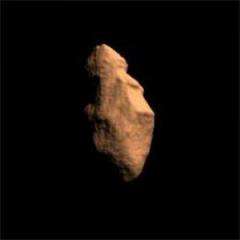
(PhysOrg.com) -- The patterns of missing asteroids are like the footprints of wandering giant planets preserved in the asteroid belt.
University of Arizona scientists have uncovered a curious case of missing asteroids.
The main asteroid belt is a zone containing millions of rocky objects between the orbits of Mars and Jupiter. The scientists find that there ought to be more asteroids there than researchers observe. The missing asteroids may be evidence of an event that took place about 4 billion years ago, when the solar system's giant planets migrated to their present locations.
UA planetary sciences graduate student David A. Minton and UA planetary sciences professor Renu Malhotra say missing asteroids is an important piece of evidence to support an idea that the early solar system underwent a violent episode of giant planet migration that might possibly be responsible for a heavy asteroidal bombardment of the inner planets.
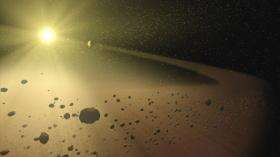
The scientists are reporting on their research in an article, "A record of planet migration in the Main Asteroid Belt," in the Feb. 26 issue of Nature.
Minton and Malhotra began by looking at the distribution of asteroids in the main asteroid belt. Astronomers first discovered a series of gaps in the asteroid belt, now called the Kirkwood gaps, back in the 1860s when only a handful of asteroids were known. The gaps occur at distinct regions of the asteroid belt where Jupiter's and Saturn's gravity strongly perturbs and ejects asteroids. The present-day orbits of Jupiter and Saturn explain why these unstable regions are devoid of asteroids.
"What we wanted to know was, how much of the structure of the asteroid belt could be explained simply by the gravitational effects of the giant planets, as are the Kirkwood gaps," Minton said.
Minton and Malhotra looked at the distribution of all asteroids with diameters greater than 50 kilometers, or about 30 miles. All asteroids of this size have been found, giving the UA researchers an observationally complete set for their study. Also, almost all asteroids this large have remained intact since the asteroid belt formed more than 4 billion years ago, a time record spanning all but the very beginning of solar system history.
"We ran massive sets of simulations with computer planets where we filled up the asteroid belt region with a uniform distribution of computer asteroids," Minton said. The scientists then had the computers simulate the billions of years of solar system history.
Their simulations ultimately ended with far more asteroids remaining than are actually observed in the asteroid belt. When the simulated asteroid belt was compared with the actual asteroid belt, they discovered a peculiar pattern in the differences. The simulated asteroid belt matched the real asteroid belt quite well on the sunward-facing sides of the Kirkwood gaps, but the real asteroid belt seemed to be depleted in asteroids on the Jupiter-facing sides.
"Then we simulated the migration of the giant planets," Minton said. "The perturbing effects of the migrating planets sculpted our simulated asteroid belt. After the migration was over, our simulated asteroid belt looked much more like the observed asteroid belt."
The UA scientists' research was funded by NASA and by the National Science Foundation.
"Our interpretation is that as Jupiter and Saturn migrated, their orbital resonances swept through the asteroid belt, ejecting many more asteroids than is possible with the planets in their current orbits," Malhotra said. "And the particular pattern of missing asteroids is characteristic of the pattern of Jupiter's and Saturn's migration."
"Our work explains why there are fewer asteroids on the Jupiter-facing side of the Kirkwood gaps compared to the sun-facing side," Minton said. "The patterns of depletion are like the footprints of wandering giant planets preserved in the asteroid belt."
Their results corroborate other lines of evidence indicating that the giant planets - Jupiter, Saturn, Uranus and Neptune - formed in a more tightly compacted configuration, and then Jupiter moved slightly closer to the sun, while the other giant planets moved farther apart from each other and farther away from the sun.
Minton and Malhotra say that their result has implications for how far and how fast the planets migrated early in solar system history, and the possibility that planet migration perturbed asteroids that may have contributed to a heavy bombardment of the inner solar system.
"Our result doesn't directly answer the question of whether the timing of this can be tied to inner solar system heavy bombardment - that's open for debate," Minton said. "But what it does say is that there was an event that destabilized asteroids over a relatively short period of time.
"All the asteroids being kicked out of the asteroid belt had to go somewhere," he added. "The implication of this is that when all those asteroids were getting kicked out of the main belt, they could have become projectiles impacting the Earth and the moon, Mars, Venus and Mercury."
Provided by University of Arizona


