February 26, 2009 feature
Self-Programming Hybrid Memristor/Transistor Circuit Could Continue Moore's Law
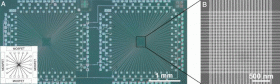
(PhysOrg.com) -- As researchers strive to increase the density and functionality of circuit elements onto computer chips, one newer option they have is a memory resistor (or “memristor”), the fourth passive circuit element. First predicted to exist in 1971 and fabricated in 2008, memristors are two-terminal devices that change their resistance in response to the total amount of current flowing through them.
By dynamically changing the doping profile inside the memristive materials, scientists can control the current-voltage relationship of the device, thus controlling the “memristance.” Since they don’t lose their state when the electrical power is turned off, memristors also have nonvolatile memory.
However, memristors are passive elements, meaning they cannot introduce energy into a circuit. In order to function, memristors need to be integrated into circuits that contain active elements, such as transistors, which can amplify or switch electronic signals. A circuit containing both memristors and transistors could have the advantage of providing enhanced functionality with fewer components, in turn minimizing chip area and power consumption.
In a recent study, a team of researchers from Hewlett-Packard Laboratories in Palo Alto, California, have fabricated and demonstrated a hybrid memristor/transistor circuit for the first time. The team demonstrated conditional programming of a nanomemristor by the hybrid circuit, showing that the same elements in a circuit can be configured to act as logic, signal routing, and memory. By routing a logic operation’s output signal back onto a memristor, the circuit could even reconfigure itself, opening the doors to a variety of self-programming circuits.
“It actually takes at least a dozen transistors to mimic the electrical properties of a single memristor,” Stan Williams of HP told PhysOrg.com. “Thus, for circuits that require some type of latching or other function performed by a memristor, it is at least conceivable for a designer to replace several active transistors with one passive memristor, which is much smaller than a single transistor. This maintains the capability of the chip while decreasing the number of transistors, which saves both silicon area and power. Thus, it may be possible to continue the equivalent of Moore's law for a couple of generations not by making transistors smaller, but by replacing some subset of them with memristors.”
The HP team’s memristor design consisted of two sets of 21 parallel 40-nm-wide wires crossing over each other to form a crossbar array, fabricated using nanoimprint lithography. A 20-nm-thick layer of the semiconductor titanium dioxide (TiO2) was sandwiched between the horizontal and vertical nanowires, forming a memristor at the intersection of each wire pair. An array of field effect transistors surrounded the memristor crossbar array, and the memristors and transistors were connected to each other through metal traces.
Then the researchers tested the device by performing a basic logic function (AB + CD) from four voltage inputs representing the four values. The operations were performed on two different rows of the memristor crossbar, and the results were routed through the transistors, which amplified the signals and fed the corresponding signal back to the memristor crossbars for programming purposes. In other words, the output signal from the simple logic function of the memristor circuits could be used to reprogram a memristor for a new operation.
“Self-programming is a form of learning,” Williams explained. “Thus, circuits with memristors may have the capacity to learn how to perform a task, rather than have to be programmed to do it.”
As the researchers explained, the basis of the memristor is that the resistance of the device can be changed and be remembered, which is physically manifested by the movement of positively charged oxygen vacancies, which are dopants in a semiconducting TiO2 film. A positive bias voltage can push the vacancies away from an electrode and increase the resistance, whereas a negative bias will attract the vacancies and decrease the resistance. If left alone, the programmed state will remain as it is for at least one year.
The researchers hope that this prototype of a hybrid memristor/transistor circuit will lead to further integrations of memristors with conventional CMOS circuits. In addition, the demonstration of a system that can alter its own programming could lead the way toward a variety of new architectures, such as adaptive synaptic circuits.
More information: Borghetti, Julien; Li, Zhiyong; Straznicky, Joseph; Li, Xuema; Ohlberg, Douglas A. A.; Wu, Wei; Stewart, Duncan R.; and Williams, R. Stanley. “A hybrid nanomemristor/transistor logic circuit capable of self-programming.” PNAS, February 10, 2009, vol. 106, no. 6, 1699-1703.
Copyright 2009 PhysOrg.com.
All rights reserved. This material may not be published, broadcast, rewritten or redistributed in whole or part without the express written permission of PhysOrg.com.


