'Freaks' help scientist unravel nature and nurture
In 1940, a Dutch goat born without front legs learned to walk upright. So did Faith, a two-legged dog in Oklahoma. Johnny Eck, a "half-man" born without legs, grew naturally into a graceful hand-walker.
And in Minnesota, conjoined twins Abigail and Brittany Hensel live successfully with separate heads connected to a single body. Each girl controls her own arm, but they manage to drive, swim, shuffle cards and play piano.
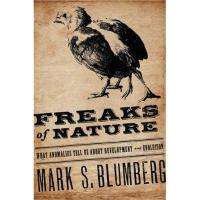
In his latest book, "Freaks of Nature," University of Iowa psychologist Mark Blumberg examines nature's oddities as a window for exploring the development and evolution of body, brain and behavior. He focuses on physical abnormalities -- how they happen and how creatures adjust to them -- to illustrate his belief that nature and nurture are inseparable and equally important to development.
"To me, the nature-nurture debate is a dead end," said Blumberg, who teaches behavioral and cognitive neuroscience in the UI College of Liberal Arts and Sciences. "Asking whether something is more nature or more nurture is like asking whether a hurricane is more wind or rain. It's both -- always both."
Blumberg's book is written for a general audience, but his ideas are creating a buzz in the scientific community. In a book review published recently in the journal Nature, Jerry Coyne at the University of Chicago argued that Blumberg doesn't give enough weight to genes. In Blumberg's response, published in the same journal this month, he explained his belief that genes do play a key role in development, but that they're only part of a complex developmental process comprising both genetic and non-genetic factors.
Genetics get a lot of attention in part because it's easy to explain differences by saying "it's in the genes," Blumberg said. But there was no specific gene to tell the Dutch goat to walk upright, or to teach the Hensel twins to coordinate their motions when they swim or play piano.
"Genes are only part of the answer, and so my argument in 'Freaks of Nature' is that we need a more balanced approach," Blumberg said. "For the past century, science has focused heavily on genes to the exclusion of other factors. But that's really a narrow vision of how development actually happens."
People representing the orthodox view have said genes control development just as a light switch controls a light. However, Blumberg points out that many factors control a light, including the person flipping the switch, the bulb, the electrical wires and the power supply. In the same way, he said, a wide range of environmental factors contribute to development.
These developmental systems, Blumberg wrote, "are so complex that genes alone are often invoked to simplify and explain them to the exclusion of other, no less real but perhaps less easily manipulated factors that just as critically guide and shape the developmental process."
The notion of interchangeability is another element of Blumberg's argument. Some anomalies are caused by mutations while others occur because of environmental factors -- or both.
Take, for example, two-headed animals. In one case, a genetic mutation may cause a cat to be born with two heads. In another, a lizard ends up with two heads because its mother laid her eggs in a compost heap that was too warm; the defect was caused by an incubation temperature that was too high. Similarly, a human may end up with an extra set of hands because of a mutation, but the same defect in a frog can be caused by a parasite.
Or consider the fact that mammals, including humans, possess distinct chromosomes -- the X and Y -- for generating males and females, whereas many species -- including alligators and turtles -- possess no such chromosomes. In such species, it is the temperature at which the eggs are incubated that determines the sex of the animal. So, when it comes to the system that creates sex, temperature and chromosomes are interchangeable.
"Such examples of interchangeability help reveal the inadequacy of thinking in terms of nature and nurture." Blumberg said. "In the end it is the system that matters, and complex systems cannot be neatly divided into nature and nurture."
Blumberg also addresses how people have viewed "freaks" over time.
P.T. Barnum extracted money from the Victorian public by parading his "specimens" -- Tom Thumb, The Elephant Man, the Bearded Lady, the Siamese Twins -- at fairs and circuses. In Elizabethan England during the 16th and 17th centuries, deformed children were advertised on illustrated birth announcements, or through folk songs. People paid the families money to get a peek at the infants.
Such behavior would be morally repugnant today, but there's a lingering fascination with "freaks." Most of us can't imagine how the Hensel twins thrive the way they do. We think we could never live that way. There's a desire to draw a sharp line between "them" and "us." But, Blumberg said, we should keep in mind the world is messy, and we're all different to varying degrees.
"Nature always takes the exception to the rule, undermines the archetype, and reminds us that our ideas about what is natural and what we should do to correct nature's 'imperfections' are as sound as a sandcastle battered by a rising tide," he wrote. "We are all extraordinary, all strange -- freaks, every last one of us. Some of us just happen to be more notable, with a particularly interesting story to tell."
Source: University of Iowa


