Antibiotic combination defeats extensively drug-resistant TB
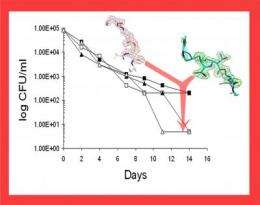
A combination of two FDA-approved drugs, already approved for fighting other bacterial infections, shows potential for treating extensively drug resistant tuberculosis (XDR-TB), the most deadly form of the infection. This finding is reported by scientists from Albert Einstein College of Medicine of Yeshiva University in the February 27 issue of Science.
TB is caused by the bacterium Mycobacterium tuberculosis (Mtb). An estimated one-third of the world's population is infected with TB. Active disease develops in approximately 10 percent of infected people over a lifetime ─ particularly those with weak immune systems such as infants, the elderly, and people infected with HIV. Globally, cases of active TB have increased significantly since the 1980s due to the AIDS pandemic and the emergence of Mtb strains resistant to standard antibiotic treatment.
In the Science paper, Einstein researchers and collaborators at the National Institute of Allergy and Infectious Diseases (NIAID), part of the National Institutes of Health, describe a two-drug combination that inhibited both the growth of susceptible laboratory strains and 13 XDR-TB strains isolated from TB patients in laboratory culture medium. The drugs truly work in tandem: one of them (clavulanate) inhibits a bacterial enzyme, β-lactamase, which normally shields TB bacteria from the other antibiotic (meropenem, a member of the β-lactam class of antibiotics).
The idea of inhibiting β-lactamase to make β-lactam antibiotics effective isn't new ─ which is why β-lactamase inhibitors, such as clavulanate, already exist. The strategy finally proved effective against XDR-TB because Einstein researchers conducted a detailed, methodical investigation of the β-lactamase enzyme to find the ideal combination of β-lactamase inhibitor and β-lactam antibiotic. β-lactam antibiotics include penicillin, the first antibiotic discovered and one of the safest.
Amoxicillin/clavulanic acid and meropenem have excellent safety profiles and are FDA-approved for adult and pediatric use.
"This is a great example of how, in a collaborative environment, basic, old-fashioned, hypothesis-driven science can lead to timely clinical applications," said John S. Blanchard, Ph.D., Dan Danciger Professor of Biochemistry at Einstein and senior author of the Science paper, whose research was funded by NIAID.
In parts of Asia, 70 percent of new TB cases are multi-drug resistant, meaning they don't respond to the two antibiotics most commonly used against TB. Recently, an even greater health threat has emerged: extensively drug-resistant (XDR) bacteria that resist at least four of the drugs used to treat TB and can prove deadly. The cure rate for patients infected with XDR-TB ranges from 12 percent to 60 percent.
XDR-TB is still rare in the United States ─ 83 cases were documented by the Centers for Disease Control and Prevention between 1993 and 2007. However, worldwide, the figures are much larger and on the rise. In 2004, the World Health Organization (WHO) estimated a half-million people were infected with multi-drug resistant TB, and in some countries the percentage of XDR-TB cases is growing. In the only global TB study to date, the WHO reported in 2008 that 15 percent of multi-drug resistant TB cases in Ukraine, for example, were XDR-TB.
Current TB therapy requires four antibiotics that must be taken for at least six months. "If proven in human subjects, the ability to simplify treatment to just two drugs that work against drug-susceptible, multi-drug resistant and XDR-TB could help patients better adhere to therapy," said Dr. Blanchard, whose laboratory has conducted pioneering studies of fundamental aspects of antibiotic resistance.
"This discovery could be one of the most promising developments in TB research since the discovery of isoniazid - it is very exciting," said William Jacobs, Ph.D., referring to the first effective antituberculosis medication discovered in the 1950s. Dr. Jacobs is a Howard Hughes Investigator and professor of microbiology & immunology at Einstein and associate director of the Einstein-Montefiore Center for AIDS Research.
Currently, clavulanate is not commercially available, except in combination with β-lactam antibiotics, such as amoxicillin. This combination of clavulanate and amoxicillin has been used against other types of bacteria to inhibit β-lactamase activity and make β-lactams more effective. But it has rarely been used against TB, which is why the β-lactamase inhibitor/β-lactam approach had not been comprehensively analyzed until now.
NIAID researcher Clifton E. Barry, III, Ph.D., a co-author of the new paper, is leading plans to launch a phase two clinical study of the clavulanate potassium-meropenem drug combination in South Korea by the end of 2009 involving approximately 100 TB patients. NIAID investigators are currently working with manufacturers to provide the drugs needed for the trial.
Additionally, as part of a joint collaboration between Montefiore Medical Center, The University Hospital and Academic Medical Center for Albert Einstein College of Medicine, and the Nelson Mandela School of Medicine in Durban, South Africa, a separate trial slated for 2009 will test the potency of the drug combination in a smaller number of TB patients. If the results are successful and funding is available, a trial involving a larger number of XDR-TB patients will be conducted. Montefiore researchers chose South Africa for the clinical studies because of its disproportionately high number of XDR-TB cases. In some areas of South Africa, one in four TB cases is extensively drug resistant.
"We see tremendous potential for treating not only XDR-TB cases, but also routine TB cases," said Brian Currie, M.D., M.P.H., assistant dean for clinical research, and professor of medicine and of clinical epidemiology and population health at Einstein. Dr. Currie is also vice president and medical director for research at Montefiore. He will serve as U.S. leader for the planned clinical studies in Durban.
With the hope that the meropenem/clavulanate combination proves highly effective in the planned clinical trials, Einstein has filed a patent application on this novel TB treatment method as an incentive for commercial drug manufacturers to support expanded clinical trials and to develop with Einstein an improved combination clavulanate-β-lactam drug formulation that may be optimized for routine use in TB treatment.
The research and clinical components of these studies will help fulfill the mission of a $22 million Clinical and Translational Science Award given to Einstein and Montefiore by the National Center for Research Resources of the NIH in 2008. The grant supports the new Einstein-Montefiore Institute for Clinical and Translational Research (ICTR) whose goal is to collaboratively expedite the transfer of research discoveries to patient care.
Source: Albert Einstein College of Medicine


