Spun-sugar fibers spawn sweet technique for nerve repair
Researchers at Purdue University have developed a technique using spun-sugar filaments to create a scaffold of tiny synthetic tubes that might serve as conduits to regenerate nerves severed in accidents or blood vessels damaged by disease.
The sugar filaments are coated with a corn-based degradable polymer, and then the sugar is dissolved in water, leaving behind bundles of hollow polymer tubes that mimic those found in nerves, said Riyi Shi, an associate professor in Purdue's Weldon School of Biomedical Engineering and Department of Basic Medical Sciences.
The scaffold could be used to promote nerve regeneration by acting as a bridge placed between the ends of severed nerves, said biomedical engineering doctoral student Jianming Li, who is a member of Shi's research team that developed the technique.
The researchers are initially concentrating on the peripheral nerves found in the limbs and throughout the body because nerve regeneration is more complex in the spinal cord. About 800,000 peripheral nerve injuries are reported annually in the United States, with about 50,000 requiring surgery.
The approach also might have applications in repairing blood vessels damaged by trauma and disease such as atherosclerosis and diabetes, Shi said.
The new approach represents a potential alternative to the conventional surgical treatment, which uses a nerve "autograft" taken from the leg or other part of the body to repair the injured nerves. Researchers are trying to develop artificial scaffolds to replace the autografts because removing the donor nerve causes a lack of sensation in the portion of the body where it was removed.
"The autograft is the lesser of two evils because you have to sacrifice a healthy nerve to repair a damaged segment," said Li, who led the research.
New findings were published online in December and this month in the print edition of the journal Langmuir. The paper was written by Li, biomedical engineering doctoral student Todd A. Rickett and Shi. Rickett also is attending the Indiana University School of Medicine in an MD-Ph.D. program.
Researchers from Cornell University published similar findings online Feb. 9 in the journal Soft Matter. Those findings focused on using the technique to create vascular networks for providing blood and nutrients to tissues and grafts.
The synthetic scaffold resembles the structural assembly of natural nerves, which are made of thousands of small tubes bundled together. These tubes act as sheaths that house the conducting elements of the nerve cell.
The first step in making the tubes is to spin sugar fibers from melted sucrose.
"It's basically like making cotton candy," Li said.
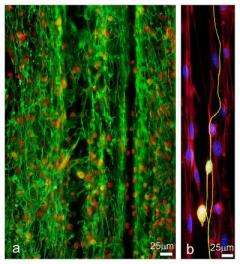
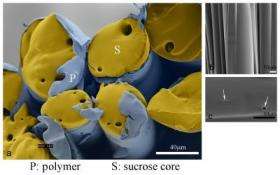
The sugar filaments were coated with a polymer called poly L-lactic acid. After the filaments were dissolved, hollow tubes of the polymer remained. The researchers then grew nerve-insulating cells called Schwann cells on these polymer tubes. These cells automatically aligned lengthwise along the tubes, as did nerve cells grown on top of the Schwann cells.
This alignment is critical for the fast growth of nerves, Shi said.
Nerve cells grew not only inside the hollow tubes but also around the outside of the tubes.
"This finding is important because the increased surface area may accelerate the regeneration process following an accident," Li said.
The scaffolds are designed specifically to regenerate a portion of a nerve cell called the axon, a long fiber attached to the cell body that transmits signals. Fast regeneration is essential to prevent the atrophy of muscles and organs connected to severed nerves.
The researchers also discovered that the polymer tubes contain pores that are ideal for supplying nutrients to growing nerve cells and removing waste products from the cells.
Images of the polymer-coated sugar strands were taken using a scanning electron microscope. Another instrument, called an atomic force microscope, was used to obtain images of the hollow tubes and pores in the walls of the tubules. Other images using fluorescent dyes revealed the nerve cell alignment along the tubes.
The work was done using cell cultures in petri dishes, but ongoing work focuses on implanting the scaffolds in animals.
The method for creating the scaffolds is relatively simple and inexpensive and does not require elaborate laboratory equipment, Shi said.
"This is low-tech," he said. "We used the same kind of sugar found in candy and a cheap polymer to make samples of these scaffolds for a few dollars. The process easily lends itself to mass production. It is a unique idea, and the simplicity and efficiency of this technology distinguish it from other approaches for nerve repair."
A provisional patent application on the material has been filed.
Source: Purdue University


