CO2 drop and global cooling caused Antarctic glacier to form
February 26, 2009 The First Antarctic Ice Sheet

Enlarge

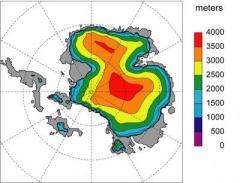
Projection of the what the first Antarctic ice sheet might have looked like as the global climate cooled about 33.5 million years ago. Antarctica is in gray, with the ice sheet shown in meters of ice thickness. The ice sheet is continental in scale, but somewhat smaller than today. The estimate is based on prior modeling work of DeConto and Pollard and is supported by this new data study. Credit: DeConto & Pollard/ Nature

(PhysOrg.com) -- Global climate rapidly shifted from a relatively ice-free world to one with massive ice sheets on Antarctica about 34 million years ago. What happened? What changed? A team of scientists led by Yale geologists offers a new perspective on the nature of changing climatic conditions across this greenhouse-to-icehouse transition—one that refutes earlier theories and has important implications for predicting future climate changes.

Detailed in the February 27 issue of Science, their data disproves a long-held idea that massive ice growth in the Antarctic was accompanied by little to no global temperature change.

This report shows that before the Southern Hemisphere ice expansion, high-latitude temperatures were at least 10°C (about 18˚F) warmer than previously estimated and that there was a 5˚C - 10˚C drop in surface-water temperature during the climate transition.

"Previous reconstructions gave no evidence of high-latitude cooling," according to senior author Mark Pagani, professor of geology and geophysics at Yale. "Our data demonstrate a clear temperature drop in both hemispheres during this time."

Their conclusions are based on sea-surface "temperature proxies" - calculations of temperature based on the distribution of specific organic molecules from ancient plankton that only lived at certain temperatures and were later preserved in ocean sediments. These molecules were assayed in ocean cores collected by the Integrated Ocean Drilling Program (IODP) and earlier marine programs that study Earth history by coring deep-ocean sediments and crust around the world.

"Temperatures in some regions, just before the Antarctic glaciers formed, were surprisingly higher than current climate models predicted, suggesting that these models underestimate high-latitude warming under high CO2 conditions," said lead author Zhonghui Liu, Pagani's postdoctoral associate who is now an assistant professor at the University of Hong Kong. Further, he said, the substantial cooling that occurred in both Northern and Southern high latitudes suggests that a decline in CO2 level, rather than a localized change of ocean circulation drove the climate transition.

The ice formed over Antarctica in about 100,000 years, which is an "overnight" shift in geological terms. "Just over thirty-five million years ago, 'poof,' there was an ice sheet where there had been subtropical temperatures before," said Co-author Matthew Huber of Purdue University.

Another theory refuted by this study is the notion that ice-expansion also occurred in the Northern Hemisphere during this time — a supposition poorly supported by physical evidence of glacier formation in that region, say the Yale scientists.

There are about 70 meters of vertical sea level rise represented in the ice sheets of Antarctica. And, there are many questions regarding the glacier's stability, the temperature thresholds that would cause radical glacier melting, and the rate at which it would change, according to Pagani. "Our findings point to the difficulty of modeling accurate temperatures under higher CO2 in this critical region."

Provided by Yale University


print this article email this article download pdf blog this article bookmark this article     Stumble it Digg this share on Facebook retweet share on Reddit add to delicious
Rate this story - 3.1 /5 (20 votes)

Rank Filter

Move the slider to adjust rank threshold, so that you can hide some of the comments.


Display comments: newest first

  • GrayMouser - Feb 26, 2009
    • Rank: 4 / 5 (4)
    Are these results reproducible with other proxies? If not, what would be consistent with both sets of proxies?
  • deatopmg - Feb 26, 2009
    • Rank: 4 / 5 (4)
    So..., when the ocean cooled, the equilibrium solubility of CO2 went up; reducing the concentration of CO2 in the atmosphere. Plain old ordinary physical chemistry.

    I'll read the article for more details.
  • jeffsaunders - Feb 27, 2009
    • Rank: 5 / 5 (3)
    Seems like there is still a lot of work to do on this. Should keep some people happy for quite some time. I for one am looking forward to more information coming forth.

    Info on CO2 and where it went and why did CO2 vanish OR was it because the temperature dropped that the CO2 vanished and how long after the temperature dropped?

    Which ever happened first we could do with some possible causes, and other results. like, what happened to corals and shellfish of the oceans when acidity suddenly reduced or did the acidity change that much and if not why not?

    These are just a few of the questions that spring to mind.
  • Velanarris - Feb 27, 2009
    • Rank: 3.9 / 5 (7)
    So..., when the ocean cooled, the equilibrium solubility of CO2 went up; reducing the concentration of CO2 in the atmosphere. Plain old ordinary physical chemistry.

    I'll read the article for more details.


    And that's the gorilla in the room. CO2 doesn't drive climate but climate drives CO2. Explains the lags in CO2 vs temp, explains the need for excessive proxy correction, explains a lot of the holes in GW. All you have to do is remove the A in AGW and it becomes more sound as a descriptive framework.
  • Arkaleus - Feb 27, 2009
    • Rank: 4.3 / 5 (6)
    AWG or GW, I don't understand why the precitions are so dire. Any warming of climate can only produce more arable land and longer growing seasons. Kind of like the earth was like last time it was warm.
  • vos - Feb 27, 2009
    • Rank: 4 / 5 (8)
    CO2 doesn't matter,its signal is masked by the REAL greenhouse gas, water vapor. give it a rest everyone(excepting you) has realized the CO2 hype is a money grab.
  • dbren - Feb 27, 2009
    • Rank: 3 / 5 (4)
    No, Manbearpig is real! Manbearpig is real! Why won't you take me serial?!
  • jonnyboy - Feb 28, 2009
    • Rank: 3 / 5 (6)
    As we all know, anything published in NATURE is questionable science at best.
  • thermodynamics - Feb 28, 2009
    • Rank: 1.8 / 5 (5)
    What are you smoking jonnyboy? Nature is one of the most respected journals on earth. It has an amazingly good record. I have to suspect anyone that considers Nature to be producing "questionable science" to be incredibly ignorant of the history of the Journal, its standards, and the peer review process that goes into having material published in it. You obviously have no inkling of science and scientific publishing.
  • Shootist - Mar 01, 2009
    • Rank: 3.7 / 5 (3)
    Interesting that the time coincides with two 90KM meteor impacts, Chesapeake Bay in the US and Popigai in Russia.

    Oh, and Nature (magazine) does not "produce" science. It publishes science papers and treatises.
  • mikiwud - Mar 03, 2009
    • Rank: 4 / 5 (4)
    thermodynamics,
    "You obviously have no inkling of science and scientific publishing."
    Neither do you.
    Peer review comprises of a "review" by recognised sientists who comment on the viability of the science in the paper in their opinion. Mostly reviewed by a person known to them (on their Christmas card list?). A clique (IPCC?) with an agenda can peer review each other. It can work for warmers or sceptics.
    Verifying a paper is all together different. Data compiled and methods used are checked carefully.
    With some recent papers, such as the Antarctic is warming one, it is proving almost impossible to obtain this data. Steve Macintyre and others are doing such verification were possible are showing glareing errors or complete fabrication in some cases.
    BTW. I don't think anyone has yet submitted a paper showing the direct link between man released CO2 and global warming, only computer guesework.
    If anyone can find one, please show me.
  • lengould100 - Mar 03, 2009
    • Rank: 1 / 5 (6)
    The deniers are getting hysterical(ly funny).
  • Velanarris - Mar 03, 2009
    • Rank: 4.8 / 5 (5)
    Yet you're not providing any of the requested links.
  • jonnyboy - Mar 04, 2009
    • Rank: 5 / 5 (1)
    here is a link to Mockton's july 2008 refutation of the IPCC

    [http://www.aps.or...ndex.cfm
  • jonnyboy - Mar 04, 2009
    • Rank: 3 / 5 (2)
    and here is a analysis of the IPCC report that was reviewed by "thousands"

    http://scienceand...ing.html
  • jonnyboy - Mar 04, 2009
    • Rank: 3 / 5 (2)
    and here a refutation of Al Gore's an Inconvenient Truth showing just some of the misstatements, mistakes and outright lies claimed in the movie.

    http://scienceand...ors.html
  • Velanarris - Mar 04, 2009
    • Rank: 5 / 5 (2)
    jonny, I was referring to Len, not you.

    I'm looking for references that are factual and pro-agw. Hardly surprising that none have appeared as of yet.
  • lengould100 - Mar 23, 2009
    • Rank: 5 / 5 (1)
    I haven't yet stopped laughing at "As we all know, anything published in NATURE is questionable science". 8

February 26, 2009 all stories

Comments: 18

3.1 /5 (20 votes)
  • Stumble this up

  • Digg this

  • share this

  • hide
  • Related Stories


  • hide
  • Relevant PhysicsForums posts

  • cycles
    created 17 hours ago
  • The Origin of the term 'fossil' fuels
    created Nov 05, 2009
  • co2
    created Nov 03, 2009
  • Early Earths Sulfidic Ocean Conditions
    created Oct 30, 2009
  • More from Physics Forums - Earth

Other News

Deep creep means milder, more frequent earthquakes along Southern California's San Jacinto fault

Deep creep means milder, more frequent earthquakes along Southern California's San Jacinto fault

Space & Earth / Earth Sciences

created 16 hours ago | popularity 4.5 / 5 (4) | comments 0

With an average of four mini-earthquakes per day, Southern California's San Jacinto fault constantly adjusts to make it a less likely candidate for a major earthquake than its quiet neighbor to the east, the ...


Success in 'space elevator' competition (AP)

Success in 'space elevator' competition (Update 3)

Space & Earth / Space Exploration

created Nov 05, 2009 | popularity 4.3 / 5 (33) | comments 50

(AP) -- A robot powered by a ground-based laser beam climbed a long cable dangling from a helicopter on Wednesday to qualify for prize money in a $2 million competition to test the potential reality of the ...


In a Galaxy Far, Far Away...

In a Galaxy Far, Far Away...

Space & Earth / Astronomy

created Nov 06, 2009 | popularity 4.8 / 5 (5) | comments 17

(PhysOrg.com) -- Astronomers have published the discovery of the farthest known object in the cosmos: a star that exploded when the universe was only 630 million years old -- only 4.6% of its current age. ...


'Dropouts' pinpoint earliest galaxies

'Dropouts' pinpoint earliest galaxies

Space & Earth / Astronomy

created Nov 06, 2009 | popularity 4.2 / 5 (10) | comments 13

Astronomers, conducting the broadest survey to date of galaxies from about 800 million years after the Big Bang, have found 22 early galaxies and confirmed the age of one by its characteristic hydrogen signature ...


Space hotel taking bookings for 2012 opening

Space hotel taking bookings for 2012 opening

Space & Earth / Space Exploration

created Nov 05, 2009 | popularity 4.4 / 5 (21) | comments 11

(PhysOrg.com) -- The first orbiting space hotel is on track to open for its first customers in 2012, but hurry, as bookings are filling fast.