Good vibrations: Devices aid the deaf by translating sound waves to vibrations
February 26, 2009 by Anne Trafton
Good vibrations: Devices aid the deaf by translating sound waves to vibrations

Enlarge

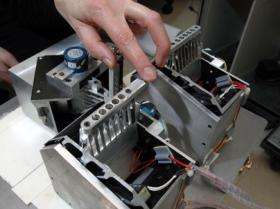
Researchers in RLE, led by Charlotte Reed, are using the sense of touch to develop communication aids for the profoundly deaf. The devices convert sound waves to vibrations, which the deaf person holding the device can feel, and help lip-readers identify sounds that can be difficult to distinguish visually. Photo / Donna Coveney

(PhysOrg.com) -- Lip reading is a critical means of communication for many deaf people, but it has a drawback: Certain consonants (for example, p and b) can be nearly impossible to distinguish by sight alone.

Tactile devices, which translate sound waves into vibrations that can be felt by the skin, can help overcome that obstacle by conveying nuances of speech that can't be gleaned from lip reading.

Researchers in MIT's Sensory Communication Group are working on a new generation of such devices, which could be an important tool for deaf people who rely on lip reading and can't use or can't afford cochlear implants. The cost of the device and the surgery make cochlear implants prohibitive for many people, especially in developing countries.
Good vibrations: Devices aid the deaf by translating sound waves to vibrations
Enlarge

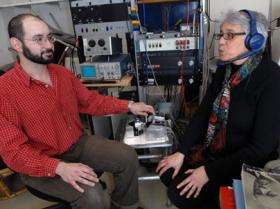
Here Senior Research Scientist Charlotte Reed speaks while the device she helped develop converts the sounds into vibrations. Graduate research assistant Theodore Moallem uses the device to read her lips and feel the sounds. Photo / Donna Coveney

"Most deaf people will not have access to that technology in our lifetime," said Ted Moallem, a graduate student working on the project. "Tactile devices can be several orders of magnitude cheaper than cochlear implants."

Moallem and Charlotte Reed, senior research scientist in MIT's Research Laboratory of Electronics and leader of the project, say the software they are developing could be compatible with current smart phones, allowing such devices to be transformed into unobtrusive tactile aids for the deaf.

"Anyone who has a smart phone already has much of what they would need to run the program," including a microphone, digital signal-processing capability, and a rudimentary vibration system, says Moallem.

Sensing vibrations

Tactile devices translate sound waves into vibrations that allow the user to distinguish between vibratory patterns associated with different sound frequencies. The MIT researchers are testing devices that have at least two vibration ranges, one for high-frequency sounds and one for low-frequency sounds.

Using such handheld devices, deaf people can more easily follow conversations than with lip reading alone, which requires a great deal of concentration, says Moallem.

"It's hard to have a casual conversation in a situation where you have to be paying attention like that," he says.

Current prototypes can be held in the user's hand or worn around the back of the neck, but once the acoustic processing software is developed, it could be easily incorporated into existing smart phones, according to the researchers. To lay the groundwork for such future applications, the researchers are investigating the best way to transform sound waves into vibrations.

Existing tactile aids have been in use for decades, but the MIT team hopes to improve the devices by refining the acoustic signal processing systems to provide tactile cues that are tailored to boost lip-reading performance, says Reed.

As part of their project, the researchers have done several studies on the frequency reception ability of the skin. The human ear can perceive frequencies up to 20,000 hertz, but for touch receptors in the skin, optimal frequencies are below 500 hertz.

Using a laboratory setup with a device that can provide distinct vibration patterns to three fingers simultaneously, Moallem has done preliminary studies of deaf people's ability to interpret the vibrations from tactile devices.

This project was originally inspired by earlier studies Reed did on the Tadoma technique, a communication method taught to deaf-blind people. Practitioners of that method hold their hands to someone's face while they are talking, allowing them to feel the vibrations of the face and neck.

Reed's study, done about 20 years ago, showed that the deaf-blind subjects could successfully understand speech with this method -- especially if the other person spoke clearly and slowly.

"We were inspired by seeing what deaf-blind people could accomplish just using the sense of touch alone," says Reed.

This research is funded by the National Institute on Deafness and Other Communication Disorders.

Provided by MIT


Rank not rated yet
Related Stories
Relevant PhysicsForums posts
  • How to tilt a object
    created2 hours ago
  • How to calculate total compressibility in liquid porous solid system
    created7 hours ago
  • Need help reading 3-D
    createdFeb 11, 2012
  • A way to send and receive wireless data
    createdFeb 11, 2012
  • Calling function with no input argument
    createdFeb 10, 2012
  • Force free body diagram problem on gym equipment
    createdFeb 10, 2012
  • More from Physics Forums - General Engineering

More news stories

Google might launch Drive for cloud storage soon

(PhysOrg.com) -- Google's next big move, according to the Wall Street Journal, is a cloud storage service called Drive. Hardly first to the plate, Google is simply catching up to introducing its cloud reposi ...

Technology / Internet

created 15 hours ago | popularity 4.8 / 5 (5) | comments 5 | with audio podcast report

Iran blocks email, restricts net access: reports

Iran has further restricted access to the Internet and blocked popular email services for the past few days, in a move a top lawmaker said could "cost the regime dearly," media reports said on Sunday.

Technology / Internet

created 8 hours ago | popularity 5 / 5 (2) | comments 5

Love a click away in Indonesia's Twitter Republic

He was a geeky kid from Yogyakarta, she a glamorous city girl in Jakarta. In a country with one of the world's most vibrant social networking scenes they fell in love on Twitter.

Technology / Internet

created 16 hours ago | popularity 4 / 5 (1) | comments 0

Walney offshore wind farm is world's biggest (for now)

(PhysOrg.com) -- The Walney wind farm on the Irish Sea--characterized by high tides, waves and windy weather--officially opened this week. The farm is treated in the press as a very big deal as the Walney ...

Technology / Energy & Green Tech

created Feb 11, 2012 | popularity 4.1 / 5 (14) | comments 52 | with audio podcast weblog

Navy to begin tests on electromagnetic railgun prototype launcher

The Office of Naval Research (ONR)'s Electromagnetic (EM) Railgun program will take an important step forward in the coming weeks when the first industry railgun prototype launcher is tested at a facility ...

Technology / Engineering

created Feb 06, 2012 | popularity 4.5 / 5 (19) | comments 95 | with audio podcast


Scientists discover molecular secrets of 2,000-year-old Chinese herbal remedy

For roughly two thousand years, Chinese herbalists have treated Malaria using a root extract, commonly known as Chang Shan, from a type of hydrangea that grows in Tibet and Nepal. More recent studies suggest that halofuginone, ...

New method to examine batteries -- MRI from the inside

There is an ever-increasing need for advanced batteries for portable electronics, such as phones, cameras, and music players, but also to power electric vehicles and to facilitate the distribution and storage of energy derived ...

A mitosis mystery solved: How chromosomes align perfectly in a dividing cell

Although the process of mitotic cell division has been studied intensely for more than 50 years, Whitehead Institute researchers have only now solved the mystery of how cells correctly align their chromosomes during symmetric ...

Lab study raises questions over nano-particle impact

Tests involving chickens have raised questions about the impact on health from engineered nano-particles, the ultra-fine grains commonly used in drugs and processed foods, scientists said on Sunday.

Starve a virus, feed a cure? Findings show how some cells protect themselves against HIV

A protein that protects some of our immune cells from the most common and virulent form of HIV works by starving the virus of the molecular building blocks that it needs to replicate, according to research published online ...

Overeating may double risk of memory loss

New research suggests that consuming between 2,100 and 6,000 calories per day may double the risk of memory loss, or mild cognitive impairment (MCI), among people age 70 and older. The study was released today and will be ...