Great Depression spurred ‘amazing’ period of creativity
(PhysOrg.com) -- The hardships of the Great Depression spurred a period of unparalleled creativity according to a University of Manchester historian.
Dr Charlie Wildman says the modern high street and great architecture are a lasting legacy of one of the most traumatic times in British economic history.
According to her study of archives in Liverpool and Manchester from the 1920s and 30s, councils invested massively in public transport, civic and commercial architecture as well civic exhibitions and official celebrations.
If history repeats itself, the findings may provide a crumb of comfort for people enduring current economic woes.
Iconic landmarks such as Manchester Central Library, Manchester Town hall extension, the Mersey Tunnel and the Liverpool Philharmonic Hall were all built during the early 1930s.
“Without doubt, the Great Depression caused huge hardship for millions of people - but that was not the whole story,” she said.
“Municipal rulers, civic leaders and businessmen were the spur for amazing levels confidence, innovation and civic pride.
“Many retail businesses moved from the suburbs to central locations. They adopted creative ideas to attract more customers who could shop at lower prices.
“This had a lasting legacy though the creation of the modern high street and what we recognise today as shopping culture.
”The jury’s out on whether the similar levels of creativity will result from today’s economic crisis - but I don’t see why not.”
According to Dr Wildman’s research, department stores used innovative ideas to attract shoppers. Examples include a zoo at George Henry Lees and an appearance as a shop assistant by Gracie Fields at Bon Marche, both in Liverpool.
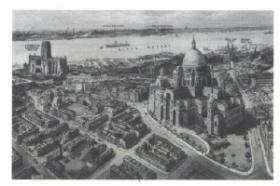
An ambitious Liverpudlian archbishop called Richard Downing raised £1 million - a huge sum in those days - to build the largest Cathedral outside Rome.
The building - never completed - was designed by renowned architect Edwin Lutyens and would have been twice the size of the city’s Anglican Cathedral.
And Trafford Park in Manchester - one of the oldest industrial estates in the world - was revitalised during the Depression.
Also according to Dr Wildman’s research, the innovations were a pragmatic response by politicians, businessmen, and church leaders to the threat of extremist politics.
She added: “You could say this period of civic investment was a form of opium for the masses.
“It certainly worked: the Tories still dominated and the Labour Party enjoyed greater support.
“Britain did not follow the experience of countries such as Spain, France and Germany: Communists and fascists were visible but in reality pretty marginal.”
Examples of innovations during the Great Depression:
• Around 140,000 people -15 per cent of Liverpool’s population - were re-housed by Liverpool Corporation between the wars, in 33,355 purpose-built suburban houses.
• In Manchester there were 21,859 new suburban council houses by 1933. In Wythenshawe alone, 40,000 inhabitants occupied 8,145 homes by 1939, nearly half way towards to Corporation’s goal of 100,000 people.
• The Mersey Tunnel was competed in 1934 and formally opened by the King on 18 July 1934, amid great celebrations.
• Manchester Corporation invested large amounts of money in the 1930s to extend the Town Hall and built a grand central library: renaming the area Manchester’s “Civic Centre”.
• Manchester Central Library cost almost £600,000, accommodated one million volumes and seated over 300 readers in the Great Hall, making it the largest after the reading room of the British Library.
• The Town Hall Extension cost £750,000 and included a new council chamber, Gas and Electricity Departments with their own showrooms, cinemas and demonstration rooms, and a 200 ft ‘Rates Hall’, where people paid their taxes.
• The Ship Canal Building (1926) in Manchester, was much taller than any other buildings in the city and required an Act of Parliament to overrule pre-existing regulations on building height.
L• iverpool Corporation encouraged architects in the city to emulate the building style of New York and the Lord Mayor of Liverpool visited the Lord Mayor of New York City in 1931. Examples include Herbert Rowse’s India Buildings (1930) and Martins Bank (1932), Rowse’s Philharmonic Hall (1939), and George’s Dock Ventilation and Control Station.
• In 1922, there were 1109 clothing shops listed in inner Liverpool and 2025 listed in outer Liverpool. Conversely, by 1938, there were 1209 clothing shops listed in inner Liverpool and just 830 in outer Liverpool.
Provided by University of Manchester


