Researchers isolate and purify mouse heart stem cells
February 26, 2009 By Krishna Ramanujan Researchers isolate and purify mouse heart stem cells

Enlarge

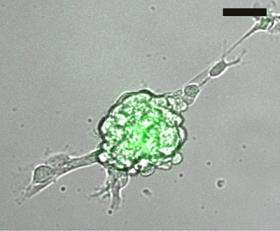
This image shows isolated, beating green heart stem cells in culture.

(PhysOrg.com) -- A pioneering Cornell and University of Bonn study has isolated and purified mouse heart stem cells, settling a debate over whether such cells exist.

The findings, published online and in an upcoming issue of the Proceedings of the National Academy of Sciences, could allow researchers to better understand whether genes can spur heart stem cells to fully differentiate into new cells after a heart attack.

The researchers, led by Michael I. Kotlikoff, the Austin O. Hooey Dean of Veterinary Medicine at Cornell, used a green fluorescent protein to label mouse heart precursor (or stem) cells and identify the cells during embryo development and immediately following birth. The fluorescent protein label also revealed that the number of cells, which differentiate into all three heart cell types (cardiac, endothelial and smooth muscle), decline drastically soon after birth.

The new method could be used to quickly and rapidly isolate and purify both heart and other stem cell populations in the laboratory; to study gene expression that leads to these cells differentiating into other cell types; to track the timing of these cells and when and where they differentiate into other cell types in vivo; and to compare heart stem cells with other types of stem cells.

"The existence of cardiac stem cells and the ability of adult stem cells to form new heart muscle have been the subject of much scientific disagreement, as there are so few of these cells in the adult heart," said Kotlikoff, who co-authored the study with Yvonne Tallini, a Cornell research scientist in biomedical sciences, and Bernd Fleischmann of the University of Bonn.

"We now have a simple way to identify these cells within the heart and to isolate and study the factors that control their fate," Kotlikoff added.

Researchers had questioned the existence of these cells, because the heart has very little regenerative capacity after an infarction, which creates a permanent scar. To address this question, the group looked for the cells after heart infarction, and found that heart stem cells form vessels that invade the scar tissue, but do not form new heart cells. Heart cells surrounding the dead tissue express a protein marker for these stem cells at low levels, suggesting that they are attempting to respond to grow new heart cells after an injury, but the response is incomplete. This may explain the detection of these cells after an injury, but their failure to re-grow new heart tissue.

Provided by Cornell University


print this article email this article download pdf blog this article bookmark this article     Stumble it Digg this share on Facebook retweet share on Reddit add to delicious
Rate this story - 5 /5 (2 votes)


February 26, 2009 all stories

Comments: 0

5 /5 (2 votes)
  • Stumble this up

  • Digg this

  • share this

  • hide
  • Related Stories


  • hide
  • Relevant PhysicsForums posts

  • What is transpulmonary pressure?
    created Nov 24, 2009
  • Is there a gay gene?
    created Nov 23, 2009
  • Super quick question about Starling forces?
    created Nov 22, 2009
  • Questions about diffusion
    created Nov 22, 2009
  • More from Physics Forums - Biology

Other News

Experts think toxic algae harming endangered fish

Biology / Ecology

created 55 minutes ago | popularity not rated yet | comments 0

(AP) -- Scientists say they think toxins from a blue-green algae plaguing lakes and rivers around the West are harming an endangered fish in the Klamath Basin, adding another obstacle to restoring species that have forced ...


Variable Temperatures Leave Insects wtih a Frosty Reception

Biology / Plants & Animals

created 1hour ago | popularity not rated yet | comments 0

(PhysOrg.com) -- For the first time, scientists at The University of Western Ontario have shown that insects exposed to repeated periods of cold will trade reproduction for immediate survival.


When camouflage is a plant's best protection

Rare woodland plant uses 'cryptic coloration' to hide from predators

Biology / Plants & Animals

created 3 hours ago | popularity not rated yet | comments 0

It is well known that some animal species use camouflage to hide from predators. Individuals that are able to blend in to their surroundings and avoid being eaten are able to survive longer, reproduce, and ...


Destruction spreads 'like a disease'

Biology / Ecology

created 2 hours ago | popularity not rated yet | comments 0

(PhysOrg.com) -- People have cleared more than a quarter of the world’s forests and half of its grasslands, according to a paper published today in the Proceedings of the Royal Society by researchers from The University of Que ...


'Safety valve' protects photosynthesis from too much light

Biology / Cell & Microbiology

created 4 hours ago | popularity not rated yet | comments 0

Photosynthetic organisms need to cope with a wide range of light intensities, which can change over timescales of seconds to minutes. Too much light can damage the photosynthetic machinery and cause cell death. Scientists ...