Mars Orbiter Puts Itself into Precautionary Mode
February 26, 2009 Mars Orbiter Puts Itself into Precautionary Mode

Enlarge

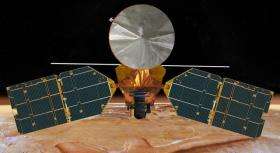
This artist's concept of NASA's Mars Reconnaissance Orbiter features the spacecraft's main bus facing down, toward the red planet.

(PhysOrg.com) -- NASA's Mars Reconnaissance Orbiter unexpectedly rebooted its computer Monday morning, Feb. 23, and put itself into a limited-activity mode that is an automated safety response.

The mission's flight-team engineers are examining possible causes of the event while planning to prepare the spacecraft to resume its scientific investigations of Mars. There has been no reoccurrence of the reboot event.

The spacecraft is in communication with and under control by the flight team. Its batteries are charged and its solar panels are properly generating electricity. The team successfully commanded an increase of more than 10,000-fold in the communication rate Monday afternoon from the rate of 40 bits per second that the orbiter initially adopted when it went into the precautionary "safe" mode.

"We are going to bring the spacecraft back to normal operations, but we are going to do so in a cautious way, treating this national treasure carefully," said Jim Erickson of NASA's Jet Propulsion Laboratory, Pasadena, Calif., project manager for the Mars Reconnaissance Orbiter. "The process will take at least a few days."

From the spacecraft data received after communications accelerated, the team gained a preliminary indication that the cause of the reboot might have been a measurement -- possibly erroneous -- of a brief increase in power load. The event lasted between 200 nanoseconds and 41 seconds. Engineers identified one possible scenario as a cosmic-ray hit that could have caused an erroneous voltage reading that would last 9 microseconds, enough to trigger the reboot.

The reboot occurred at about 4:25 a.m. Pacific Standard Time on Monday, while the orbiter was behind Mars from Earth's perspective. This is the fifth time since the spacecraft's August 2005 launch that it has entered safe mode, which is its programmed precaution when it senses a condition for which it does not know a more specific response. The symptoms from this week's event do not match any of the prior safe-mode events.

For more information about the mission, visit: http://www.nasa.gov/mro .

Provided by NASA


print this article email this article download pdf blog this article bookmark this article     Stumble it Digg this share on Facebook retweet share on Reddit add to delicious
Rate this story - 4.2 /5 (6 votes)

Rank Filter

Move the slider to adjust rank threshold, so that you can hide some of the comments.


Display comments: newest first

  • Mercury_01 - Feb 26, 2009
    • Rank: not rated yet
    'chout now!
  • Mercury_01 - Feb 26, 2009
    • Rank: 1 / 5 (2)
    'chout now!


    Interesting. This is the second time in just a couple of weeks that a mars probe has been hijacked for a short time by a certain group of shadow government hackers. Not a bad job. Enough to stump the hired heads, to be sure. To those who might be thinking about taking these new facts to the people- Good on ya! You have my patriotic support. Unless of course you chicken out!

February 26, 2009 all stories

Comments: 2

4.2 /5 (6 votes)
  • Stumble this up

  • Digg this

  • share this

  • hide
  • Related Stories

  • Mars Reconnaissance Orbite Team Plans Uplink of Protective Files
    created Nov 25, 2009 | popularity not rated yet | comments 0
  • Spacecraft Talk Continued During JPL Wildfire Threat
    created Sep 10, 2009 | popularity not rated yet | comments 0
  • Mars Orbiter in Safe Mode Increases Communication Rate
    created Aug 31, 2009 | popularity not rated yet | comments 0
  • Mars Orbiter Puts Itself in Safe Mode Again
    created Aug 27, 2009 | popularity not rated yet | comments 0
  • Mars orbiter enters safe mode after disturbance
    created Jun 05, 2009 | popularity not rated yet | comments 0


  • hide
  • Relevant PhysicsForums posts

  • Some help with a X-Ray astronomy question please!
    created Nov 27, 2009
  • Help with Images and Optical Instrument Question..
    created Nov 26, 2009
  • Redshift as a distance indicator
    created Nov 26, 2009
  • Question about 2-body gravity
    created Nov 24, 2009
  • More from Physics Forums - General Astronomy

Other News

Japan launches 5th spy satellite (AP)

Japan launches 5th spy satellite

Space & Earth / Space Exploration

created 10 minutes ago | popularity not rated yet | comments 0

(AP) -- Japan launched its fifth spy satellite into orbit Saturday in a bid to boost its ability to independently gather intelligence, the government said.


Fermi Telescope Peers Deep into Microquasar

Fermi Telescope Peers Deep into Microquasar (w/ Video)

Space & Earth / Astronomy

created 19 hours ago | popularity 4.7 / 5 (10) | comments 0

(PhysOrg.com) -- NASA's Fermi Gamma-ray Space Telescope has made the first unambiguous detection of high-energy gamma-rays from an enigmatic binary system known as Cygnus X-3. The system pairs a hot, massive ...


The Energy Sources of Ultraluminous Galaxies

The Energy Sources of Ultraluminous Galaxies

Space & Earth / Astronomy

created 19 hours ago | popularity 4.5 / 5 (13) | comments 1

(PhysOrg.com) -- Ultraluminous infrared galaxies ((ULIRGs) are galaxies whose luminosity exceeds that of a trillion suns; for comparison, the Milky Way galaxy has a typical (and much more modest) luminosity ...


New climate targets may not change daily life much (AP)

New climate targets may not change daily life much

Space & Earth / Environment

created 23 hours ago | popularity 3.8 / 5 (13) | comments 9

(AP) -- Americans' day-to-day lives won't change noticeably if President Barack Obama achieves his newly announced goal of slashing carbon dioxide pollution by one-sixth in the next decade, experts say.


Space shuttle Atlantis, 7 astronauts back on Earth (AP)

Space shuttle Atlantis, 7 astronauts back on Earth

Space & Earth / Space Exploration

created 20 hours ago | popularity not rated yet | comments 0

(AP) -- Space shuttle Atlantis and its seven astronauts returned to Earth with a smooth touchdown Friday to end an 11-day flight that resupplied the International Space Station.