Invasive Parasite Spreading Among West Coast Estuaries
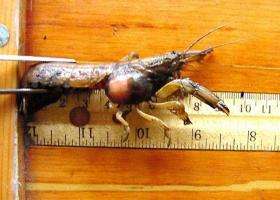
(PhysOrg.com) -- A parasitic isopod that scientists identified five years ago has all but decimated mud shrimp populations in coastal estuaries ranging from British Columbia to northern California - with the exception of a handful of locations in Oregon from Waldport to Tillamook.
And those surviving mud shrimp all are heavily infested with the parasite, known as Orthione griffenis, or Griffen's isopod, which threatens their existence as well, experts say.
“From Bamfield, Canada, down to Willapa Bay, Wash., the mud shrimp are either gone or the populations are severely depressed,” said John Chapman, an Oregon State University invasive species specialist who works out of OSU’s Hatfield Marine Science Center in Newport, Ore. “There are areas along the central- to northern Oregon coast where mud shrimp are still abundant.
“But the parasite that infects them also is abundant,” Chapman added, “and nearly all of these remaining shrimp populations are declining, which means that none of them appear to be safe.”
Mud shrimp are valuable prey for birds, fish, and other animals in estuaries, and some ecologists believe they have played a historically important role in the health of salmon runs by providing a steady food source for ocean-bound juvenile coho and chinook. In Northwest estuaries, mud shrimp have been a dominant species, comprising a very large biomass in many intertidal mudflats.
They play an important ecological role, filtering as much as 80 percent of the water in some estuaries each day during their feeding.
But in 2005, Chapman and other scientists reported that their populations were rapidly declining and identified Griffen’s isopod as the culprit. Recent surveys in 2008 and 2009 indicate the losses are epidemic, Chapman says.
“It is prudent to say that we have a serious problem,” he said, “and that this is a disaster.”
This bopyrid isopod is a form of aquatic crustacean that enters the shrimp gill chamber under the carapace. It destroys the shrimp's ability to reproduce by sucking its blood. Chapman says the parasite is a non-native species, probably introduced to West Coast waters through ballast water released from ships.
Chapman is an invasion ecologist in OSU’s Department of Fisheries and Wildlife at OSU and works out of the Hatfield Marine Science Center, where he is delving into the life cycle of the isopod to learn as much about it as he can. And make no mistake, Chapman said - it is a “fierce little critter.”
“The isopod is like something out of ‘Alien,’” Chapman said. “It is incredibly adept at finding a host and once it gets in, it essentially castrates the mud shrimp. The parasite doesn’t immediately kill the host; it just turns it into a zombie. And many of the mud shrimp still alive in Oregon estuaries are zombies. They’re still alive, but they’re infested, unable to reproduce and they’re living on borrowed time.”
In recent months, Chapman has begun looking in estuaries in California to see if the isopod has spread southward. He looked at five estuaries in the San Francisco area - Bodega Bay, Tomales Bay, Bolinas Lagoon, San Francisco Bay and Elkhorn Slough - and couldn’t find a single mud shrimp. Their populations had been decimated.
The last significant California population, he says, appears t be in Morro Bay, which is the southernmost range for the shrimp. And the Morro Bay shrimp also are infested with the parasite.
“One of the limitations of our studies is that it is hard to get accurate data about historic populations of something like mud shrimp,” Chapman said. “We know from published accounts that they were abundant at one time in those California estuaries - where they now appear to be gone.”
Chapman says it is unclear what the environmental impacts of the mud shrimp’s demise may be. Removing hundreds of tons of biomass from an estuary “has to have some effect.” The loss of these filter feeders could create excessive silt buildup, lower water quality, and reduce food for birds, juvenile salmon and steelhead, and other aquatic creatures, he added.
Brett Dumbauld of the U.S. Department of Agriculture’s Agricultural Research Service, Ted DeWitt of the U.S. Environmental Protection Agency and Tony D’Andrea, formerly of OSU’s College of Oceanic and Atmospheric Sciences, have worked with Chapman and begun monitoring Northwest estuaries. Their goal is to assess shrimp populations and gauge the effects of their presence - and ultimately disappearance - on ecological services in those estuaries.
Chapman, meanwhile, has been studying the parasite’s complex life history - which includes multiple stages of development, migration from estuaries to the ocean and back, and the use of copepods (zooplankton) as temporary hosts before settling in on the mud shrimp. He also is trying to discern how the isopod first came to the West Coast and whether its spread has been influenced by climate change.
“It most likely came in as an invasive species through the release of ballast water from an Asian ship,” Chapman pointed out. “The isopod has been found in China and Japan, where it may occur naturally. However, scientists in Asia are concerned about invasions by similar species into their estuaries now that they know such invasions are possible.”
Note:
•This map, created by OSU’s John Chapman, shows the how the mud shrimp have all but disappeared in many West Coast estuaries. And from Waldport to Tillamook - even though mud shrimp remain abundant - most are infected with the parasitic isopod and may soon die. Link: oregonstate.edu/dept/ncs/photos/Orthione.pdf
Provided by Oregon State University (news : web)


