Desert ants smell their way home
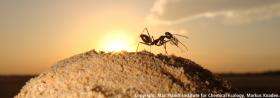
February 27, 2009 Cataglyphis fortis

Enlarge

Cataglyphis fortis

Humans lost in the desert are well known for going around in circles, prompting scientists to ask how desert creatures find their way around without landmarks for guidance. Now research published in BioMed Central's open access journal Frontiers in Zoology shows that Desert Ants input both local smells and visual cues into their navigation systems to guide them home.

Until now researchers thought that the Desert Ant Cataglyphis fortis, which makes its home in the inhospitable salt pans of Tunisia, was a pure vision-guided insect. But Kathrin Steck, Bill Hansson and Markus Knaden from the Max Planck Institute for Chemical Ecology in Jena, Germany used gas chromatography to verify that desert microhabitats do have unique odour signatures that can guide the ants back to the nest.

After having identified some odours of these signatures the researchers trained ants in field experiments to recognise these odours pointing to a hidden nest entrance. Ants learned to associate their nest entrance with a single odour and discriminated the training odour against non-training odours. They even picked out the training odour from a four-odour blend. The ants were less focused when faced with a blend rather than the pure scent of home, but still performed better in their search than those tested with the solvent control.

The use of environmentally derived olfactory landmarks has been shown for pigeons, while most ants rely rather on self generated pheromone trails. However Cataglyphis roams for over 100 meters in search for food in a habitat where high temperatures and changeable food locations make pheromone trails ineffective. This might be the reason, why these ants better go for stable olfactory landmarks that they learn at the nest entrance.

"We are amazed to discover that while keeping track of the path integrator and learning visual landmarks, these ants can also collect information about the olfactory world," said Knaden, who hopes to investigate the interaction between visual and olfactory information in future research.

More information: Smells like home: Desert ants, Cataglyphis fortis, use olfactory landmarks to pinpoint the nest
Kathrin Steck, Bill S Hansson and Markus Knaden, Frontiers in Zoology (in press), http://www.frontiersinzoology.com/

Source: BioMed Central


print this article email this article download pdf blog this article bookmark this article     Stumble it Digg this share on Facebook retweet share on Reddit add to delicious
Rate this story - 4.3 /5 (3 votes)


February 27, 2009 all stories

Comments: 0

4.3 /5 (3 votes)
  • Stumble this up

  • Digg this

  • share this

  • hide
  • Related Stories


  • hide
  • Relevant PhysicsForums posts

  • What is transpulmonary pressure?
    created Nov 24, 2009
  • Is there a gay gene?
    created Nov 23, 2009
  • Super quick question about Starling forces?
    created Nov 22, 2009
  • Questions about diffusion
    created Nov 22, 2009
  • More from Physics Forums - Biology

Other News

Variable Temperatures Leave Insects wtih a Frosty Reception

Biology / Plants & Animals

created 1hour ago | popularity not rated yet | comments 0

(PhysOrg.com) -- For the first time, scientists at The University of Western Ontario have shown that insects exposed to repeated periods of cold will trade reproduction for immediate survival.


Experts think toxic algae harming endangered fish

Biology / Ecology

created 1hour ago | popularity not rated yet | comments 0

(AP) -- Scientists say they think toxins from a blue-green algae plaguing lakes and rivers around the West are harming an endangered fish in the Klamath Basin, adding another obstacle to restoring species that have forced ...


When camouflage is a plant's best protection

Rare woodland plant uses 'cryptic coloration' to hide from predators

Biology / Plants & Animals

created 3 hours ago | popularity not rated yet | comments 0

It is well known that some animal species use camouflage to hide from predators. Individuals that are able to blend in to their surroundings and avoid being eaten are able to survive longer, reproduce, and ...


Destruction spreads 'like a disease'

Biology / Ecology

created 2 hours ago | popularity not rated yet | comments 0

(PhysOrg.com) -- People have cleared more than a quarter of the world’s forests and half of its grasslands, according to a paper published today in the Proceedings of the Royal Society by researchers from The University of Que ...


'Safety valve' protects photosynthesis from too much light

Biology / Cell & Microbiology

created 5 hours ago | popularity not rated yet | comments 0

Photosynthetic organisms need to cope with a wide range of light intensities, which can change over timescales of seconds to minutes. Too much light can damage the photosynthetic machinery and cause cell death. Scientists ...