Scientists Control Plasma Bullets

February 27, 2009 By Lisa Zyga Scientists Control Plasma Bullets

Enlarge

An image of the plasma pencil, where the blue beam is the cold plasma plume. Image credit: Plasma Pencil, Photo courtesy M. Laroussi, Old Dominion University.

(PhysOrg.com) -- On the nanoscale, things aren’t always what they seem. What first looked like a continuous plasma jet has turned out to be a train of tiny, high-velocity plasma bullets. Using a camera with an exposure time of a few nanoseconds, researchers have further investigated the plasma bullets, and have even found a way to control them.

Using a high-speed intensified charge coupled device (ICCD), Professor Mounir Laroussi and his students from the Laser & Plasma Engineering Institute at Old Dominion University in Norfolk, Virginia, has taken an up-close look at the little-known plasma bullets. Their study is published in a recent issue of the Journal of Physics D: Applied Physics.

The plasma bullets are created by a “plasma pencil,” which is a pulsed plasma source that the researchers previously developed. The plasma pencil is a hollow tube about 2.5 cm in diameter that contains two copper electrodes. To ignite the plasma, the researchers sent a gas mixture of helium and oxygen through holes in the electrodes, and applied high-voltage electric pulses between the electrodes. When the gas ignited between the electrodes, it launched a plasma plume through the hole of the outer electrode up to 5 cm into the air.
Scientists Control Plasma Bullets
Enlarge

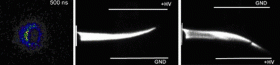
(Left) Photograph of a plasma bullet taken with an ICCD camera, illustrating the bullet’s donut shape. (Right) An externally applied dc voltage causes the plasma plume to bend in the opposite direction. Image credit: Mericam-Bourdet, et al.

The plasma plume (which is actually a train of plasma bullets) moves at a velocity of up to 100,000 meters per second - much faster than the velocity of the gas coming out of the device, which is just 8 meters per second. Although previous research has explained that photoionization could be responsible for the high velocity, Laroussi and his students at Old Dominion have now found clues to the bullets’ original formation.

In their study, the researchers found that the length of the electrically-driven plume depends mainly on two parameters: the applied voltage between the two electrodes and the helium gas flow. Also, the average bullet velocity increases when the voltage increases. By analyzing images from the ICCD camera, the scientists also found that the bullets always become extinguished when the voltage pulse ends.

By viewing the plasma bullets at multiple angles, the researchers found another surprise: the bullet is not round, but is shaped like a donut, with a hole in the middle. Based on this shape, the researchers proposed that the plasma bullets are surface waves that travel along the interface between two media - helium and ambient air.

In addition, the researchers found that they could control the initiation time and distance of the plasma bullets by applying an external dc electric field. The applied field decreased the bullets’ average velocity and distance traveled. Also, by applying the electric field perpendicular to the axis of the plasma plume, the negatively charged plume is deflected away from the negatively charged field.

As Laroussi explained, the aim of the study was to attempt to understand the physics behind the formation and propagation of these cold plasma bullets. “There has been a lot of debate as to how these bullets propagate. So we hope that we have contributed some interesting ideas to this debate,” he told PhysOrg.com, adding that still more work needs to be done.

Laroussi also said that the plasma bullets could be used for biomedical purposes, such as dental and wound healing applications. Teaming up with microbiologists, Laroussi has already used the tiny plasma bullets to inactivate bacteria, especially those of dental relevance such as Streptococcus mutans which are implicated in the onset and progression of dental caries (tooth decay).

More information: Mericam-Bourdet, N.; Laroussi, M.; Begum, A.; and Karakas, E. “Experimental investigations of plasma bullets.” J. Phys. D: Appl. Phys. 42 (2009) 055207 (7pp).

Copyright 2009 PhysOrg.com.
All rights reserved. This material may not be published, broadcast, rewritten or redistributed in whole or part without the express written permission of PhysOrg.com.


print this article email this article download pdf blog this article bookmark this article     Stumble it Digg this share on Facebook retweet share on Reddit add to delicious
Rate this story - 4.5 /5 (30 votes)

Rank Filter

Move the slider to adjust rank threshold, so that you can hide some of the comments.


Display comments: newest first

  • Sunnydips - Feb 27, 2009
    • Rank: 2.5 / 5 (6)
    the next james bond should use plasma bullets
  • earls - Feb 27, 2009
    • Rank: 1 / 5 (3)
    "wound healing applications"

    Bond is suppose to kill the bad guys, not save them! :p
  • bearly - Feb 27, 2009
    • Rank: 1.3 / 5 (3)
    It would be interesting to know the maximum range of these bullets and if it could be scaled up to a defensive type weapon. We might need such a thing when we make " first contact ".
  • earls - Feb 27, 2009
    • Rank: 2.6 / 5 (5)
    lol, typical, greeting extraterrestrial visitors with a bullet between the eyes...

    I really don't think we'll be much of a nuisance to them.
  • Modernmystic - Feb 27, 2009
    • Rank: 2.3 / 5 (4)
    If we met an advanced civilization at this point and they weren't nice, they could simply sit out at the orbit of Jupiter and throw rocks at us until we were all dead without us even seeing their faces....
  • Harkonnen - Feb 28, 2009
    • Rank: 4.8 / 5 (4)
    100,000 meters/second? Could this be used like an ion thruster in space?
  • earls - Feb 28, 2009
    • Rank: 3.3 / 5 (4)
    Certainly, Harkoennen, but you have to take efficiency into consideration... We're talking microscope masses here, and scaling up may present additional challenges.
  • bearly - Mar 01, 2009
    • Rank: 1.3 / 5 (4)
    earls, It is obvious that you need to work on your reading comprehension skills. If you re-read my comment you will notice (maybe) the word "defensive".
    While you are probubly correct in saying we wouldn't be much of a nuisance to them, We should be prepared. Prevention is better than a cure.
  • ScottyB - Mar 03, 2009
    • Rank: 1.5 / 5 (2)
    i was thinking the same thing Harkonnen. Woudl be interestingto see with further studys maybe?

  • iantresman - Mar 04, 2009
    • Rank: 4.5 / 5 (2)
    Sounds like "plasma bullets" are "plasmoids", discovered by Winston H. Bostick in the 1950s, which he fired from a plasma gun (dense plasma focus device) and were toroidal in shape. See http://www.plasma...Plasmoid
  • BrianH - Mar 04, 2009
    • Rank: 3 / 5 (1)
    I'm curious about what the oxygen is doing in the rig and mix. Helium is inert, so there's no chemistry going on.

    As for DPF, take a look at the exciting developments over at http://focusfusio...eriment/
    5-8 yrs to $.0025/kwh electricity.
  • earls - Mar 04, 2009
    • Rank: 2.3 / 5 (3)
    Ya broke your link: http://focusfusion.org/
  • Jess - Mar 07, 2009
    • Rank: 1 / 5 (2)
    interesting, but many of these comments seem to be operating under the assumption that these plasma bullets are a large-scale phenomenon (which, of curse, they are not). i wonder if scaling them up to create a weapon of some kind (as implied by the word 'bullet') would be a viable course of action as opposed to the many other weapons systems already in development?
  • goldengod - Mar 31, 2009
    • Rank: not rated yet
    I wonder if these bullets could be the explanation behind the effects found by the people working with plasma spark plugs to run a car engine on water or very lean fuel ratios reported to exceed 80:1 while also increasing power output and energy efficiencies?
  • holoman - May 14, 2009
    • Rank: 1 / 5 (1)
  • Alib - Aug 13, 2009
    • Rank: not rated yet
    An advanced civilization is advanced because they are peaceful. A 'warlike' civilization would have destroyed themselves. We are headed on that path if we do not realize this.

February 27, 2009 all stories

Comments: 16

4.5 /5 (30 votes)
  • Stumble this up

  • Digg this

  • share this

  • hide
  • Related Stories

  • Anticancer nanotech
    created Sep 16, 2009 | popularity not rated yet | comments 0
  • Lunar Reconnaissance Orbiter to Help Astronauts Survive in Infinity
    created Apr 17, 2009 | popularity not rated yet | comments 0
  • First laboratory experiment to accurately model stellar jets explains mysterious 'knots'
    created Feb 09, 2009 | popularity not rated yet | comments 0
  • Proton treatment could replace x-ray use in radiation therapy
    created Aug 28, 2006 | popularity not rated yet | comments 0
  • Research highlights need to address hemophilia in developing world
    created 2 hours ago | popularity not rated yet | comments 0


  • hide
  • Relevant PhysicsForums posts

  • Fresnel Biprism
    created 3 hours ago
  • If light has mass, and is a wave...
    created 11 hours ago
  • How do you get a mousetrap car to go forward and then backward?
    created 15 hours ago
  • Expanding Universe
    created 16 hours ago
  • Can Artificial Photosynthesis be a Fossil Fuel Alternative?
    created 18 hours ago
  • Birds Sucked into Engines?
    created 20 hours ago
  • More from Physics Forums - General Physics

Other News

Building a more versatile laser

Building a more versatile laser

Physics / Optics & Photonics

created 4 hours ago | popularity 4.3 / 5 (7) | comments 0

(PhysOrg.com) -- One of the drawbacks associated with using semiconductor lasers is that many of them can only produce a beam of a single wavelength, and can only send that beam in one direction at a time. ...


Measuring Electron Orbitals

Measuring Electron Orbitals

Physics / General Physics

created 5 hours ago | popularity 5 / 5 (3) | comments 0

(PhysOrg.com) -- For the first time, it has been possible to measure electron density in individual molecular states using what is known as the photoelectric effect. Now published in Science, this method repres ...


Scientists demonstrate 'universal' programmable quantum processor

Scientists demonstrate 'universal' programmable quantum processor

Physics / Quantum Physics

created Nov 15, 2009 | popularity 4.7 / 5 (16) | comments 11

Physicists at the National Institute of Standards and Technology have demonstrated the first "universal" programmable quantum information processor able to run any program allowed by quantum mechanics -- th ...


Do we need dark matter?

Do we need dark matter?

Physics / General Physics

created Nov 12, 2009 | popularity 4.2 / 5 (17) | comments 33

It's the biggest problem in physics: the matter we can see in the universe accounts for just five per cent of the observed gravity that holds galaxies together.


The LHC tunnel

Peckish bird briefly downs big atom smasher

Physics / General Physics

created Nov 09, 2009 | popularity 4.2 / 5 (13) | comments 23

A peckish bird briefly knocked out part of the world's biggest atom smasher by causing a chain reaction with a piece of bread, the European Organisation for Nuclear Research (CERN) said Monday.