Intelligent use of the Earth's heat
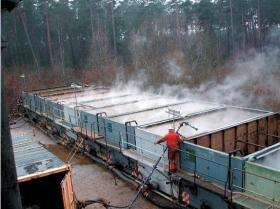
Geothermal energy is increasingly contributing to the power supply world wide. Iceland is world-leader in expanding development of geothermal utilization: in recent years the annual power supply here doubled to more than 500 MW alone in the supply of electricity. And also in Germany, a dynamic development is to be seen: over 100 MW of heat are currently being provided through geothermal energy.
Alone in the region of Travale, in the pioneering country Italy, a team of european scientists have localizied geothermal reservoirs, holding a potential comparable to the effectiveness of 1.000 wind power plants. This is one of the results presented at the international final conference of the project „I-GET" (Integrated Geophysical Exploration Technologies for deep fractured geothermal systems) in Potsdam. The aim of this European Union project, in which seven european nations participated, was the development of cutting-edge geophysical methods with which potential geothermal reservoirs can be safely explored and directly tapped.
"The new methods deliver important decision-support for the selection of sites for future geothermal projects. With this we can considerably reduce the risk of expensive misdrills" explains Dr. Ernst Huenges, Head of Geothermal Research at the host institute GFZ - German Research Centre for Geosciences.
The newly developed approaches have been tested at four European geothermal locations with different geological and thermo¬dynamic conditions: high-temperature reservoirs have been examined in Travale/Italien (metamorphic rocks) and in Hengill/Island (volcanic rocks), two deposits with medium-temperature in deep sediment rocks are Groß-Schönebeck/Germany and Skierniewice/Poland. The methodology is based on the measurement of seismic velocities and electrical conductivity in the underground which deliver information on the rock-physical characteristics at depth. Different methods have, hereby, been combined, in addition to borehole measurements and rock-analysis.
I-GET experiments have been carried out using a case study in the surrounding of the GFZ research borehole at Groß Schönebeck, nordwest of Berlin. And here, extensive pre-knowledge from experimental investigations in the in situ geothermal-laboratory in Groß Schönebeck is already available. The geological conditions prevailing in the North German Basin are representative for further parts of central Europe, and thus the research results are also of high interest beyond Germany's borders.
The GFZ, member of the Helmholtz-Association of German Research Centres, had the leading role in I-GET and was able to contribute with is acquired knowledge in the field of low-temperature geothermal reservoirs.
The results of I-GET emanate worldwide: experts from Indonesia, New Zealand, Australia, Japan and the USA were among the 120 scientists and industry representatives from the 20 countries who participated at the meeting.
"Reliable geothermal technologies are in demand worldwide. Even countries with a long experience in geothermal energy such as Indonesia and New Zealand are interested in the results acquired in I-GET", says Dr. Ernst Huenges. Therefore, the GFZ is further developing its geothermal research and is currently setting up an International Centre for Geothermal Research, which will, in particular, carry out application-oriented large-scale projects on a national and international level.
Source: Helmholtz Association of German Research Centres


