Nano-sonar uses electrons to measure under the surface
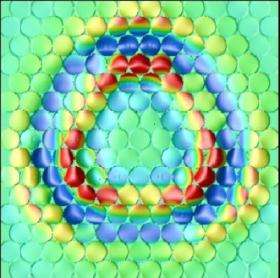
February 27, 2009 Crystal Lattice of Copper

Enlarge

In a computer simulation, Jülich scientists succeeded in showing what shape these rings take on the crystal lattice of copper. Credit: Forschungszentrum Jülich

Just as sonar sends out sound waves to explore the hidden depths of the ocean, electrons can be used by scanning tunnelling microscopes to investigate the well-hidden properties of the atomic lattice of metals. As researchers from Göttingen, Halle and Jülich now report in the high-impact journal Science, they succeeded in making bulk Fermi surfaces visible in this manner. Fermi surfaces determine the most important properties of metals.

"Fermi surfaces give metals their personality, so to speak," explained Prof. Stefan Blügel, Director at the Jülich Institute of Solid State Research. Important properties, such as conductivity, heat capacity and magnetism, are determined by them. On the Fermi surfaces inside the atomic union, high-energy electrons are in motion. Depending on what form the surfaces have and what mobility is assigned to the electrons, they determine the physical properties of metals.
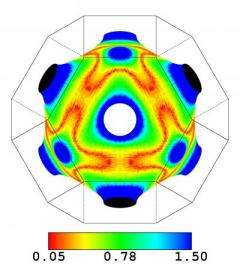
Fermi Surface Around Cobalt Atom
Enlarge

This is the Fermi surface of copper metal. The colors represent the curvature of the surface, which determines the propagation properties for electron waves. Credit: Martin Luther University Halle

In their latest publication, the researchers report on how they used a scanning tunnelling microscope to direct electrons into a copper sample. As electrons spread out like waves, they pass through the metal and are scattered and reflected at obstacles in the bulk, such as single cobalt atoms. "The overlap between incoming and outgoing waves is so strong," said Dr. Samir Lounis from Forschungszentrum Jülich who turned the theoretical calculations into an experiment, "that they can be measured as spherical patterns on the surface using the scanning tunnelling microscope.

The somewhat deformed rings on the surface allow us to draw direct conclusions on the shape of the Fermi surfaces and the depth of the cobalt atoms, similar to how sonar recognises the ocean floor by means of reflected sound waves. "We hope that more sophisticated methods will make it possible to gain a detailed understanding of deep impurities and interfaces between atomic lattices," explained Lounis. For his simulations of the scanning tunnelling experiment, he used the supercomputer known as JUMP in the Jülich Supercomputing Centre.
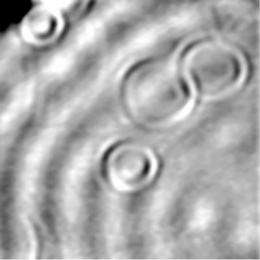
Spherical Patterns on a Copper Surface
Enlarge

A scanning tunneling microscope recognizes spherical patterns on a copper surface (image section approx. nine times nine nanometers). These irregularities in electron distribution are caused by cobalt atoms deep inside the copper. Credit: Forschungszentrum Jülich

In a related article in the "Perspectives" section of "Science", the innovative approach is praised. A scanning tunnelling microscope is primarily used to characterise the surface of a sample. Thanks to the theoretical work in Jülich, it can now be used to gain a direct insight into the bulk of solids and to understand interesting effects in the nanoworld.

More information: Science, 27 February 2009, Vol 323, Issue 5918, Seeing the Fermi Surface in Real Space by Nanoscale Electron Focusing, Weismann et al.

Source: Helmholtz Association of German Research Centres


print this article email this article download pdf blog this article bookmark this article     Stumble it Digg this share on Facebook retweet share on Reddit add to delicious
Rate this story - 4.8 /5 (6 votes)

Rank Filter

Move the slider to adjust rank threshold, so that you can hide some of the comments.


Display comments: newest first


February 27, 2009 all stories

Comments: 1

4.8 /5 (6 votes)
  • Stumble this up

  • Digg this

  • share this

  • hide
  • Related Stories

  • Scientists discover, visualize exotic electrons on surfaces of unique insulators
    created Aug 10, 2009 | popularity not rated yet | comments 0
  • Cool plasma packs heat against biofilms
    created Jun 11, 2009 | popularity not rated yet | comments 0
  • Researchers Find Better Way To Manufacture Fast Computer Chips
    created Mar 31, 2009 | popularity not rated yet | comments 0
  • Progress Toward a Biological Fuel Cell?
    created Dec 30, 2008 | popularity not rated yet | comments 0
  • Denser computer chips possible with plasmonic lenses that 'fly'
    created Oct 22, 2008 | popularity not rated yet | comments 0


  • hide
  • Relevant PhysicsForums posts

Other News

New nano color sorters from Molecular Foundry

New nano color sorters from Molecular Foundry

Nanotechnology / Nanophysics

created 1minute ago | popularity not rated yet | comments 0

Berkeley Lab researchers have engineered a new class of bowtie-shaped devices that capture, filter and steer light at the nanoscale. These "nano-colorsorter" devices act as antennae to focus and sort light ...


In touch with molecules

In touch with molecules

Nanotechnology / Nanophysics

created 17 minutes ago | popularity not rated yet | comments 0

The performance of modern electronics increases steadily on a fast pace thanks to the ongoing miniaturization of the utilized components. However, se-vere problems arise due to quantum-mechanical phenomena ...


Researchers turn algae into high-temperature hydrogen source

Researchers turn algae into high-temperature hydrogen source

Nanotechnology / Nanophysics

created 2 hours ago | popularity 3.3 / 5 (3) | comments 1

In the quest to make hydrogen as a clean alternative fuel source, researchers have been stymied about how to create usable hydrogen that is clean and sustainable without relying on an intensive, high-energy ...


Understanding mechanical properties of silicon nanowires paves way for nanodevices

Understanding mechanical properties of silicon nanowires paves way for nanodevices

Nanotechnology / Nanomaterials

created 22 hours ago | popularity 4.5 / 5 (2) | comments 0

Silicon nanowires are attracting significant attention from the electronics industry due to the drive for ever-smaller electronic devices, from cell phones to computers. The operation of these future devices, ...


carbon fiber

Ultra-Long Carbon Nanotubes Could Serve as Future Transmission Lines

Nanotechnology / Nanomaterials

created Nov 10, 2009 | popularity 4.8 / 5 (19) | comments 13

(PhysOrg.com) -- When it comes to carbon nanotubes, the majority of research so far has focused on small-scale applications. But now, a team of researchers from Rice University has created carbon nanotubes ...