Satellites show the way to new oil finds
February 27, 2009 Satellites show the way to new oil finds

Enlarge

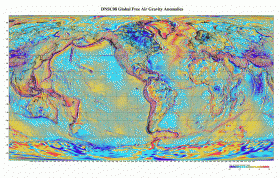
The map shows variations in gravitational force across the surface of the Earth and knowledge about these small variations is a valuable tool in oil exploration.

A new map of the Earth’s gravitational force based on satellite measurements makes it much less resource intensive to find new oil deposits. The map will be particularly useful as the ice melts in the oil-rich Arctic regions. Ole Baltazar, senior scientist at the National Space Institute, Technical University of Denmark (DTU Space), headed the development of the map.

The US company Fugro, one of the world’s leading oil exploration companies, is one of the companies that have already made use of the gravitational map. The company has now initiated a research partnership with DTU Space.

“Ole Baltazar’s gravitational map is the most precise and has the widest coverage to date,” says Li Xiong, Vice President and Head Geophysicist with Fugro. “On account of its high resolution and accuracy, the map is particularly useful in coastal areas, where the majority of the oil is located”

Ole Baltazar’s map shows variations in gravitational force across the surface of the Earth and knowledge about these small variations is a valuable tool in oil exploration. Subterranean oil deposits are encapsulated in relatively light materials such as limestone and clay and because these materials are light, they have less gravitational force than the surrounding materials.

Ole Baltazar’s map is based on satellite measurements and has a hitherto unseen level of detail and accuracy. With this map in your hands, it is, therefore, easier to find new deposits of oil underground.

The gravitational map from DTU Space is unique on account of its resolution of only 2 km and the fact that it covers both land and sea regions. Oil companies use the map in the first phases of oil exploration. Previously, interesting areas were typically selected using protracted, expensive measurements from planes or ships. The interesting areas appear clearly on the map and the companies can, therefore, plan their exploration much more efficiently.

“The map will also be worth its weight in gold when the ice in the Arctic seriously begins to melt, revealing large sea regions where it is suspected that there are large deposits of oil underground. With our map, the companies can more quickly start to drill for oil in the right places without first having to go through a resource-intensive exploration process,” explains Ole Baltazar.

The success of the gravitational map is due in large part to the fact that it is not based on direct gravitation measurements but on observations of the height of the sea, which reflects the gravitation.

“Height measurements have the advantage that it is possible to determine the gravitational field very locally and thus make a gravitational map with a resolution of a few km. For comparison, the resolution of satellite measurements of gravitational force is typically around 200 km. Satellite gravitation measurements are used, for example, to explore conditions in the deeper strata of the Earth, but are not well suited to our purposes,” Ole Baltazar explains.

Provided by Technical University of Denmark


print this article email this article download pdf blog this article bookmark this article     Stumble it Digg this share on Facebook retweet share on Reddit add to delicious
Rate this story - 4.3 /5 (3 votes)


February 27, 2009 all stories

Comments: 0

4.3 /5 (3 votes)
  • Stumble this up

  • Digg this

  • share this

  • hide
  • Related Stories

  • New Light on Dark Energy
    created Jan 30, 2008 | popularity not rated yet | comments 0
  • Joint Dark Energy Mission a Top Priority for NASA, Says NRC
    created Sep 06, 2007 | popularity not rated yet | comments 0
  • GOCE delivering data for best gravity map ever (w/ Video)
    created Sep 30, 2009 | popularity not rated yet | comments 0
  • Scientists directly measure charge states of atoms using an atomic force microscope
    created Jun 23, 2009 | popularity not rated yet | comments 0
  • Earth Explorer mission GOCE launches
    created Mar 17, 2009 | popularity not rated yet | comments 0


  • hide
  • Relevant PhysicsForums posts

Other News

Close-up movie shows hidden details in the birth of super-suns

Close-up movie shows hidden details in the birth of super-suns (w/ Video)

Space & Earth / Astronomy

created 11 hours ago | popularity 4.8 / 5 (5) | comments 0

(PhysOrg.com) -- The constellation of Orion is a hotbed of massive star formation, most prominently in the Great Nebula that sits in Orion's sword. The glowing gas of the Nebula is powered by a group of young ...


Ghostly 'Spokes' Puff Out From Saturn's Ring's

Ghostly 'Spokes' Puff Out From Saturn's Ring's (w/ Video)

Space & Earth / Space Exploration

created 8 hours ago | popularity 5 / 5 (1) | comments 0

(PhysOrg.com) -- Massive, bright clouds of tiny ice particles hover above the darkened rings of Saturn in an image captured by the Cassini spacecraft on Sept. 22, 2009, around the time of Saturn's equinox. ...


NASA 'Drops' Next Generation Robotic Lander During Autonomous Tests

NASA 'Drops' Next Generation Robotic Lander During Autonomous Tests

Space & Earth / Space Exploration

created 8 hours ago | popularity 4.7 / 5 (3) | comments 1

(PhysOrg.com) -- NASA has successfully completed a series of autonomous "drop" tests of a robotic lander test article - in a record 10 months - to demonstrate the ability to perform a controlled landing on ...


Volatile gas could turn Rwandan lake into a freshwater time bomb

Space & Earth / Earth Sciences

created 9 hours ago | popularity 4.4 / 5 (5) | comments 3

A dangerous level of carbon dioxide and methane gas haunts Lake Kivu, the freshwater lake system bordering Rwanda and the Republic of Congo.


Space shuttle Atlantis lifts off on supply mission (AP)

Space shuttle Atlantis lifts off on supply mission

Space & Earth / Space Exploration

created 8 hours ago | popularity 3.5 / 5 (2) | comments 0

(AP) -- With 100 Internet-savvy NASA fans cheering on the shuttle and churning out constant Twitter updates, Atlantis sailed smoothly into orbit Monday with six astronauts and a full load of spare parts for ...