Cassini Maps Global Pattern of Titan's Dunes
February 27, 2009 Cassini Maps Global Pattern of Titan's Dunes

Enlarge

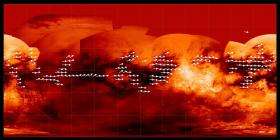
Scientists have used data from the Cassini radar mapper to map the global wind pattern on Saturn's moon Titan using data collected over a four-year period, as depicted in this image. Image: NASA/JPL/Space Science Institute

(PhysOrg.com) -- Titan's vast dune fields, which may act like weather vanes to determine general wind direction on Saturn's biggest moon, have been mapped by scientists who compiled four years of radar data collected by the Cassini spacecraft.

Titan's rippled dunes are generally oriented east-west. Surprisingly, their orientation and characteristics indicate that near the surface, Titan's winds blow toward the east instead of toward the west. This means that Titan's surface winds blow opposite the direction suggested by previous global circulation models of Titan.

"At Titan there are very few clouds, so determining which way the wind blows is not an easy thing, but by tracking the direction in which Titan's sand dunes form, we get some insight into the global wind pattern," says Ralph Lorenz, Cassini radar scientist at Johns Hopkins University Applied Physics Laboratory in Laurel, Md. "Think of the dunes sort of like a weather vane, pointing us to the direction the winds are blowing." A paper based on these findings appeared in the Feb. 11 issue of Geophysical Research Letters.

"Titan's dunes are young, dynamic features that interact with topographic obstacles and give us clues about the wind regimes," said Jani Radebaugh, Brigham Young University, Provo, Utah. "Winds come at these dunes from at least a couple of different directions, but then combine to create the overall dune orientation."

The wind pattern is important for planning future Titan explorations that might involve balloon-borne experiments.

Some 16,000 dune segments were mapped out from about 20 radar images, digitized and combined to produce the new map.

Titan's dunes are believed to be made up of hydrocarbon sand grains likely derived from organic chemicals in Titan's smoggy skies. The dunes wrap around high terrain, which provides some idea of their height. They accumulate near the equator, and may pile up there because drier conditions allow for easy transport of the particles by the wind. Titan's higher latitudes contain lakes and may be "wetter" with more liquid hydrocarbons, not ideal conditions for creating dunes.

Cassini, which launched in 1997 and is now in extended mission operations, continues to blaze its trail around the Saturn system and will visit Titan again on March 27. Seventeen Titan flybys are planned this year.

Provided by NASA


print this article email this article download pdf blog this article bookmark this article     Stumble it Digg this share on Facebook retweet share on Reddit add to delicious
Rate this story - 4.9 /5 (8 votes)


February 27, 2009 all stories

Comments: 0

4.9 /5 (8 votes)
  • Stumble this up

  • Digg this

  • share this

  • hide
  • Related Stories


  • hide
  • Relevant PhysicsForums posts

  • Question about 2-body gravity
    created Nov 24, 2009
  • life on Mars
    created Nov 24, 2009
  • Semi-major axis from cartesian co-ordinates
    created Nov 23, 2009
  • Primary Mirror grinding
    created Nov 23, 2009
  • More from Physics Forums - General Astronomy

Other News

Small faults in Southeast Spain reduce earthquake risk of larger ones

Small faults in Southeast Spain reduce earthquake risk of larger ones

Space & Earth / Earth Sciences

created 1hour ago | popularity not rated yet | comments 0

A team of Spanish scientists, studying recent, active deformations in the Baetic mountain range, have shown that the activity of smaller tectonic structures close to larger faults in the south east of the ...


Cutting greenhouse pollutants could directly save millions of lives worldwide

Space & Earth / Environment

created 31 minutes ago | popularity 1 / 5 (1) | comments 0

Tackling climate change by reducing carbon dioxide and other greenhouse emissions will have major direct health benefits in addition to reducing the risk of climate change, especially in low-income countries, according to ...


It's not just dirt!

Space & Earth / Environment

created 28 minutes ago | popularity not rated yet | comments 0

Soil is the linchpin of the environment, where atmosphere, biosphere, and hydrosphere meet. Despite that, many students see soil as "just dirt" - a place to grow plants, but nothing more. Soil science educators are challenged ...


First black holes may have incubated in giant, starlike cocoons, says CU-Boulder study

First black holes may have incubated in giant, starlike cocoons

Space & Earth / Astronomy

created 21 hours ago | popularity 4.5 / 5 (11) | comments 15

(PhysOrg.com) -- The first large black holes in the universe likely formed and grew deep inside gigantic, starlike cocoons that smothered their powerful x-ray radiation and prevented surrounding gases from ...


Mars Reconnaissance Orbite

Mars Reconnaissance Orbite Team Plans Uplink of Protective Files

Space & Earth / Space Exploration

created 3 hours ago | popularity 5 / 5 (1) | comments 0

(PhysOrg.com) -- The team operating NASA's Mars Reconnaissance Orbiter plans to uplink protective files to the spacecraft next week as one step toward resuming the orbiter's research and relay activities.