Dawn Finishes Mars Phase
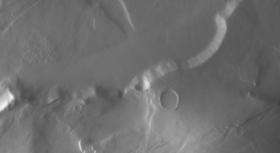
February 27, 2009 Dawn Finishes Mars Phase

Enlarge

This image was taken near the point of closest approach to Mars on Feb. 17, 2009, during Dawn's gravity assist flyby. Image credit: NASA/JPL/MPS/DLR/IDA, and the Dawn Flight Team

(PhysOrg.com) -- With Mars disappearing in its metaphorical rearview mirror, NASA's Dawn spacecraft's next stop is the asteroid belt and the giant asteroid Vesta. Dawn got as close as 549 kilometers (341 miles) to the Red Planet during its Tuesday, Feb. 17, flyby.

Dawn's navigators placed the spacecraft on a close approach trajectory with Mars so the planet's gravitational influence would provide a kick to the spacecraft's velocity. If Dawn had to perform these orbital adjustments on its own, with no Mars gravitational deflection, the spacecraft would have had to fire up its engines and change velocity by more than 9,330 kilometers per hour (5,800 miles per hour).

The achieved goal of the flyby was to obtain this orbital pick-me-up, making possible its voyage to asteroid Vesta and, later, the dwarf planet Ceres. But Dawn's science teams used this massive target of opportunity to also perform calibrations of some of the scientific instruments. Calibration images were taken by Dawn's framing camera, and the Gamma Ray and Neutron Detector also observed Mars for calibration. These data will be compared to similar observations taken by spacecraft orbiting Mars.

Further observations were planned during the flyby, but fault detection software canceled the data collection and put the spacecraft into safe mode, a limited-activity precautionary status. The cause was determined to be an inappropriate software response to an expected temporary loss of valid data from the spacecraft's star tracker in the vicinity of Mars, and engineers were able to restore the spacecraft to normal operations within 48 hours.

While the spacecraft will never be back in the vicinity of Mars again, the Dawn team is using the event to fine-tune its software.

The spacecraft has already traveled about 1.8 million kilometers (1.1 million miles) beyond Mars. It has 30 months and 1.8 billion kilometers (1.1 billion miles) to go before its rendezvous with Vesta in 2011.

Dawn's 4.8-billion-kilometer (3-billion-mile) odyssey includes orbiting Vesta and the dwarf planet Ceres in 2015. These two giants of the asteroid belt have been witness to much of our solar system's history. By using Dawn's instruments to study both objects for several months, scientists can more accurately compare and contrast the two. Dawn's science instrument suite will measure geology, elemental and mineral composition, shape, surface topography, geomorphology and tectonic history, and will also seek water-bearing minerals. In addition, the Dawn spacecraft's orbital characteristics around Vesta and Ceres will be used to measure the celestial bodies' masses and gravity fields.

Provided by NASA


print this article email this article download pdf blog this article bookmark this article     Stumble it Digg this share on Facebook retweet share on Reddit add to delicious
Rate this story - 4.7 /5 (3 votes)


February 27, 2009 all stories

Comments: 0

4.7 /5 (3 votes)
  • Stumble this up

  • Digg this

  • share this

  • hide
  • Related Stories

  • Spacecraft Talk Continued During JPL Wildfire Threat
    created Sep 10, 2009 | popularity not rated yet | comments 0
  • NASA Spacecraft Falling For Mars
    created Feb 13, 2009 | popularity not rated yet | comments 0
  • Dawn Glides Into New Year
    created Nov 21, 2008 | popularity not rated yet | comments 0
  • Saturn dominates during March, while Jupiter moves onto the stage
    created Feb 29, 2008 | popularity not rated yet | comments 0
  • NASA postpones Dawn spacecraft launch
    created Sep 24, 2007 | popularity not rated yet | comments 0


  • hide
  • Relevant PhysicsForums posts

  • The shape of our solar system's orbits.
    created Nov 07, 2009
  • Above or Below the Line of Nodes
    created Nov 07, 2009
  • Supernova vs. Nova?
    created Nov 07, 2009
  • Supernova's Gamma Rays and Comets
    created Nov 06, 2009
  • More from Physics Forums - General Astronomy

Other News

Deep creep means milder, more frequent earthquakes along Southern California's San Jacinto fault

Deep creep means milder, more frequent earthquakes along Southern California's San Jacinto fault

Space & Earth / Earth Sciences

created 17 hours ago | popularity 4.5 / 5 (4) | comments 0

With an average of four mini-earthquakes per day, Southern California's San Jacinto fault constantly adjusts to make it a less likely candidate for a major earthquake than its quiet neighbor to the east, the ...


Success in 'space elevator' competition (AP)

Success in 'space elevator' competition (Update 3)

Space & Earth / Space Exploration

created Nov 05, 2009 | popularity 4.3 / 5 (33) | comments 50

(AP) -- A robot powered by a ground-based laser beam climbed a long cable dangling from a helicopter on Wednesday to qualify for prize money in a $2 million competition to test the potential reality of the ...


In a Galaxy Far, Far Away...

In a Galaxy Far, Far Away...

Space & Earth / Astronomy

created Nov 06, 2009 | popularity 4.8 / 5 (5) | comments 17

(PhysOrg.com) -- Astronomers have published the discovery of the farthest known object in the cosmos: a star that exploded when the universe was only 630 million years old -- only 4.6% of its current age. ...


'Dropouts' pinpoint earliest galaxies

'Dropouts' pinpoint earliest galaxies

Space & Earth / Astronomy

created Nov 06, 2009 | popularity 4.2 / 5 (10) | comments 13

Astronomers, conducting the broadest survey to date of galaxies from about 800 million years after the Big Bang, have found 22 early galaxies and confirmed the age of one by its characteristic hydrogen signature ...


Space hotel taking bookings for 2012 opening

Space hotel taking bookings for 2012 opening

Space & Earth / Space Exploration

created Nov 05, 2009 | popularity 4.4 / 5 (21) | comments 11

(PhysOrg.com) -- The first orbiting space hotel is on track to open for its first customers in 2012, but hurry, as bookings are filling fast.