Long-term study of orchard ground cover management systems
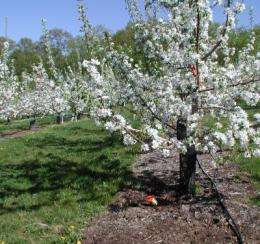
Orchard floor and groundcover management is important to fruit growers, affecting the efficiency of orchard operations, fruit tree performance, and soil quality.
Herbicide-treated tree rows with mowed grass "drive lanes" are the most widely used orchard groundcover management systems (GMS) in North America and Europe; the system is widely considered to be the most efficient and least expensive GMS.
Due to increased concerns about the environmental impact of herbicides and mechanical soil tillage, alternative methods are being sought to suppress orchard weeds and maintain soil quality. In response to environmental concerns, scientists have tested different types of cover crops and mulches, particularly biomass, inorganic, and geotextile mulch. Although root systems play an important role in tree growth and development, little is known about differential GMS effects on orchard root growth and distribution.
Researchers Shengrui Yao (University of Minnesota) and Ian A. Merwin and Michael G. Brown (Cornell University) coauthored a study that compared apple root density and distribution, root turnover, and root lifespan of trees after 10 years under different GMS treatments. The study was published in the journal HortScience.
The experiment involved the use of two minirhizotrons, or root observation tubes, installed on both sides of one tree in three replicates for each GMS treatment. Roots were observed by camera at two or three weekly intervals during the growing seasons of 2002 and 2003, and from whole tree excavations in 2000.
Minirhizotrons were used to study root emergence, turnover, and depth distribution of apple rootstocks under four groundcover management systems: pre-emergence herbicide, post-emergence herbicide, mowed sod grass, and hardwood bark mulch. All systems had been maintained since 1992 in an orchard near Ithaca, New York. Tree growth, yield, nutrient uptake, retention and leaching, soil moisture content, and soil temperature data were collected annually throughout the study.
The researchers discovered substantial differences among the GMS treatments. For instance, tree growth and yield observations from 1992 to 2003 showed that the hardwood bark mulch and post-emergence herbicide treatments produced more tree growth and higher yields than other treatments during most years. The mowed sod grass treatment usually had the smallest trees and lowest yields. Pre-emergence treatment trees had more total roots and new roots than all other treatments, and trees in mowed sod grass plots had fewer total roots than others.
Explaining the impact of the study, Merwin observed; "This study provides information on the relationship between orchard GMS' and tree root demography and dynamics, about which little has been reported previously. GMS treatments affected root growth, turnover, and distribution at this orchard, and these differences were linked with long-term trends in tree growth and fruit production in this research."
The complete study and abstract are available on the ASHS HortScience electronic journal web site: hortsci.ashspublications.org/c … nt/abstract/44/1/168
Source: American Society for Horticultural Science


