Evidence appears to show how and where frontal lobe works
March 2, 2009 Evidence appears to show how and where frontal lobe works

Enlarge

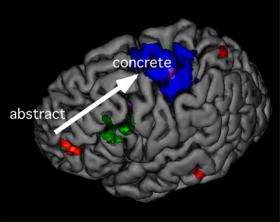
The neuroscience of decision-making By examining stroke victims, researchers determined that the brain’s frontal lobe controls decision-making, with abstract decisions made closer to the front and concrete decisions farther back. Image: Journal of Cognitive Neuroscience

(Physorg.com) -- A Brown University study of stroke victims has produced evidence that the frontal lobe of the human brain controls decision-making along a continuum from abstract to concrete, from front to back.

Abstract actions can be controlled at an abstract level, such as deciding to make a sandwich, or at more concrete and specific levels, such as choosing a sequence of movements that make the sandwich.

The scientific data supports preexisting theories that abstract decisions about action take place in the front of the frontal lobe, the back portion controls the capacity for concrete decisions, and the progression from front to back forms a gradient from abstract to concrete.

The Brown researchers are among the first to show that specific areas of the frontal cortex are needed for different levels of abstract decision.

The finding, to be detailed March 1 in the journal Nature Neuroscience, represents a huge leap in comprehending how the brain supports higher level cognition and intelligent behavior. It could lead to advances in everything from the treatment of strokes to understanding how humans develop thought. Researchers from the University of California-Berkeley also participated in the study.

"It is among the strongest evidence to date for a systemic organization of the frontal cortex," said lead author David Badre, an assistant professor of cognitive and linguistic sciences at Brown University.

The frontal cortex of brain has been long known to affect the internal control of behavior. It controls the capacity to plan, reason, conduct higher-level thinking and connect what we know about the world to how we behave.

Badre and his collaborators came to their conclusion by studying stroke victims who suffered damage to different parts of the frontal lobe. The patients all suffered a stroke at least six months prior to testing. All were screened with an MRI or CT scan to determine where any lesions existed in the brain post-stroke.

The scientists recruited 11 patients — seven men and four women, ranging from age 45 to 73. A 12th patient was recruited but could not perform any of the tests involved.

Researchers gave the patients four different tests that ultimately required selecting a finger-press response. For example, the first test would show a color such as red, which required an index finger push. Blue would trigger the middle finger. The test would then become more difficult by adding more alternate finger presses.

Patients faced greater challenges in selecting a response as subsequent, progressive tests became more complex, with more abstract options.

Badre and colleagues found that damage at a given location affected more abstract decisions but left intact the capacity for more concrete decisions. "If there is damage in a given spot, it will affect all higher (decision-making) functions but not lower functions," Badre said.

Provided by Brown University


print this article email this article download pdf blog this article bookmark this article     Stumble it Digg this share on Facebook retweet share on Reddit add to delicious
Rate this story - 4.7 /5 (10 votes)


March 2, 2009 all stories

Comments: 0

4.7 /5 (10 votes)
  • Stumble this up

  • Digg this

  • share this

  • hide
  • Related Stories

  • Is Tetris good for the brain?
    created Sep 01, 2009 | popularity not rated yet | comments 0
  • Study Finds How the Brain Interprets the Intent of Others
    created Feb 17, 2006 | popularity not rated yet | comments 0
  • The Protein for Quick Decision-Makers
    created Oct 26, 2009 | popularity not rated yet | comments 0
  • You can't trust a tortured brain: Neuroscience discredits coercive interrogation
    created Sep 21, 2009 | popularity not rated yet | comments 0
  • Timing is everything: Growth factor keeps brain development on track
    created Jul 15, 2009 | popularity not rated yet | comments 0


  • hide
  • Relevant PhysicsForums posts

  • 23 Years in a Vegetative State....or not?
    created 18 hours ago
  • Has the H1N1 vaccine been scientifically proven to work?
    created Nov 24, 2009
  • nesfatin
    created Nov 22, 2009
  • Obsessive Compulsive Disorder
    created Nov 20, 2009
  • More from Physics Forums - Medical Sciences

Other News

Brain's endocannabinoid signaling pathway kept in check by two enzymes

Medicine & Health / Research

created 2 hours ago | popularity 5 / 5 (2) | comments 0

(PhysOrg.com) -- A research team has shown that blocking the degradation of two naturally occurring cannabinoids in the endocannabinoid signaling pathway of the brain produces marijuana-like behavioral effects in mice, according ...


Implant-based cancer vaccine is first to eliminate tumors in mice

Implant-based cancer vaccine is first to eliminate tumors in mice

Medicine & Health / Cancer

created 5 hours ago | popularity 5 / 5 (8) | comments 2

(PhysOrg.com) -- A cancer vaccine carried into the body on a carefully engineered, fingernail-sized implant is the first to successfully eliminate tumors in mammals, scientists report this week in the journal ...


Engineers, doctors develop novel material that could help fight arterial disease

Medicine & Health / Research

created 2 hours ago | popularity not rated yet | comments 0

A fortuitous discovery that grew out of a collaboration between UCLA engineers and physicians could potentially offer hope to the nearly 10 million Americans who suffer from peripheral arterial disease.


Free e-samples of prescription drugs: At what cost?

Medicine & Health / Health

created 2 hours ago | popularity 5 / 5 (1) | comments 0

Search the Internet to learn about your asthma, high cholesterol or other common disorder, and odds are you'll be directed to a pharmaceutical company-sponsored Web homepage. There you'll often find an offer for a free sample ...


Some patients diagnosed with HIV experience improved outlook on life

Medicine & Health / HIV & AIDS

created 1hour ago | popularity not rated yet | comments 0

A new study from researchers at the University of Cincinnati (UC) and the Cincinnati Department of Veterans Affairs Medical Center reaffirms that some patients with HIV experience an improved quality of life following their ...