Battery Wrapped in Solar Cells Recharges in the Sun
March 2, 2009 by Lisa Zyga
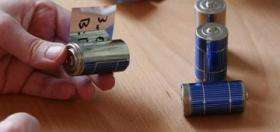
A battery with a half-glued flexible solar cell, and batteries wrapped with the blue solar cells. Image credit: Knut Karlsen.
(PhysOrg.com) -- Although you can buy solar charging devices for rechargeable batteries, it would be even more convenient if batteries had built-in solar cells. Sitting in sunlight, the battery could then recharge itself.
Knut Karlsen, a blogger from Norway, hit upon this idea of a solar battery (a rechargeable battery with integrated solar cells) in hopes of making battery charging more convenient. He was able to work with some flexible solar cells given to him by the Institute for Energy Technology (IFE) in Norway. He then glued the 1.8V solar cells around some 1.5V NiMH rechargeable batteries. Using a conductive silver pen and some flat wires from a broken canon lens, he connected the solar cells and batteries.
Karlsen calls his DIY prototype "SunCat" batteries. As he explains, "The batteries should just bask in the sun like a cat and left for a while, in a sunny window, they would slowly recharge." However, according to his blog post, the weather wasn't sunny enough to test the batteries yet. He explains that the current set-up is not ideal, but a second version might include capacitors to charge the batteries more efficiently and electronics to show when the batteries are fully charged.
Via: blog.bareknut.no
-
Engineers build first sub-10-nm carbon nanotube transistor
Feb 01, 2012 |
4.9 / 5 (33) |
30
-
Something old, something new: Evolution and the structural divergence of duplicate genes
Jan 31, 2012 |
4.6 / 5 (7) |
1
-
The hidden nanoworld of ice crystals: Revealing the dynamic behavior of quasi-liquid layers
Jan 30, 2012 |
5 / 5 (4) |
1
-
Stock market network reveals investor clustering
Jan 27, 2012 |
3.9 / 5 (23) |
8
-
Of microchemistry and molecules: Electronic microfluidic device synthesizes biocompatible probes
Jan 26, 2012 |
5 / 5 (2) |
0
-
How to calculate total compressibility in liquid porous solid system
3 hours ago
-
Need help reading 3-D
22 hours ago
-
A way to send and receive wireless data
Feb 11, 2012
-
Calling function with no input argument
Feb 10, 2012
-
Force free body diagram problem on gym equipment
Feb 10, 2012
-
Empirical data regarding shower heads and water
Feb 10, 2012
- More from Physics Forums - General Engineering
More news stories
Google might launch Drive for cloud storage soon
(PhysOrg.com) -- Google's next big move, according to the Wall Street Journal, is a cloud storage service called Drive. Hardly first to the plate, Google is simply catching up to introducing its cloud reposi ...
Iran blocks email, restricts net access: reports
Iran has further restricted access to the Internet and blocked popular email services for the past few days, in a move a top lawmaker said could "cost the regime dearly," media reports said on Sunday.
4 hours ago |
5 / 5 (1) |
3
Love a click away in Indonesia's Twitter Republic
He was a geeky kid from Yogyakarta, she a glamorous city girl in Jakarta. In a country with one of the world's most vibrant social networking scenes they fell in love on Twitter.
12 hours ago |
4 / 5 (1) |
0
Walney offshore wind farm is world's biggest (for now)
(PhysOrg.com) -- The Walney wind farm on the Irish Sea--characterized by high tides, waves and windy weather--officially opened this week. The farm is treated in the press as a very big deal as the Walney ...
Navy to begin tests on electromagnetic railgun prototype launcher
The Office of Naval Research (ONR)'s Electromagnetic (EM) Railgun program will take an important step forward in the coming weeks when the first industry railgun prototype launcher is tested at a facility ...
Feb 06, 2012 |
4.5 / 5 (17) |
94
|
Overeating may double risk of memory loss
New research suggests that consuming between 2,100 and 6,000 calories per day may double the risk of memory loss, or mild cognitive impairment (MCI), among people age 70 and older. The study was released today and will be ...
Scientists discover molecular secrets of 2,000-year-old Chinese herbal remedy
For roughly two thousand years, Chinese herbalists have treated Malaria using a root extract, commonly known as Chang Shan, from a type of hydrangea that grows in Tibet and Nepal. More recent studies suggest that halofuginone, ...
New method to examine batteries -- MRI from the inside
There is an ever-increasing need for advanced batteries for portable electronics, such as phones, cameras, and music players, but also to power electric vehicles and to facilitate the distribution and storage of energy derived ...
Injured boomers beware: Know when to see doctor
(AP) -- It happened to nurse Jane Byron years after an in-line skating fall, business owner Haralee Weintraub while doing "men's" push-ups, and avid cyclist Gene Wilberg while lifting a heavy box.
Lab study raises questions over nano-particle impact
Tests involving chickens have raised questions about the impact on health from engineered nano-particles, the ultra-fine grains commonly used in drugs and processed foods, scientists said on Sunday.
A mitosis mystery solved: How chromosomes align perfectly in a dividing cell
Although the process of mitotic cell division has been studied intensely for more than 50 years, Whitehead Institute researchers have only now solved the mystery of how cells correctly align their chromosomes during symmetric ...
Mar 02, 2009
Rank: 4.4 / 5 (8)
Very clever idea.
Mar 02, 2009
Rank: 2.4 / 5 (5)
Mar 02, 2009
Rank: 2.2 / 5 (5)
i read the heading.
viewed just to comment.
both are inefficient. lol!
nothing clever... really.
Mar 03, 2009
Rank: 1 / 5 (1)
I have a couple of devices that puke on the 1.2V instead of the alkaline 1.5V. Sure would be nice to have some of these special 1.5V NiMH batteries....
How much credibility are you going to give an article when they can't get the basics correct? Also, wouldn't it be a little hard for the batteries to recharge if in a device? haha. Real convenient! All right, altogether now, TOTAL FAIL!
Mar 03, 2009
Rank: not rated yet
We don't want a technology that's so convenient that all someone has to do is let something SIT somewhere for a period of time and then re-use it virtually GUARANTEEING it WILL be used. No, no, we want people to be FORCED to use the kind of technology we think they SHOULD used because it conforms to OUR almighty notions of efficiency, or "green-ness".
Yeah it isn't efficient, yeah you're going to throw things away (just like you do now...), and WOAH they made a mistake on the voltage of the battery in the article...man that should like totally discredit the idea right THERE.
Pftt....whatever. No wonder the ecowacko movement is still stuck in the starting gate. Maybe it should stay there a while longer...
Mar 04, 2009
Rank: 5 / 5 (2)
Currently, rechargable batteries are too short lived for me. Disposables may be little rolled up tubes of toxicity, but by gosh they are cheap, readily available, and last for years if unused.
Mar 08, 2009
Rank: not rated yet
Well I think what Barakn is trying to say is, if you consider the costs economically and ecologically that the solar cells on these batteries are costing then you'd find that they're not only bad for the environment, but also bad for your wallet. This makes them essentially useless and redundant when you could just plug the normal rechargeable batteries into a solar powered charger that, given the consumer base of these "green batteries", would sell just as easily and be far more efficient in both aspects previously mentioned.
Mar 09, 2009
Rank: not rated yet
Mar 13, 2009
Rank: not rated yet
I'm with Modern on this, it's a good idea, and a good way to get people off of a toxic disposable item.
Mar 14, 2009
Rank: not rated yet
Reusable batteries are a great idea. Especially with solar energy being harnessed to charge them, but the format of a round battery that most people value at close to nothing isn't the most efficient way to go.
I do say, however, I'd like to see them in the marketplace. I just don't believe they'll sell well, or make a major difference in "going green".