Simple device can ensure food gets to the store bacteria free
March 2, 2009 By Brian Wallheimer Simple device can ensure food gets to the store bacteria free

Enlarge

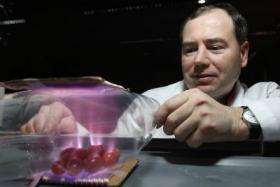
Kevin Keener's in-bag ozonation method creates ozone in packaged foods by using high-voltage coils to charge the gas inside sealed food packages, effectively killing any bacteria inside them. In this demonstration with a bag of tomatoes, helium has been added to a plastic bag because it glows, showing the ionization process. Credit: Purdue Agricultural Communication photo/Tom Campbell

A Purdue University researcher has found a way to eliminate bacteria in packaged foods such as spinach and tomatoes, a process that could eliminate worries concerning some food-borne illnesses.

Kevin Keener designed a device consisting of a set of high-voltage coils attached to a small transformer that generates a room-temperature plasma field inside a package, ionizing the gases inside. The process kills harmful bacteria such as E. coli and salmonella, which have caused major public health concerns.

Keener's process is outlined in an article released online early in LWT - Food Science and Technology, a journal for the Swiss Society of Food and Technology and the International Union of Food Science and Technology.

"Conceptually, we can put any kind of packaged food we want in there," said Keener, an associate professor in the Department of Food Science. "So far, it has worked on spinach and tomatoes, but it could work on any type of produce or other food."

By placing two high-voltage, low-watt coils on the outside of a sealed food package, a plasma field is formed. In the plasma field, which is a charged cloud of gas, oxygen has been ionized and turned into ozone. Treatment times range from 30 seconds to about five minutes, Keener said.

Ozone kills bacteria such as E. coli and salmonella. The longer the gas in the package remains ionized, the more bacteria that are killed. Eventually, the ionized gas will revert back to its original composition.

The process uses only 30-40 watts of electricity, less than most incandescent light bulbs. The outside of the container only increases a few degrees in temperature, so its contents are not cooked or otherwise altered.

Other methods of ozone treatment require adding devices to bags before sealing them to create ozone or pumping ozone into a bag and then sealing it. Keener's method creates the ozone in the already sealed package, eliminating any opportunity for contaminants to enter while ozone is created.

"It's kind of like charging a battery. We're charging that sample," Keener said. "We're doing it without electrode intrusion. We're not sticking a probe in the package. We can do this in a sealed package."

Keener said testing has worked with glass containers, flexible plastic-like food-storage bags and rigid plastics, such as strawberry cartons and pill bottles. He said the technology also could work to ensure pharmaceuticals are free from bacteria.

According to the Centers for Disease Control and Prevention, about 40,000 cases of Salmonellosis, an infection caused by salmonella, are reported each year in the United States, causing 400 deaths. The CDC reports that about 70,000 E. coli infections are reported each year, causing dozens of deaths.

Source: Purdue University


print this article email this article download pdf blog this article bookmark this article     Stumble it Digg this share on Facebook retweet share on Reddit add to delicious
Rate this story - 4.8 /5 (10 votes)

Rank Filter

Move the slider to adjust rank threshold, so that you can hide some of the comments.


Display comments: newest first

  • TJ_alberta - Mar 03, 2009
    • Rank: 5 / 5 (1)
    what else does the ozone react with, besides the bacteria?
  • Falcon - Mar 03, 2009
    • Rank: 1 / 5 (1)
    I am no doctor but doesn't ozone cause health problems? And is supposedly a cause of greenhouse gasses?
    http://en.wikiped...ki/Ozone
  • h0dges - Mar 03, 2009
    • Rank: 5 / 5 (1)
    I am no doctor but doesn't ozone cause health problems? And is supposedly a cause of greenhouse gasses?
    http://en.wikiped...ki/Ozone

    "Eventually, the ionized gas will revert back to its original composition. "

    And this happens well before the packaging is opened by the consumer. Maybe you should read the article properly.
  • physpuppy - Mar 06, 2009
    • Rank: not rated yet
    Interesting - people are irrationally afraid of irradiation of food due to the rational reason that possibly the trace degradation products formed might be harmful - now with ozonation of food, where much higher amounts of materials could be formed, would people feel the same way?
  • NeilFarbstein - Mar 15, 2009
    • Rank: 1 / 5 (1)
    Ozone will recat with the food causing toxic by products

March 2, 2009 all stories

Comments: 5

4.8 /5 (10 votes)
  • Stumble this up

  • Digg this

  • share this

  • hide
  • Related Stories

  • Crashing the size barrier
    created Nov 18, 2009 | popularity not rated yet | comments 0
  • Research Goes Online in Birck Nanotechnology Center 'Cleanroom'
    created Jun 14, 2006 | popularity not rated yet | comments 0
  • UQ archaeology digs into the life behind Pompeii
    created 8 hours ago | popularity not rated yet | comments 0
  • Fish food fight: Fish don't eat trees after all, says new study
    created Nov 24, 2009 | popularity not rated yet | comments 0
  • Diabetes surgery summit consensus lays foundation for new field of medicine
    created Nov 24, 2009 | popularity not rated yet | comments 0


  • hide
  • Relevant PhysicsForums posts

  • Putting every element in a box
    created 10 hours ago
  • a question in Lewis structure???
    created 17 hours ago
  • Paint Technology
    created Nov 24, 2009
  • About pH, Metallic electrodes
    created Nov 24, 2009
  • More from Physics Forums - Chemistry

Other News

Blocking biofilms: Alzheimer's research sheds light on potential treatments for urinary tract infections

Chemistry / Biochemistry

created 15 hours ago | popularity 5 / 5 (1) | comments 0

(PhysOrg.com) -- Research into Alzheimer's disease seems an unlikely approach to yield a better way to fight urinary tract infections (UTIs), but that's what scientists at Washington University School of Medicine in St. Louis ...


Chemists get custom-designed microscopic particles to self-assemble in liquid crystal

Chemists get custom-designed microscopic particles to self-assemble in liquid crystal

Chemistry / Materials Science

created 15 hours ago | popularity 5 / 5 (5) | comments 0

(PhysOrg.com) -- The scientists anticipate their "LithoParticles" will have significant applications in photonics, optical communications and other areas.


Sandia CR5

Machine Converts CO2 into Gasoline, Diesel, and Jet Fuel

Chemistry / Biochemistry

created Nov 23, 2009 | popularity 4.6 / 5 (30) | comments 19

(PhysOrg.com) -- Researchers at Sandia National Laboratories have built a machine that uses the sun's energy to convert carbon dioxide waste from power plants into transportation fuels such as gasoline, diesel, ...


New hydrogen-storage method discovered

New hydrogen-storage method discovered

Chemistry / Materials Science

created Nov 22, 2009 | popularity 4.3 / 5 (42) | comments 15

Scientists at the Carnegie Institution have found for the first time that high pressure can be used to make a unique hydrogen-storage material. The discovery paves the way for an entirely new way to approach ...


Study shows flavanol antioxidant content of US chocolate and cocoa-containing products

Chemistry / Other

created 17 hours ago | popularity 1 / 5 (2) | comments 0

A recent study confirms that the antioxidants and other plant-based nutrients in chocolate and cocoa products are highly associated with the amount of non-fat cocoa-derived ingredients in the product. The study expands on ...