'Inlet Outlet' Lets Users Give Power Back To Wall Sockets
March 2, 2009 by Lisa Zyga
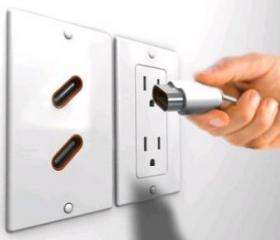
The "inlet outlet" allows users to give power back to the grid to counteract energy consumption. Image credit: Carla Diana and Jeff Hoefs, Smart Design.
(PhysOrg.com) -- Ever wish you could you power your home's electrical appliances with the energy you generate on your exercise bike? A new concept called an "inlet outlet" could allow homeowners to put power from kinetic household activities - such as exercise equipment - back into the grid through a wall socket, helping to lower electricity bills. Basically, the inlet outlet would be the opposite of a typical wall outlet.
The concept was one of 50 finalists at this year's Greener Gadgets Design Competition, which was held last Friday, February 27, in New York City, and is sponsored by the Consumer Electronics Association. Designed by Carla Diana and Jeff Hoefs of Smart Design, the inlet outlet concept includes adapter kits that convert common household products into energy-generating devices compatible with the inlet outlets.
Besides exercise equipment, sources of reusable energy could include things like a refrigerator or gas oven/range, which generate heat that could be captured by a panel and converted into electricity. In addition, motion is everywhere: a welcome mat that is constantly stepped on, an outdoor trampoline, and a flag in the wind all generate kinetic energy that could be converted into electricity and fed back into the grid through the inlet outlet. No matter how small, inlet energy could counteract some of the energy consumed.
The designers hope that, if the inlet outlet plugs and adapters are easy to use, the system could encourage further development of household devices that can be used to generate electricity.
The inlet outlet was just one of many innovative eco concepts at the competition, and didn't make the top 10. Based on audience feedback and live judging, a concept called the Tweet-a-Watt - a power meter that wirelessly publishes your power usage on your Twitter page - won first place. The Power-Hog, a piggy bank that monitors power consumption, won second place.
More information:
Inlet Outlet concept page
Top 50 Entries
Green Gadgets press release
• Join PhysOrg.com on Facebook!
• Follow PhysOrg.com on Twitter!
© 2009 PhysOrg.com


That's right folks. Step right up, you to can earn 1-2 cents per hour(!!!) while exercising. Amazing.
I don't know how much electricity one of those things could generate but, from the fact that a normal pushbike can power the bike's headlight, I estimate that it could power a 100W light bulb. You ride that thing an hour a day for a month, and you've generated 3 kilowatt-hours, or about 1% of your monthly electricity usage.
Doesn't sound like a lot, but if it costs you nothing to do (remember you're only buying the bike for the exercise), saves you a little bit of money and motivates you to actually do the exercise, then it can only be a good thing.
On the other hand, the news machines I keep seeing (with huge LCD screens with video and all) probably consume around 100W on their own...
-fleem
I agree thought that energy conservation such as using energy-efficient bulbs, insulation and the like are a much better approach.
For starters where does the energy go? Lets imagine an exercise bike - most is lost due to friction on the bearings. Additional resistance is applied to make it harder to pedal.
This resistance could be a generator, but extracting more energy would make it more difficult to pedal
And I agree with ealex about this 'concept' loosing to simple gimmicky power 'Monitoring' devices (which themselves USE POWER TO MONITOR THE POWER, kind of counter productive don't you think?) to a concept that atleast suggests giving something back. The idea itself is sound, the method of making it happen may not be as easy as it seems, but atleast they made an effort to try and give something back to the grid.
@Treetops - You are right in your own way.. improving insulation, upgrading to energy efficient appliances is a step in the right direction, and while it DOES save you money.. Its the IDEA of giving something back that I like about this concept.
Honey, tell our 3 year old to plug in the exercise bike, I'm gonna make me some powah!
This would also significantly lower the cost of modifying something like an exercise bike to use the system, since you would just need a simple DC generator and the 'inlet system' would handle the rest. And without having to connect such devices directly to mains power in order to synchronize to the grid, many of the safety concerns for such a device simply vanish.
Obviously, there's a minimum threshold for power output of a device, below which generating power for such a system becomes a losing proposition. But I suspect that exercise equipment is a common household item that lies above that threshold, whereas it would most likely take years for energy collected from a flag to recoup the energy cost of building and installing the device to collect it.
Can anyone see a reason why these ideas wouldn't work?
One would assume that these plugs would be connected to a device doing exactly that...otherwise there would be no point.
A lot of comments seemed to assume that devices being plugged in would need circuitry to synch with the grid, and none of the articles I've seen mentioning the inlet idea give any details at all on what's happening past the wall with it.
They do mention BOTH "inlet outlet plugs and adapters". I am dubious, however, as to the efficiency that any device could have which would accomplish this task. Hopefully the energy you'd create would not be used just to power the synchronization device's circuitry!
Could this concept be more viable in a commercial or industrial setting? Especially with machinery that creates massive amounts of waste heat as well as material, liquid and air flow.
But then again, gathering waste heat with huge banks of thermal couples could be a very costly endeavor, and you would probably be much better off just installing some solar panels or fiberglass insulation...
They don't use any silly "power inlets", they just hardwire it.
The electrical grid is not a bank that can store electricity and use it later. As long as you're ofsetting single cycle natural gas turbines you're probably fine. If you start eating into baseload or CCGT you'll create needless wear and tear on the electrical grid and the excess power will go unused.
With that said, I think that the projects that did come in first and second to monitor our power usage, did so quite rightfully. Sunlight being the best medicine and all. At some point the monitoring could even be broken down to given outlets if not actual appliances. Then we would really be able to see if our exercise bike was helping with our electricity bill or if the old freezer down in the basement was killing your bill.
"Price of admission? Walk around a lot."