Geologic Findings Undermine Theories of Permian Mass Extinction Timing
March 2, 2009 Geologic Findings Undermine Theories of Permian Mass Extinction Timing

Enlarge

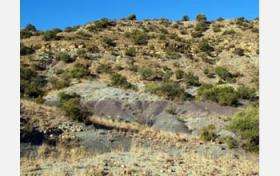
The Karoo Basin in South Africa holds the world's best record of the Permian Mass Extinction. Credit: Robert Gastaldo, Colby College

(PhysOrg.com) -- New scientific findings by geologist Robert Gastaldo of Colby College in Waterville, Maine, and colleagues call into question popular theories about the largest mass extinction in Earth's history.

A paper reporting the results by Gastaldo, South African scientist Johann Neveling, and two 2008 Colby undergraduate students, C. Kittinger "Kit" Clark and Sophie Newbury, appears in the March 2009 issue of Geology.

Tens of millions of years before dinosaurs roamed Earth, their ancestors were all but eliminated in a catastrophic event called the Permian Mass Extinction. The Permian period extended from 299 to 252.6 million years ago.

"The Permian-Triassic boundary marks the greatest extinction event in Earth's history, with significant loss of biodiversity both on land and in the oceans," says H. Richard Lane, a paleontologist and program director in the National Science Foundation (NSF)'s Division of Earth Sciences, which funded the research.

"Until this study, it was believed that the event was marked by unique rocks traceable across southern hemisphere continents. This research calls into question whether the extinction event is actually constrained in the geologic record on land."

Ideas about the event's impact on land animals and plants are based largely on records in the Karoo Basin in central South Africa, where the best fossil records from that time are found, and where Gastaldo and his students have worked since 2003 with funding from NSF.

Earlier analysis of the rock record by other scientists working in South Africa led them to hypothesize about the nature, scope and timing of the mass die-off of prehistoric amphibians and reptiles.

They claimed that one unique sedimentary layer in the Karoo Basin overlies fossils of the last reptiles of the Permian period (synapsids, including the genus Dicynodon).

This layer has been dubbed "the dead zone" because of its absence of fossil remains.

This dead zone was thought to be synchronous in time and space, marking the event across southern Africa and as far away as Antarctica.

Now Gastaldo and co-authors report that they have found conflicting stratigraphic evidence in the Karoo Basin.

They discovered that this dead zone layer, or event bed, is not found at the same physical position in the rock record at all places, even across the immediate landscape where it was first described.

As such, it is not a reliable marker of the mass extinction of terrestrial animals, Gastaldo says.

Within one kilometer, just across the valley from the site where it was first described, the layer occurs lower in the rock record by eight meters (more than 25 feet).

Several hundred kilometers away, at Lootsberg Pass, reptile fossils occur above the layer rather than below it, further undermining the credibility of the zone as a marker of the mass extinction of animals at the end of the Permian.

Gastaldo says that the research proves that "there is no evidence to support a terminal extinction event in the record of the Karoo Basin, based on the criterion of an unique event bed or dead zone."

Provided by NSF


print this article email this article download pdf blog this article bookmark this article     Stumble it Digg this share on Facebook retweet share on Reddit add to delicious
Rate this story - 4 /5 (19 votes)

Rank Filter

Move the slider to adjust rank threshold, so that you can hide some of the comments.


Display comments: newest first

  • jonnyboy - Mar 03, 2009
    • Rank: 1 / 5 (1)
    righhhhhhhhhhhhhhhhhttttttttttttttttttttt

    everyone else that has studied this is wrong and only this one professor is right
  • out7x - Mar 05, 2009
    • Rank: 1 / 5 (2)
    On the contrary, there is much evidence in the Karoo. Read this book. "Extinction", by Erwin.
  • Velanarris - Mar 15, 2009
    • Rank: not rated yet
    righhhhhhhhhhhhhhhhhttttttttttttttttttttt

    everyone else that has studied this is wrong and only this one professor is right

    It's like steady state theory, there's strong evidence against it, but everyone accepts it as truth. That doesn't necessarily make it true.

    This new evidence is certainly interesting.

March 2, 2009 all stories

Comments: 3

4 /5 (19 votes)
  • Stumble this up

  • Digg this

  • share this

  • hide
  • Related Stories

  • Poisonous volcanic gas caused world's largest mass extinction, study
    created Dec 02, 2005 | popularity not rated yet | comments 0
  • Dinosaur-Killer was Soft on Algae
    created Oct 02, 2009 | popularity not rated yet | comments 0
  • Canada's shores saved animals from devastating climate change 252 million years ago
    created Oct 01, 2008 | popularity not rated yet | comments 0
  • Insect predation sheds light on food web recovery after the dinosaur extinction
    created Aug 24, 2006 | popularity not rated yet | comments 0
  • Lunar rocks suggest meteorite shower
    created Apr 12, 2006 | popularity not rated yet | comments 0


  • hide
  • Relevant PhysicsForums posts

  • cycles
    created 15 hours ago
  • The Origin of the term 'fossil' fuels
    created Nov 05, 2009
  • co2
    created Nov 03, 2009
  • Early Earths Sulfidic Ocean Conditions
    created Oct 30, 2009
  • More from Physics Forums - Earth

Other News

Deep creep means milder, more frequent earthquakes along Southern California's San Jacinto fault

Deep creep means milder, more frequent earthquakes along Southern California's San Jacinto fault

Space & Earth / Earth Sciences

created 14 hours ago | popularity 4.7 / 5 (3) | comments 0

With an average of four mini-earthquakes per day, Southern California's San Jacinto fault constantly adjusts to make it a less likely candidate for a major earthquake than its quiet neighbor to the east, the ...


Success in 'space elevator' competition (AP)

Success in 'space elevator' competition (Update 3)

Space & Earth / Space Exploration

created Nov 05, 2009 | popularity 4.3 / 5 (33) | comments 50

(AP) -- A robot powered by a ground-based laser beam climbed a long cable dangling from a helicopter on Wednesday to qualify for prize money in a $2 million competition to test the potential reality of the ...


In a Galaxy Far, Far Away...

In a Galaxy Far, Far Away...

Space & Earth / Astronomy

created Nov 06, 2009 | popularity 4.8 / 5 (5) | comments 17

(PhysOrg.com) -- Astronomers have published the discovery of the farthest known object in the cosmos: a star that exploded when the universe was only 630 million years old -- only 4.6% of its current age. ...


'Dropouts' pinpoint earliest galaxies

'Dropouts' pinpoint earliest galaxies

Space & Earth / Astronomy

created Nov 06, 2009 | popularity 4.2 / 5 (10) | comments 13

Astronomers, conducting the broadest survey to date of galaxies from about 800 million years after the Big Bang, have found 22 early galaxies and confirmed the age of one by its characteristic hydrogen signature ...


Space hotel taking bookings for 2012 opening

Space hotel taking bookings for 2012 opening

Space & Earth / Space Exploration

created Nov 05, 2009 | popularity 4.4 / 5 (21) | comments 11

(PhysOrg.com) -- The first orbiting space hotel is on track to open for its first customers in 2012, but hurry, as bookings are filling fast.