Ladyboy lizards use transvestite trickery: researchers
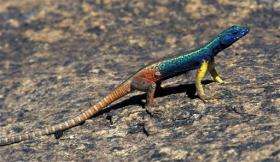
March 3, 2009 An adult male Augrabies Flat Lizard

Enlarge

Young male lizards in South Africa imitate females to fool aggressive older males into leaving them alone, in an example of transvestism in the natural world, according to South African and Australian reaseachers. They found that young male Augrabies flat lizards (pictured) delayed displaying the extravagent coloration of sexually-mature males until they were able to defend themselves adequately.

Young male lizards in South Africa imitate females to fool aggressive older males into leaving them alone, in an example of transvestism in the natural world, researchers have found.

The lizards not only avoid fights but gain access to females under the nose of their more macho rivals, the South African and Australian researchers discovered.

They found that young male Augrabies flat lizards delayed displaying the extravagant coloration of sexually-mature males until they were able to defend themselves adequately.

"Experienced males will chase and bite their young rivals," said associate professor Martin Whiting of Johannesburg's University of the Witwatersrand.

"By delaying the onset of colour to a more convenient period, these males, termed she-males, are making the best of a bad situation."

Australian National University associate professor Scott Keogh said opting to become transvestites for a period offered young males a dual advantage.

"They can avoid potentially dangerous bouts with dominant males and still have access to normally inaccessible females," he said.

But, as with large hands and an Adam's apple in the human world, there is a flaw in the lizards' transvestite transformation.

Dominant males can detect transvestite's male hormones with their sensitive tongues, even if they are taken in by their female appearance.

University of Sydney researcher Jonathan Webb said this meant the she-males needed to be nimble to avoid advances from dominant males smitten by their fake female allure.

"Males are fooled by looks, but not by scent," he said.

"She-males are able to maintain this deception by staying one step ahead of a prying male, and thereby avoiding a nosey tongue that might give the game away."

The research was published in the journal Proceedings of the Royal Society.

(c) 2009 AFP


print this article email this article download pdf blog this article bookmark this article     Stumble it Digg this share on Facebook retweet share on Reddit add to delicious
Rate this story - not rated yet


March 3, 2009 all stories

Comments: 0

not rated yet
  • Stumble this up

  • Digg this

  • share this

  • hide
  • Related Stories


  • hide
  • Relevant PhysicsForums posts

  • Cornea and Sclera
    created 2 hours ago
  • This is a long shot...
    created 15 hours ago
  • How do I get an A in Bio AP if I know nothing about Biology?
    created 18 hours ago
  • Mutation
    created 22 hours ago
  • More from Physics Forums - Biology

Other News

Gov't says brown pelicans are endangered no longer (AP)

Gov't says brown pelicans are endangered no longer

Biology / Ecology

created 46 minutes ago | popularity not rated yet | comments 0

(AP) -- Much like its death-defying dives for fish, the brown pelican has resurfaced after plummeting to the brink of extinction.


Antarctic lake

Antarctic lake home to diverse community of viruses

Biology / Cell & Microbiology

created 6 hours ago | popularity 5 / 5 (5) | comments 0

(PhysOrg.com) -- A study of the genetic structure of viruses in an Antarctic lake has revealed an astonishing genetic richness in the large number of viral families discovered.


Can a plant be altruistic?

Biology / Plants & Animals

created 6 hours ago | popularity 5 / 5 (1) | comments 0

The concept of altruism has long been debated in philosophical circles, and more recently, evolutionary biologists have joined the debate. From the perspective of natural selection, altruism may have evolved because any ...


Cornell releases predator beetle to battle hemlock pest

Cornell releases predator beetle to battle hemlock pest

Biology / Ecology

created 7 hours ago | popularity 5 / 5 (1) | comments 0

(PhysOrg.com) -- Cornell researchers released a well-studied beetle predator to test its ability to ward off a hemlock-killing aphid-like insect.


Africa's rarest monkey had an intriguing sexual past, DNA study confirms

Africa's rarest monkey had an intriguing sexual past, DNA study confirms

Biology / Plants & Animals

created 4 hours ago | popularity not rated yet | comments 0

The most extensive DNA study to-date of Africa's rarest monkey reveals that the species had an intriguing sexual past. Of the last two remaining populations of the recently discovered kipunji, one population ...