Eugene-Springfield face Upper Willamette climate threats
Effects of climate change projected this century for Oregon's Upper Willamette River Basin, including Eugene-Springfield, will threaten water supplies, buildings, transportation systems, human health, forests, and fish and wildlife, according to a report produced by the University of Oregon's Climate Leadership Initiative and the National Center for Conservation Science & Policy.
The authors say that extensive efforts should begin now to prepare for these threats.
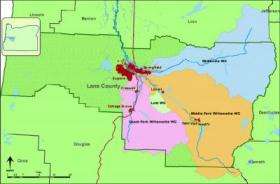
The 2.1 million-acre upper basin stretches from the headwaters of the McKenzie and Willamette rivers to where they join as one flowing north to the Columbia. The basin is home to $32 billion in taxable property, with 94 percent of it in Lane County's two side-by-side cities, which together make up the state's second-largest urban area. More than 33,000 acres of the 47,600 acres of taxable lots in the basin are located in floodplains, as are many buildings, roads and other infrastructure. Intense weather events, such as flooding, will put these properties at elevated risks for losses.
The heavily forested basin spans four major sub basins -- The McKenzie, Mohawk, Middle Fork Willamette and Coast Fork Willamette -- and borders the Coast Mountain Range to the west and the headwaters of the Cascade Mountains to the east. Other cities in the watershed are Oakridge, Cottage Grove, Westfir, Marcola, Lowell, Santa Clara and Creswell.
Consequences for human health from increases in ground-level ozone, according to the report, will be more allergens and degraded air quality, potentially raising rates of asthma and other respiratory problems. Increasing temperatures will mean more risk from insect-borne diseases such as West Nile from mosquitoes and Lyme disease from ticks, as well as the risk of increased heat stroke and cardiovascular problems, especially for people without access to air conditioning.
"Our research indicates that the effects of climate likely will place significant stresses on the natural, built, human and economic sectors in the Upper Willamette River Basin," said Bob Doppelt, director of the Climate Leadership Initiative. "If no action is taken to prepare for the likely stresses, damages could amount to millions of dollars in direct costs. The indirect costs, along with reduced quality-of-life, undoubtedly will be greater than this amount."
Among the report's recommendations are new approaches to cooperative public-private planning and decision-making, limited commercial or residential development into areas still dominated by forests and natural vegetation or into floodplains, and the establishment of cooling centers to reduce health consequences during extreme heat events for low income families, the elderly and infirmed.
"While Lane County farm and forest businesses will be affected by warming temperatures, the report identifies profitable strategies to cope with climate impacts such as increasing water use and energy efficiencies and developing distributed renewable energy technologies," said Roger Hamilton, UO CLI staff who co-managed the report. "Researching and planting vine, orchard, and tree species more suitable to the new climate conditions are opportunities to become more competitive over the coming decades."
"Preparing for Climate Change in the Upper Willamette River Basin of Western Oregon" is the second of four reports that, authors say, are the first such comprehensive scaling down of global models to specific river basins in the United States. The three models involved (Hadley, CSIRO and MIROC) are used by the Intergovernmental Panel on Climate Change, a scientific intergovernmental body established in 1988 by the World Meteorological Organization and United Nations Environment Programme.
The models agree that annual average temperatures in the Upper Willamette will rise 6-8 degrees Fahrenheit by 2080, storm events will increase in intensity and changed growing conditions will foster shifts in the distribution of trees in forests and crops in gardens, orchards and vineyards.
Although total annual precipitation is not likely to change significantly, slightly less of it is projected to fall in spring, summer and fall, and higher evaporation rates and water demand resulting from warmer temperatures could mean significantly less water will be available. Snowpack across the region and entire Northwest is projected to suffer a 60 percent decline by 2040 and 90 percent by 2095.
For the Upper Willamette basin, only one model predicts an increase in acres burned by wildfires, although all models project more extreme fire in certain locations.
The projections are expected to have far-reaching impacts on stream flows, including both the Willamette and McKenzie rivers. Among these are changes to species habitats and the potential threats to both public water supplies for Eugene-Springfield and the levels of water required for generating electricity to meet rising demand in warmer temperatures.
Cold-water fish such as Chinook salmon, steelhead and Oregon chub could give way to more warm-water species, the report notes. Likewise, wildlife species that depend on old-growth forests in high elevations will be at risk.
"Increased winter storm intensity, prolonged and diminished flows in the summer, increased temperature, and poorer water quality are likely to be the most significant climate change risks to rivers and streams and the people, fish, amphibians and other species that rely on them," said Cindy Deacon Williams, senior fellow with the National Center for Conservation Science and Policy who co-managed the report. "This report identifies several critical actions to restore the landscape so the land itself can help us both resist damage from the changes coming our way and recover from the flood, drought, and fire damage that we can't avoid."
The assessment found that the economy of the Upper Willamette River Basin, whether manufacturing, services, agriculture, forestry or tourism, is highly dependent on stored water for hydroelectricity, irrigation and municipal water supply. With warmer temperatures and greater chance of more extended dry periods predicted by the climate models, ample supplies of hydroelectricity and water may become increasingly less stable. In addition, road, air and rail transportation are likely to face disruptions due to increased storm events, flooding and wildfires.
Forthcoming reports will cover Oregon's Klamath and Umatilla river basins. These regional reports are the result of work of the UO's Climate Leadership Initiative and the National Center for Conservation Science & Policy in partnership with the U.S. Forest Service Pacific Northwest Research Station through its Mapped Atmosphere-Plant-Soil System (MAPSS) Team. The reports incorporate findings and recommendations of separate panels of scientists, land managers, government personnel and policy experts.
Source: University of Oregon


